By Fabrizio Bandini
Perugia 1416 is a historical reenactment that began in 2016 on the occasion of the 600th anniversary of the Battle of Sant’Egidio, which saw the army of Braccio Fortebraccio, a Perugian condottiere, face off against that of Carlo I Malatesta, lord of Rimini.
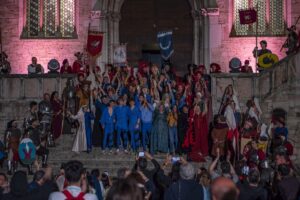
The exiled Perugian nobles, the so-called Beccherini, fought with Braccio, while the Perugians of the opposing party, the Raspanti, that is, the nobles and members of the “grasso popolo” (the wealthy people), the rising bourgeois class, fought with Malatesta.
Having won the battle, Braccio Fortebraccio obtained the keys to the city and the government of Perugia, thus beginning his rule and putting an end to the bloody infighting between the two factions.
Braccio’s rule also symbolically marks Perugia’s transition from the Middle Ages to the Renaissance.
The reenactment event, which takes place in June, involves the city’s five districts: Porta Santa Susanna, Porta Sant’Angelo, Porta Sole, Porta Eburnea, Porta San Pietro, and the Compagnia del Grifoncello.
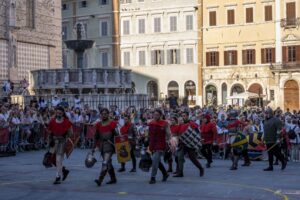
The competition between the districts is expressed through three athletic contests: archery, tug of war, and the cloth race, to which a theatrical challenge has also been added this year.
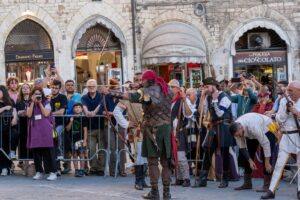
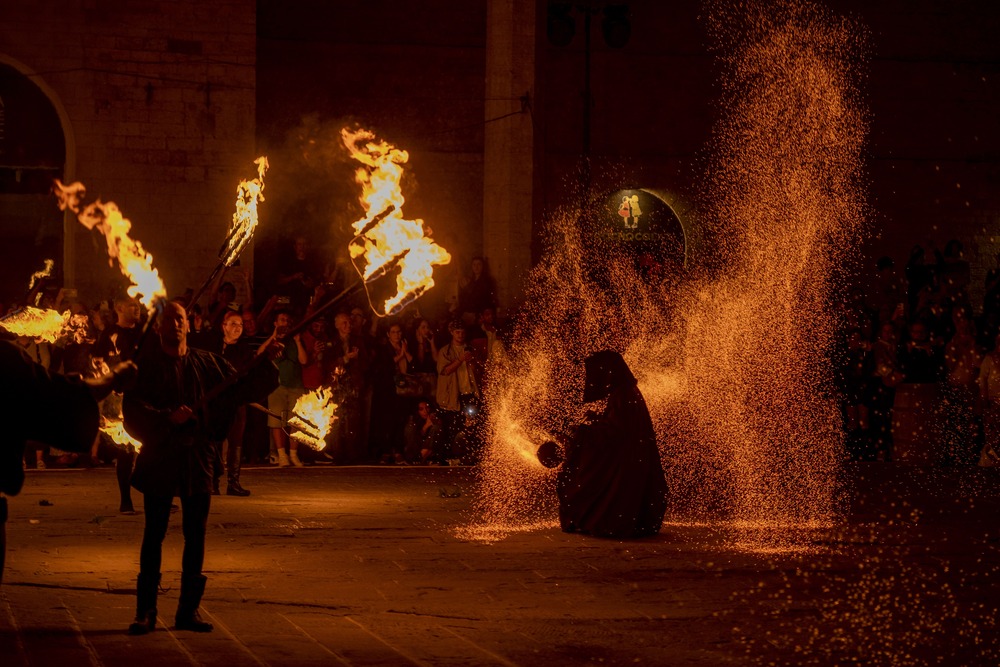
Other spectacular moments of Perugia 1416 are the entry into the city of Braccio Fortebraccio, the great historical procession of the districts – which sees hundreds of participants parade in 15th-century clothes – and the historical re-enactment of the Sassaiola, presented again this year by the Compagnia del Grifoncello for the 600th anniversary of the historic proclamation.
In these years of the reenactment, the Palio has been won 4 times by Porta Santa Susanna, 2 times by Porta Sole, and 1 time each by Porta Sant’Angelo, Porta Eburnea, and Porta San Pietro.
In 2020 and 2021, the Palio was not held due to the Covid epidemic, and was donated to the city of Perugia the first year and to businesses the second year.
This year, Porta Santa Susanna won its fourth Palio, also triumphing in the Children’s Palio, which took place for the first time.
The 2026 edition also saw a large turnout, with the public crowding Piazza IV Novembre (the Piazza Grande of medieval chronicles) both on the evening of the theatrical challenges and during the subsequent events, reaching its climax on the evening of Braccio’s entry, the historical procession, and the cloth race.
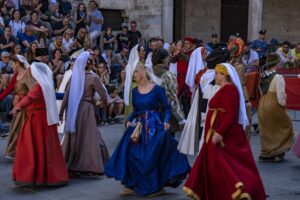
This great success of the reenactment, in terms of audience and interest, brings great joy to all of us – the writer is also Prior of Porta Santa Susanna – and gives us hope for the continuation of the Palio di Perugia, to which hundreds of volunteers from the various districts and the Compagnia del Grifoncello dedicate themselves throughout the year.
In the past, Perugia had various challenges, races, horse races, and jousting tournaments.
In the city’s memory, in addition to the Sassaiola, there was also a Giostra dell’anello, eagerly awaited by the people of Perugia, which consisted of spearing a silver ring suspended by a thread while galloping.
The city then, having lost its independence and been incorporated into the Papal States, saw its games progressively abolished and remained without a city challenge for a long time.
While the cities – large and small – of central Italy have jealously preserved their games or re-established them during the twentieth century as historical reenactments, Perugia has sadly remained without them.
It suffices to mention the Palio di Siena, the Calcio Fiorentino, the Saracino di Arezzo, the Quintana di Foligno, and the Calendimaggio di Assisi to get an idea.
It was therefore a serious anomaly that a city like ours, rich in its historical past, did not have a historical reenactment worthy of the name.
Fortunately, Perugia 1416 has come to heal this wound.
Info: www.perugia1416.com / fabriziobandini71@gmail.com