By Simone Bandini
Located along the Apennine watershed between Umbria and Marche, in the Municipality of Foligno, the Colfiorito Plateau is a place apart, intimately magical and unique. Like all lands in the ‘middle’,’ it preserves a powerful, suspended message, which is keenly felt but difficult to fully reveal; thus, it prepares us for encounters with other lands and ancient customs. From the Colfiorito Park, with its great naturalistic value, to agricultural and folk traditions, we speak of this land through the eyes, experience, and sensitivity of those who live and inhabit it: Alfiero Pepponi, an expert ornithologist – Regional Coordinator of Lipu Umbria – and Stefano Morini, President of the local Proloco, who organizes the Sagra della Patata Rossa (Red Potato Festival) in August (August 14-23, 2026), which, as many will already know, finds its greatest expression in these mountainous terrains.
We first meet Alfiero Pepponi, a passionate devotee of this land.
What is your relationship with the Plateau?
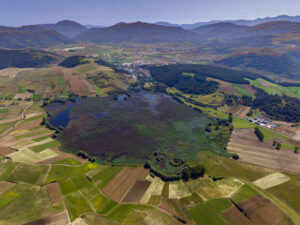
“I want to talk to you about that part of Umbria that reveals itself so much by better hiding. Many believe they know it, but only ‘from a postcard’; few know how to penetrate the secrets of the soul of a community that is as extroverted as it is elusive, brilliant, and rigorous – a nature that appears untouched but has instead been shaped over centuries with elegant and proud passion precisely by its inhabitants. The importance of this marshy area – which seems excluded from the world with its seemingly still waters – is truly central; these lands, through the passionate work of generations upon generations, have become a great paradise of beauty and welcome, for those who know how to understand and therefore love them. A desire for beauty that has become tangible and presents itself to the admiration of the world, with a great proudness from its children. But how can we blame them, it is all deserved!”
We spoke of the Plateau as a land in the middle and of ‘passage.’ Is this also true for the world of birds and seasonal migrations?
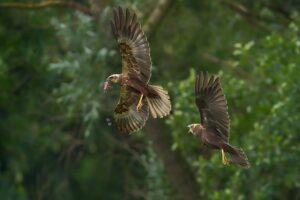
“The open environments, the woods, the scrublands, and especially the presence of an extensive marsh, allow for a rich ornithological fauna. The latter environment hosts rare and threatened species during reproduction, such as the Purple Heron, Squacco Heron, Little Bittern, Montagu’s Harrier, Skylark, Bearded Reedling, Eurasian Reed Warbler, Great Reed Warbler, and Ortolan Bunting. For most of the year, however, observable species include Mallard, Coot, Common Moorhen, Great Crested Grebe, Great White Egret, Grey Heron, Penduline Tit, Marsh Harrier, Common Buzzard, and Common Kestrel. The plateaus, with their complex agro ecosystem, also host important bird species during migrations, especially waders and passerines that can be observed in spring or autumn.”
You mentioned the Bearded Reedling; we’ve become curious! We’d like to know more…
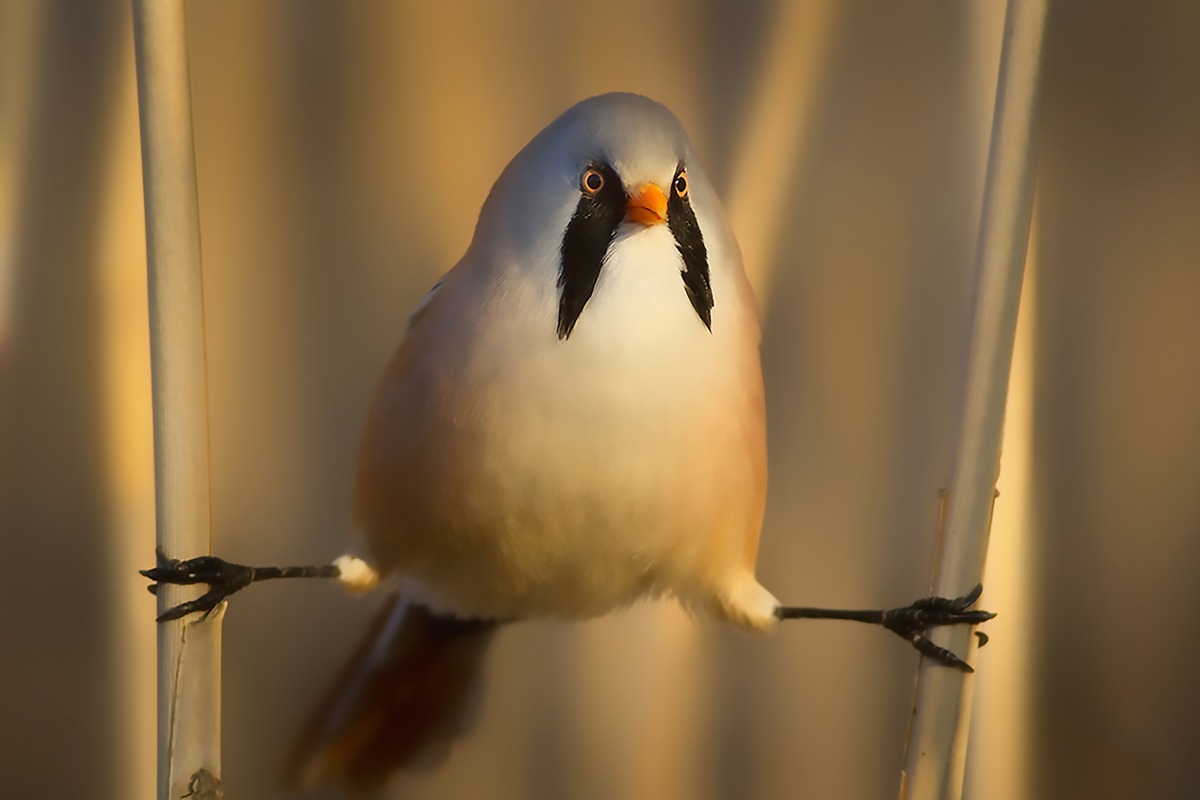
“The Bearded Reedling is decreasing alarmingly. This species, present in Europe, Asia, and Africa, finds a home in Italy in the reeds of our wetlands, where it migrates, winters, and nests. Today, however, many of these environments are silent: the Bearded Reedling has almost disappeared from our peninsula, surviving locally only in the last wetlands of the upper Adriatic coast, in the central-eastern Po Valley, and in Puglia – with a small population that persists in Colfiorito. The beautiful Bearded Reedling is so rare and elusive that when it appears, it completely captivates me, and I lose myself in observing it. The adult male has a gray-blue head and two prominent black ‘whiskers,’ which the female lacks. Measuring 16 centimeters, with a tail of 8 centimetres, the adult individual weighs around 14 grams. For the population of the Colfiorito Marsh, reproduction begins at the end of February and concludes in August. In the period preceding egg-laying, males perform aerial evolutions as a courtship ritual, culminating in mating, which generally occurs in the dense reed bed.”
What are the reference structures of the Colfiorito Park for visitors, and what advice would you give to those who wish to visit it?
“The reference structure of the Colfiorito Regional Park is certainly the ‘InfoPoint – Museo Naturalistico’ (Park House – Naturalistic Museum), a starting point for all visitors to the area – complemented by the ‘MAC / Museo Archeologico di Colfiorito’ (Archaeological Museum of Colfiorito), which houses artifacts from the Umbrian people called Plestini and the ancient Roman city of Plestia (to be seen are the remains of the ancient pavement, the Roman domus, and the urban layout, the Church of Santa Maria di Pistia, in Romanesque style, built directly over the remains of a large Roman public building, and the Archaeological Museum of Colfiorito, which holds 1450 artifacts, including funerary trousseaus, bracelets, and statues that tell the story of daily life of the time, editor’s note). There are numerous naturalistic trails that wind through the area, allowing for excursions throughout the region, and observation hides for birdwatching and nature photography; also noteworthy is the camper stop area. Spring is the best time for birdwatching, with hundreds of migratory birds stopping or nesting in the area. Nature awakens with beautiful blooms, among which wild orchids stand out. In summer, you can continue to enjoy the vegetation, and it is the ideal time for excursions and for birdwatching and nature photography. Autumn is a magical time for colours and for savouring local products. In winter, you can enjoy new views and perspectives of the marsh with the scenic sight of snow-capped mountains.”
Lastly. What conservation and protection projects are underway, and what are you currently engaged in?
“There are currently two projects underway in the Colfiorito Marsh area: the first has been carried out since the mid-1980s by the Observatory of Biodiversity – Lipu Ornithological Station, coordinated by ISPRA (Higher Institute for Environmental Protection and Research) through the ‘MonITRing’ project, with the aim of studying bird behaviour, ecology, and movements to better understand climate change and the impact of human activities on biodiversity.” Authorized operators using fine nets called ‘mist-nets’ or ‘fog nets,’ set up at dawn, capture birds without harming them; each bird is then extracted, placed in a cotton bag to avoid stress, and brought to the study table where, before being released, various operations are performed: identification, biometrics, assessment of general health conditions, and marking: an aluminium ring will allow, at a later stage, to determine the distance travelled, which migratory routes are used, and how the population changes over the years.
The second project is funded by the Rural Development Programme (PSR) and involves the Comunanza Agraria of Colfiorito, the Department of Botany at the University of Perugia, and Lipu for the restoration of wetlands in the marginal area of the Colfiorito Marsh. It includes managing water levels and controlling the development of unwanted shrubs; in practice, drainage channels are regulated to keep the soil saturated, and late mowing (at the end of summer) is used to prevent the area from transforming due to the invasive settlement of reeds and alien shrubs.”
The Colfiorito Regional Park
A true treasure trove of biodiversity where an ancient harmony between agricultural activities and the natural environment reveals a territory characterized by wide plateaus and gentle undulations, alternating between wetlands, woods, pastures, and cultivated fields.
The Piani di Colfiorito (or Plestini Plateaus) are made up of seven karst basins, which in ancient times were occupied by lakes that naturally dried up or were reclaimed by humans.
The Colfiorito Marsh is currently the only area of the plateaus where water remains year-round, serving as a focal point for a large number of birds, which build their nests, reproduce, and feed among the reeds. For this reason, in 1995, the Umbria Region decided to protect it by establishing a Regional Park. It is also included in the Ramsar Convention, which highlights its international importance for its natural aspects. Furthermore, it is designated as a Special Conservation Area (ZSC) and a Special Protection Area (ZPS) by the European Community due to the conservation importance of the bird community present. In addition to the Marsh, the Park encompasses Mount Orve and a stretch of the Colfiorito plateau.
Not least, today, the plateau hosts a vibrant community that guards an agricultural tradition lost in the mists of time. There is no better chance to get to know this territory and its people than the Sagra della Patata Rossa, scheduled from August 14 to 23, 2026. The cultivation of the Colfiorito Red Potato IGP in the Umbrian-Marche Apennine plateaus dates back to the late 18th century when it was introduced, it is believed, by imperial troops – and later by French occupiers during the Napoleonic period. Originally from the Netherlands, this variety found its ideal habitat in the unique microclimate of Colfiorito.
We talked with the President of the Pro Loco of Colfiorito, Stefano Morini.
This year the event has reached its 47th edition, if I’m not mistaken, almost 50 springs. Can it be said that for the local community it represents the main identity event?
“Yes, the Festival was born on October 22, 1978, on the spontaneous initiative of young people from the plateau led by the then parish priest of Colfiorito, Monsignor Mario Sensi, and thanks to the collaboration of the Municipality of Foligno. It only stopped for Covid for two years (2020 and 2021) and is one of the longest-running events in our Region. For our community, it has been very important, especially in the early years, to make our territory known and subsequently, commercial and entrepreneurial initiatives were born. Today we have companies known throughout Italy, so we contributed to the decisive push: the increase in production, then commercialization, and the development of our territory.”
The Colfiorito Red Potato IGP is well-known in Italy, and its history is now centuries old. What value does it have today for the local economy?
“The Red Potato, since its introduction to our plateau, has brought economic and agricultural development, but we can say that its fame has grown thanks to the participation of the inhabitants of all the villages on the plateau; traditional recipes have emerged that still manage to attract thousands of visitors. And we can undoubtedly state that, even though many now grow red potatoes in many areas of Italy, the Colfiorito red potato is in progressive growth.”
What are the most suitable areas of the plateau for its cultivation? Have climate change and the rise in average annual temperature brought benefits or drawbacks to its production?
“The Red Potato does not have a precise cultivation area on the plateau; it is very versatile. In fact, the Desiree potato is a late-ripening product and can be cultivated not only in mountainous areas like Colfiorito but also in plains, near sloples, or close to the Colfiorito Marsh. Climate change has not yet seemed to compromise its cultivation; problems can only arise in seasons that are too dry and without thunderstorms – and it is in these cases that growers must resort to irrigation, in full compliance with legal requirements, so much so that today the procedures are almost comparable to organic practices. The red potato can be sown from March 15 to May 15, and the harvest usually takes place in October. For consumption and the preparation of traditional dishes, some producers opt for early sowing in March to have the harvest in August.”
How is the Festival organized, and what will be the main points of interest?
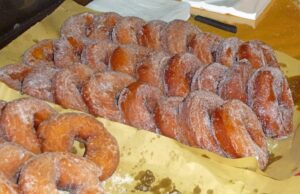
“The Red Potato Festival is centred on good food and the use of local products; the gnocchi and red potato donuts, which are our pride and joy, are prepared with traditional recipes passed down by the women of our hamlets. It takes place daily from 5:00 PM to 1:00 AM, and on the two Sundays and August 15th, there will also be the traditional Ferragosto lunch. On the same day, the XXV edition of the ‘Trofeo Sagra della Patata Rossa’ (Red Potato Festival Trophy) for the beginners’ cycling category will be held; it is a race in which competitors from many Italian regions will participate. On August 19, in the afternoon, we will have the ‘3rd Permanent Conference on the Mountains,’ dedicated this year, in a time of exceptional energy crisis due to military activity, to renewable energies and their possible applications in the Umbrian-Marche territory. On August 20, a conference will be held focusing on our territory and the presentation of a book on toponymy, a project developed over three years by the Colfiorito school with the support of the ProLoco; an exhibition hall will be open daily, hosting conferences, art exhibitions, photography, and artisan products.
Throughout the event, the Plestia market will be open, offering various products, vintage items, and handicrafts.”
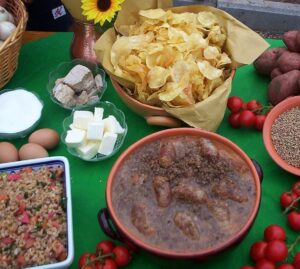
The Colfiorito red potato is renowned for its firm texture, making it excellent in the kitchen for preparing gnocchi, purées, baked, or fried dishes. What is your favourite dish? And what can we taste in town?
“My favourite dish is gnocchi with wether sauce; this is a very common dish in the area, almost all restaurants have it on their menu. It is a flavourful and characteristic dish that highlights the red potato, with its taste and texture. During the festival, you can taste the red potato donuts, a dessert first presented in 1978 that distinguishes us from many other festivals; it is a fried donut made with red potatoes that has become our specialty, highly sought after by all participants in the event!”
Info generali: Ufficio Informazioni e Accoglienza Turistica (Iat) Valle Umbra / Porta Romana, Corso Cavour 126, 06034 Foligno (Pg) / Tel 0742 354459 – 354165 / email: servizio.turismo@comune.foligno.pg.it / www.comune.foligno.pg.it/turismo/ facebook e instagram: visit.foligno