By Catia Giorni
 From August 9th to 16th, the Umbrian hilltown once again dresses itself in flags and banners for one of the region’s most beloved historical reenactments. Behind the medieval pageants, the archery contest, and the election of the Castellana, lies the quiet work of hundreds of volunteers who, for over sixty years, have kept Montone’s memory alive.
In the lanes of Montone, in the days before the Palio, something unseen but unmistakable fills the air: anticipation. The flags of the three Rioni — Porta del Borgo, Porta del Monte, and Porta del Verziere — are raised over the squares, costumes come out of the wardrobes where they are kept all year, and in the neighbourhood clubs the final touches are put on the stage sets. It is the prelude to a week — this year running from August 9th to 16th — that has shaped the identity of this town, still encircled by its medieval walls, for more than six decades.
It all began in 1961, when the Pro Loco Montonese decided to give shape to an episode handed down through centuries of local tradition: the arrival in the town square of Count Carlo Fortebracci, bringing the people a Thorn from the Crown of Christ as a gift. In its early years, the event was tied almost exclusively to the exposition of the relic; over time, however, an increasingly elaborate historical procession grew up around that religious core, and the three Rioni began parading with their own banners and noble couples. The town took on the colours of its districts, and the sense of belonging to one of the three gates that have divided the historic centre since the Middle Ages grew stronger year after year — a belonging that, even today, is measured in the hours of volunteer work each family devotes to its own Rione.
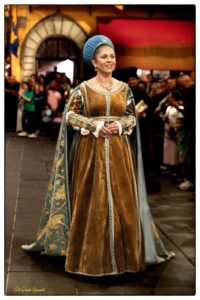
It was in the early 1970s that rivalry between the Rioni found a competitive outlet: the Palio was born, awarded through an archery contest among Montone’s archers on the day of the procession. Over the years the contest grew richer with popular games and challenges, designed more for conviviality than historical accuracy, and the sum of each week’s scores allowed every Rione to elect its own Castellana — the lady chosen to represent Margherita Malatesta of Rimini, wife of Carlo Fortebracci, who legend says governed the town in his absence.
Among the week’s most evocative moments, ever since the early 1980s, is the Friday-night medieval pageants: the Menestrelli troupe makes its way through the three Rioni to pay homage, with medieval songs and music, to the candidates for Castellana. Torches lighting the faces of the ladies, melodies drifting through the streets of the old town — it is a spectacle that has captivated visitors for decades, and one that takes weeks of musical and theatrical preparation, once again entrusted to the Rioni’s volunteers.
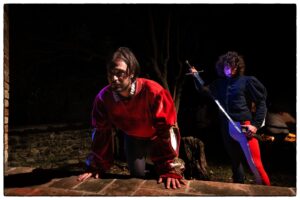
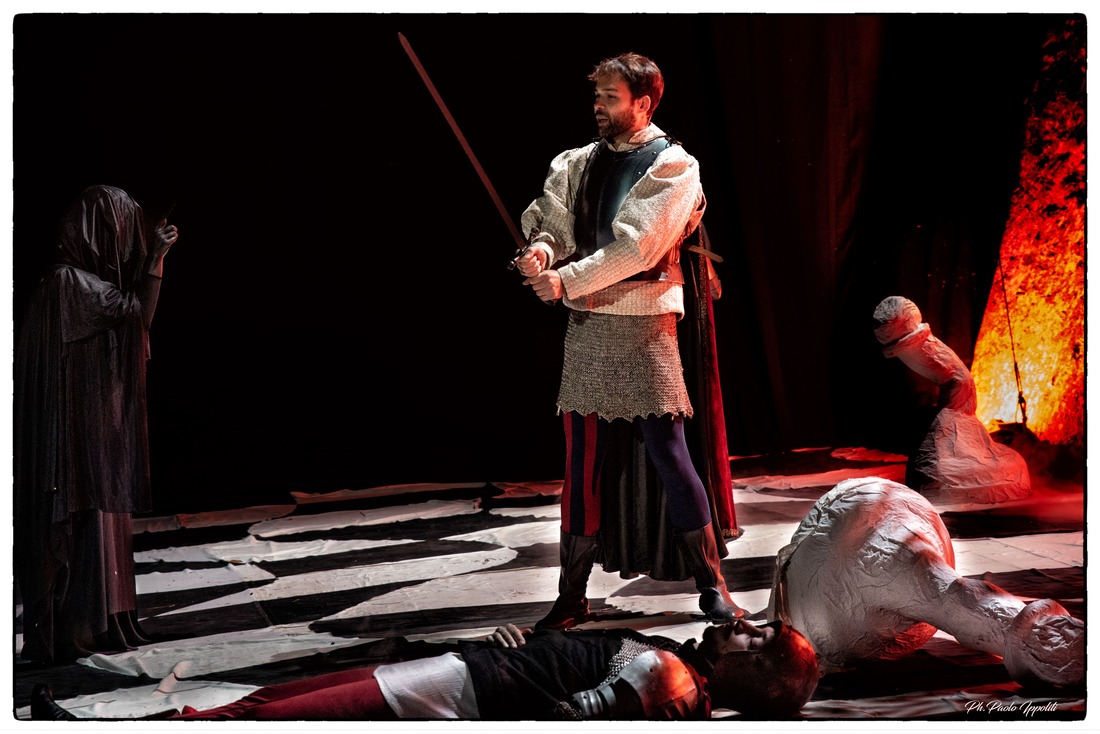
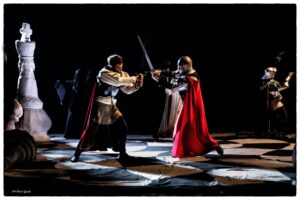
The Rioni’s medieval pageants have grown ever more elaborate over the years, ranging from scenes of everyday fifteenth-century life to episodes from the career of the condottiero Braccio Fortebracci. Since 1994, these pageants, together with the Bandi di Sfida (challenge proclamations), have been judged by a panel of experts who assess historical accuracy, staging, and performance: the Bando di Sfida is worth 15, 10, and 5 points for the top three Rioni, the archery contest 6, 4, and 2, and the medieval pageants 18, 12, and 6. It is a formula that keeps the tension high right up to Saturday night, when the opening of the judges’ sealed envelopes declares the winning Rione.
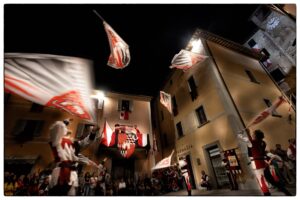
The week reaches its close on Sunday — this year, August 16th — with the historical procession of the Donation: the people of Montone, led by the newly elected Castellana, pay tribute to the return of Carlo Fortebracci and his gift of the Holy Thorn, in a procession that follows, tradition holds, the very same streets walked over five centuries ago.
Yet if the Donation of the Holy Thorn is today a reenactment known and admired well beyond Umbria’s borders, the credit is not due to its historical plot alone. It is the result of the work of those who, Rione by Rione, sew the costumes, build the stage sets, train the archers, rehearse the choreography, and run the logistics of an entire week of celebration — often starting months in advance, in evenings after a day’s work. Behind every flag raised in the square, behind every torch lit for the stornellata, is the commitment of volunteers who seek no spotlight, but who, year after year, allow a small community to keep alive a story far bigger than any one of them.