By Federico Minghi
At the Val d’Orcia Mill, the Grappi family has been guarding a circular and organic supply chain since 1992: a sensory journey that goes from the fields of Pienza to the table of the Locanda.
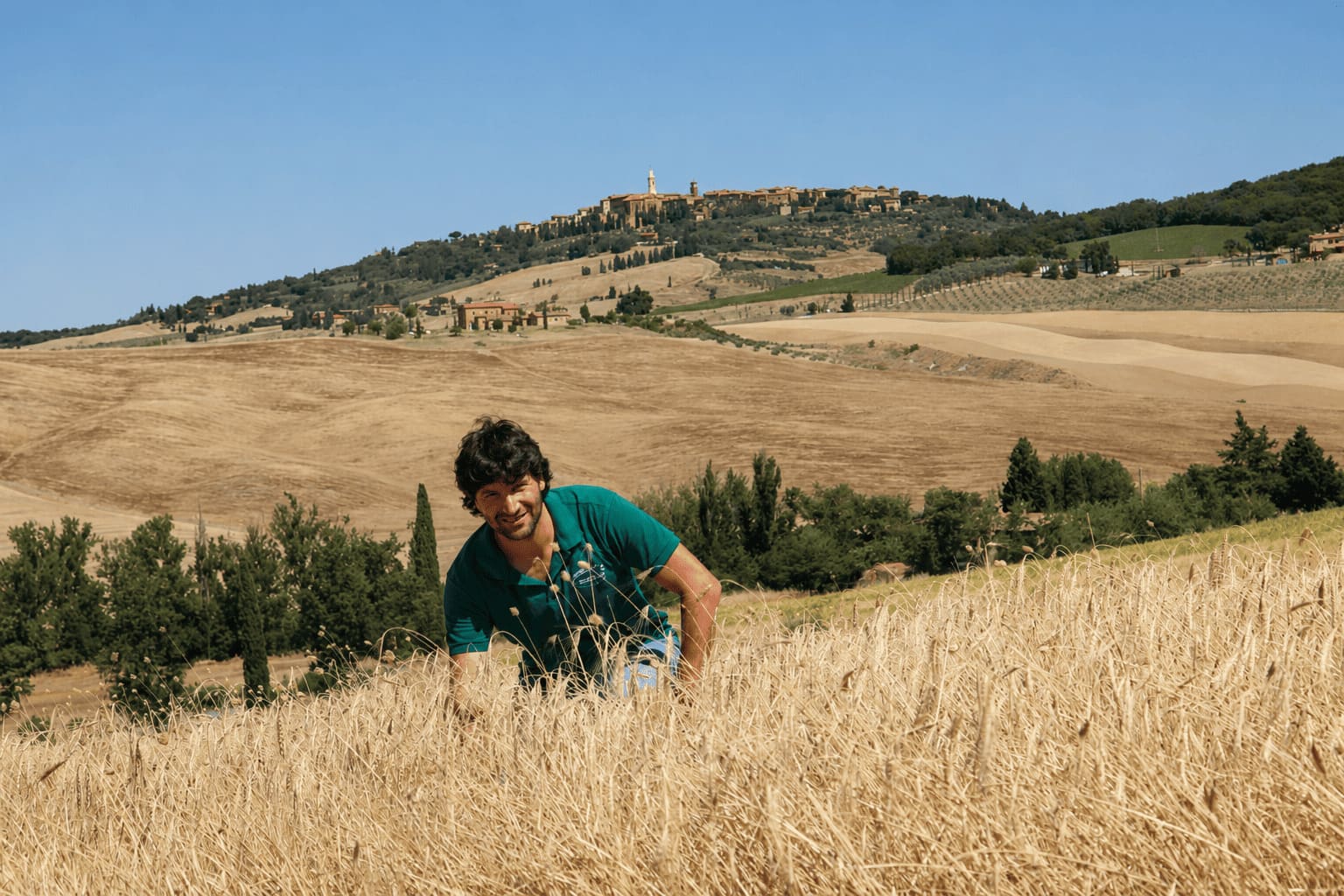
The Val d’Orcia is a design of rolling hills and immense skies, a miracle of harmony elected by UNESCO as a World Heritage Site because here, for centuries, nature and man’s work have dialogued in a perfect embrace. In this theater of land and wind, where the light caresses the wheat fields, transforming them into golden expanses, beauty is not just a panorama to be admired, but a cultural heritage to be protected. It is here, in the municipality of Pienza, that the land ceases to be a simple background to become the guardian of ancient knowledge and timeless flavors, linked to the slow rhythms of nature. Among these hills, the excellence of the Val d’Orcia Mill comes to life, where a family tradition spanning generations demonstrates how the future of agriculture lies in deep respect for one’s roots.
The secret of this extraordinary reality, which extends over more than 150 hectares cultivated organically since 1992, is contained in a philosophy as simple as it is revolutionary: “Before being master pasta makers and millers, we are farmers”. This is the real difference. The Grappi family controls every single breath of the ancient cereals supply chain: from rotational sowing with legumes to preserve the soil, to stone grinding, which keeps the precious wheat germ and its nutritional properties intact thanks to low processing speeds.
The result is a unique idea of pasta, like the one born from Senatore Cappelli Durum Wheat: amber, porous, bronze-drawn and slowly dried. A pasta with a tenacious but never stubborn structure, which does not look for a condiment that overpowers it, but a companion with which to compete, playfully, for the stage of the palate. A journey that is completed a few steps further, at the Locanda del Mulino, the restaurant with a very short supply chain where guests, before tasting the famous artisan pici of the pasta factory, are invited to visit the mill to see with their own eyes how the earth becomes poetry to be tasted.
Philosophy and the land: You Amedeo proudly repeat that ‘before being master pasta makers and millers, you are farmers’. How does this visceral and daily bond with the land reflect on the final quality of your pasta compared to those who simply transform a raw material purchased elsewhere? “We were born farmers and the land has remained inside you since you were a child. By directly following the entire cycle, carefully cultivating ancient grains with a low gluten content such as Senatore Cappelli or Monococco and legumes such as chickpeas and lentils, we control every single phase of the process to ensure an excellent, digestible and protein-rich final product.”
The pioneering choice of an organic farm: You embraced the organic method back in 1992, at a time when it was not a market trend. What prompted you, more than thirty years ago, to make such a clear choice of field? “My father made this choice thirty-five years ago following his ecological dream. In the midst of the boom of the ‘green revolution’, where chemistry dominated to exasperate production, we were a real exception; we preferred to preserve a pure cultivation, same to that of a hundred years ago.”
The secret of the stone and the germ: Technically, your stone grinding works at low speed so as not to overheat the flour. Can you explain what changes for the consumer when the bean is preserved entirely? “The stone does not overheat the grain and preserves its fibers, minerals and skin, giving the paste its unique color, flavor and aroma. Being a pure wholemeal, we keep the wheat cool below 16°C because in organic farming it is the only method to avoid the development of butterflies, without using any insecticide; a safety that only a healthy and strictly organic product can guarantee.”
A “different” idea of pasta: Speaking of your Senator Cappelli, you describe him as a “tenacious but not obstinate” structure. What is the ideal condiment at the Locanda to enhance it? «Our pasta already has its own intense and fragrant flavor given to it by the stone mill, so the absolute ideal is a drizzle of oil and Parmesan cheese. At the Locanda we celebrate it with the classic pici all’aglione or with white Cinta and Chianina sauces, condiments that accompany pasta without ever overpowering it.”
The Rite of the Inn: Your Locanda del Mulino offers a wonderful and true experience: you visit the mill and then have lunch next door. How do your guests react to seeing the entire cycle enclosed in a few meters? “Guests, especially foreigners, are literally ecstatic. While wine cellars are very pupular destinations of excellence, the universe of the artisan pasta factory is still a little-known world; Seeing flour born just a few meters from your table conveys an unforgettable charm.”
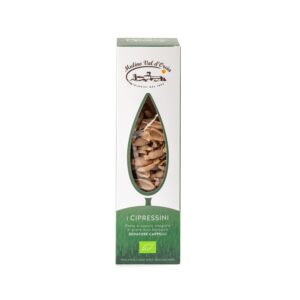
Tradition and future: In addition to the traditional and beloved pici, we know that “il Cipressino” was born, a new pasta shape. Can you tell us about this novelty and the openness to other small realities in the area? “The Cipressino is our new patented creation, a collective tribute born together with a young local engineer to celebrate the shape of the symbol of the Val d’Orcia. In addition, today the company also makes its organic supply chain available on behalf of third parties, helping small farmhouses in the area to transform their hectare of wheat into packages of flour or pasta under their own brand.”
Info: Località Spedaletto, Pienza (Si) / Tel. 0578 1965619 / 366 8155437 (ristorante) / www.mulinovaldorcia.it / info@mulinovaldorcia.it