By Simone Bandini
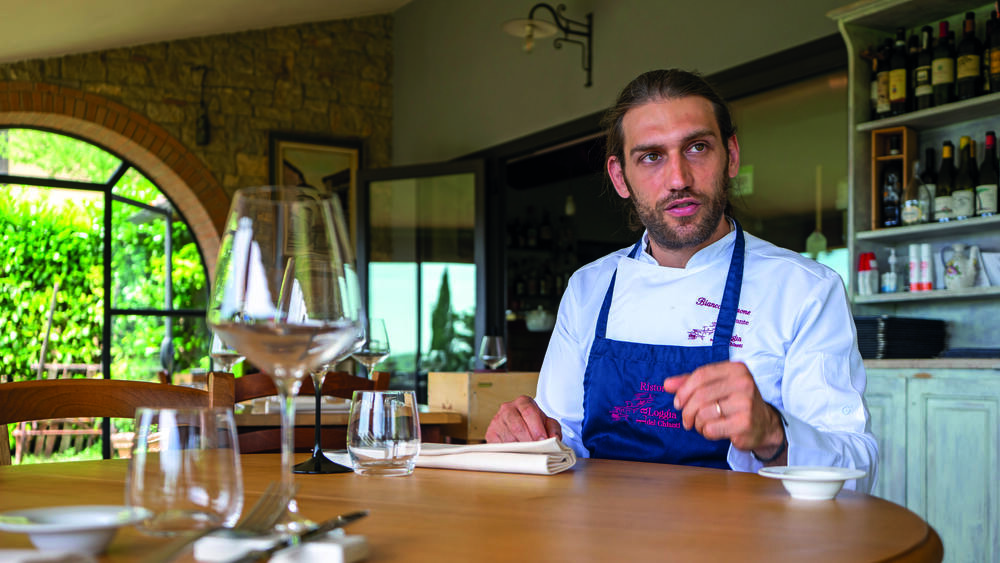
Cooking as reasoning, raw ingredients as the starting and ending point, the forest as a poetic and theoretical universe. The coherence between philosophy and the dish is total: nothing is left to chance, and precisely because of this, chance encounters—kefir butter born from an error—become the most beautiful discoveries. We are with Simone Bianco, chef at La Loggia nel Chianti, for our usual update: new directions, game, fish, and that logic of pairings that, more than creativity, guides his cooking.
Valley Life: Simone, every year we check in on your cooking. What are this year’s directions compared to previous years?
 Simone Bianco: It’s increasingly about the search for raw ingredients. Working with the single ingredient: that has always been my obsession. From there come the associations, the pairings, the combinations—but they are logical reasonings. Now I have wild boar: wild boar is found in the forest, so I use a mushroom as a side dish, in this case, a cardoncello. I found a local company that collects lichens for me; they are the last ones now because I’ll stop for the summer, and I serve them toasted in butter next to the dish. This way, I stage and present an overall and authentic forest experience on the plate.
Valley Life: So reasoning, logic, holds a very important place, in some ways superior to creativity itself.
Simone Bianco: There is reasoning, a philosophy first and foremost. Then there are also chance encounters, in cooking as in life. And those are the most beautiful ones, the ones you least expect. Like falling in love.
Valley Life: Tell me about a chance encounter.
Simone Bianco: A while ago, I made kefir butter. I had started with cream flavored with elderflower, I wanted to make whipped kefir for dessert. At a certain point, in the stand mixer, it wasn’t whipping and was going bad. I said, you know what… since I have a fatty component… I’ll ferment it to thicken it. So I made butter, I de-lactose it, and I got an acidic elderflower butter that came from the kefir. Spectacular.
Valley Life: This year, regarding seafood, what direction are you taking?
Simone Bianco: The total use of the fish, without doing the classic codified procedures like: I take the fish, I fillet it, I take the fillet. But integral: from the belly to the tail, to the fin, to the head. All different parts are used. If you ask me what the best part of the fish is, I’ll tell you the cheek, the fisherman’s bite; or the gill fin, toasted, for me it’s better than the fillet.
Valley Life: Parts that many would call secondary, but are instead precious.
 Simone Bianco: Exactly. Reductions and dressings are made; the bones, in the end, are used for a stock that integrates into the dish. We always try to use everything. And then the play between the fatty and lean parts begins.
Valley Life: What fish do you use?
Simone Bianco: For now, Mediterranean croakers. Soon I’ll be getting a yellow grouper from the southern Mediterranean, wild. I want to start working much more with wild fish, as I already do with game—a natural, sustainable philosophy. I try to use large fish, old animals, even just out of respect: the specimen has lived a long life. And then, if you look at reality, in intensive farming, old cows have no quality. Instead, an animal that has always lived in freedom, without stress, has totally different meat.
Valley Life: And freshwater? Trout, shrimp?
Simone Bianco: Trout, yes. Freshwater shrimp are no longer farmed in Tuscany; Luni has closed. I get trout from Casentino, from a farm taken over by young people who have restored the oldest Italian farm. They are also guardians of the stream: they monitor the waters.
Valley Life: How do you prepare your trout?
Simone Bianco: Until now, I did the classic fillet, in quotes – but I treated it like a sea fish, only searing the skin. Trout is beautiful but a double-edged sword: if you get the cooking wrong, like salmon, it quickly loses its fatty part. Now I do a marinade, a small aging, then I marinate it for six hours in beetroot to give it purplish hues, and I serve it as sashimi: Casentino goat cheese, trout sashimi, and we use the trout stock to bind the dish.
Valley Life: Wild boar in Tuscany is really overused, everywhere, all year round. Have you found your own version?
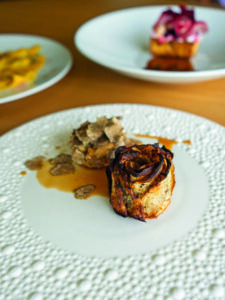
Simone Bianco: Yes. Now I have a warm wild boar terrine on the menu – in fact, selective hunting is open. I cook it classically, then I smoke it, which for me is one of the fundamental keys. Then I finish it in the wood-fired oven. Then I treat it like a mousse, I create a soft warm terrine, served with mushrooms. And I revisit the Tuscan ideology of strong flavors: a carob sauce, which tastes like chocolate but is lighter.
Valley Life: And venison?
Simone Bianco: Venison seared rare. Making a stew of game, for me, is foolish – you have a beautiful ingredient, you can cut it into various parts like pork. I spent years cutting the cuts myself, because no one had taught me. Now I do the sirloin and the fillet, hanging them for about a month: game needs to age.
Valley Life: Regarding the cooking of venison?
 Simone Bianco: It remains tender, I cook it like duck breast, like a beef fillet – a little less ‘bloody.’ Venison is very ferrous, so if you get the temperature wrong, you bring out the heavy ferrous note; if you play with the blood, with good aging, you just sear it. I deglaze it with a grappa my father makes, with forest herbs: it contrasts the sweetness of the meat.
Valley Life: What are you proposing for first courses?
Simone Bianco: We are now in the last week of a stuffed Reginella. I make a long raviolo, and inside I have braised osso buco, with its own stock on the outside. A fondue of 36-month-aged Parmesan, saffron grown in Chianti, and an onion oil to give it the missing freshness. From next week, however, we’ll move to a “primo sale” cheese with rabbit: summer, free-range animals, lighter, whiter meats. Then we’ll feature chicken, guinea fowl… and in a week or two, I’ll get quail, and things will change again.
Valley Life: Tell me about the guinea fowl dish.
Simone Bianco: The guinea fowl is from farmer Laura Peri. I chose to work with her because of her philosophy and because there’s no comparison in quality: free-range animals, raised as they were originally. They cost more—it’s true, because raising them like this is expensive – but the guinea fowl tastes like guinea fowl, it’s not overly tender, it’s a meat that holds its own.
Valley Life: And how is the dish constructed?
Simone Bianco: Breast stuffed with smoked potato – I revisit my smoking note, which gives depth at the end and leaves the sensation of roasted guinea fowl. Black truffle, because we find excellent quality here and it’s in season; we return to the forest philosophy. And celeriac, with the guinea fowl fat and truffle. I always reuse the element: I don’t use butter, I use the guinea fowl fat.
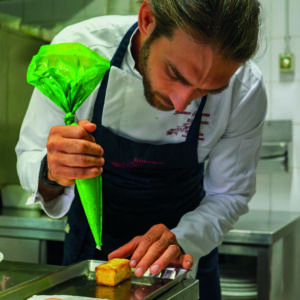
Valley Life: Can you show me something from the gardens?
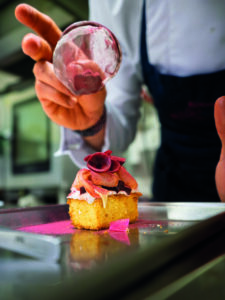
Simone Bianco: Here, this is a black cherry tomato from our gardens. It has an exceptional flavour, without the skin it brings out both sweetness and dryness. With two types of basil – Greek mignon and Vietnamese red – a salt from Normandy, which is sweeter, and basil oil. Then a 36-month-aged Parmesan foam, local truffle. And a toasted zucchini flower, not battered, with a buffalo ricotta cream underneath, tartare zucchini, and black basil.
And we’re only at the amuse-bouche!
Info: La Loggia del Chianti, Via degli Ulivi 1, Radda in Chianti (Si) / Tel. +39 0577 738491 / www.laloggiadelchianti.it / ristorantelaloggiadelchianti@gmail.com