By Susanna Salvadori
The exhibition features 15th-century panels by Bicci di Lorenzo and Cosimo Rosselli, and a 14th-century one by Niccolò di Pietro Gerini. These three Florentine artists were central to the evolution of art between the 14th and 15th centuries. They are finally accessible after many years in the storerooms of the Pinacoteca di Siena, the Superintendence, and the Archdiocese, at San Pietro d’Ovile. The works by Bicci di Lorenzo and Cosimo Rosselli, in particular, are seeing the light of day and returning to their region of origin after 25 years.
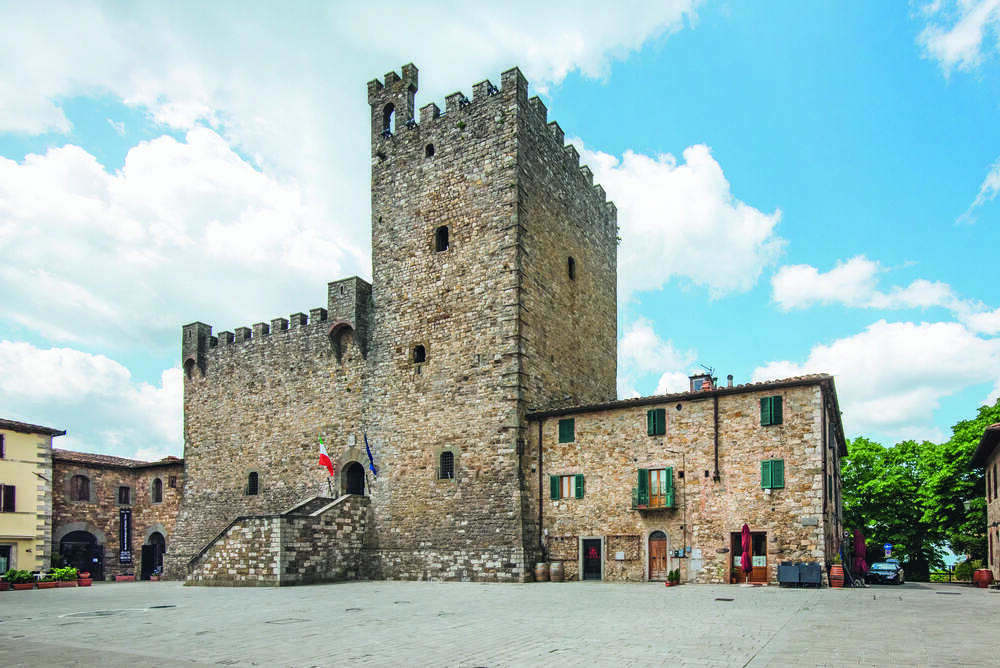
The paintings are the stars of the exhibition “Return to Chianti. 14th and 15th Century Paintings,” held in the ground-floor council hall of the 15th-century Rocca of Castellina, at the Archaeological Museum, starting July 31st.
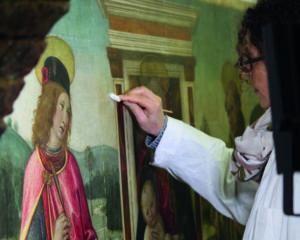
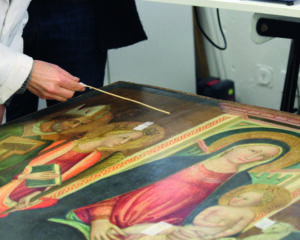
This is the major event of the Chianti summer. It brings to light works that were historically prominent in the churches and squares of Castellina, before finding their place in the storerooms of the Pinacoteca di Siena. After five months of restoration by restorer Monica Mancini, and study by art historians Nicoletta Matteuzzi, Lucia Bencistà, and Annarubina Cateni, these pieces can now be admired in a new light. The exhibition is curated by Nicoletta Matteuzzi, an art historian official from the Superintendence of Siena, and Marco Firmati, director of the Archaeological Museum of Chianti in Castellina. The organization of the exhibition was also made possible by precious donations from private patrons and companies through Art Bonus.
“We, like the entire Chianti area, have a cultural heritage that mirrors the historical, cultural, and artistic events that have shaped these places,” says the mayor of Castellina, Giuseppe Stiaccini. “The paintings on display have artistic value because they tell us about the evolution of Florentine and Chianti art between the 14th and 15th centuries. Furthermore, these paintings are being exhibited after 25 years. Doing culture also means supporting the relocation of artworks, working to ensure they can once again reflect the historical and cultural peculiarities of their origins, giving them museum dignity, and creating events and structures that can become attractions, reasons for visits, and catalysts for the valorization of the territories. Therefore, thanks to everyone who worked on the organization, to the municipal employees, to the Superintendence, to those who oversaw the restoration, to the scholars whose scientific work will be published in the catalog, to the management of the Archaeological Museum of Chianti, to the Dioceses that own the works, to the National Museums of Siena, and to the private funders who contributed through Art Bonus.”
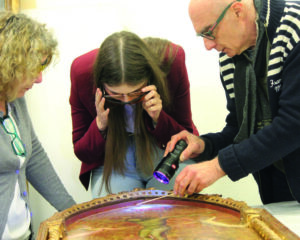
The Lyons Club Chianti and the Constantinian Order of Saint George contributed to the restoration of the works. The Art Bonus project supporting the exhibition is still active, having already received two contributions from local companies, with two more expected soon.
The exhibition is organized and promoted by the Municipality of Castellina in Chianti in collaboration with the Superintendence of Archaeology, Fine Arts, and Landscape for the provinces of Siena, Grosseto, and Arezzo. It is sponsored by the Tuscany Region and the Province of Siena, with the collaboration of the Fondazione Musei Senesi. It will open on July 31st and run until January 10th, 2027.
The Works
“The Madonna and Child with Saints Blaise, Catherine of Alexandria, Agnes, and Augustine,” by Bicci di Lorenzo, is a 15th-century tempera on panel. As an exponent of one of the main Florentine family workshops, Bicci exemplifies the artistic landscape of Florence between the 14th and 15th centuries. The work originally comes from Castellina in Chianti, where it was housed in the Pieve di Sant’Agnese, and is now owned by the Archdiocese of Siena Colle Montalcino.
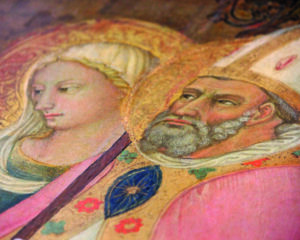
“The Madonna and Child with Saints George and Francis” is by Cosimo Rosselli. Dated between 1495-1500, it is a tempera on panel. Rosselli was a student of Neri di Bicci from May 1453 to October 1456, and later followed Alesso Baldovinetti. In 1459, he received his first significant commission for an altarpiece, now lost, for the Florentine church of Santa Trinita. It is hypothesized that he also worked with Benozzo Gozzoli, with whom he shared stylistic affinities. A highly receptive painter, he also drew inspiration from the works of Verrocchio, Antonio and Piero del Pollaiolo, and Alesso Baldovinetti. The artwork that will be featured in the exhibition comes from Castellina in Chianti, originally located in the Church of San Giorgio in Piazza, and is now owned by the Diocese of Florence.
“The Crucifixion with the Mourners and Saint Francis” is by Niccolò di Pietro Gerini, with an earlier dating, around 1390-1395. Gerini was a prolific follower of the late 14th-century revival of the Giotto school, in the tradition of Taddeo Gaddi and Orcagna. This is also a tempera on panel that was originally located in Gaiole in Chianti, in the Pieve di San Sigismondo. Today, it is owned by the Pinacoteca Nazionale di Siena.
Info: The exhibition will be open daily from 10 AM to 6 PM. All information is available on the website www.museoarcheologicochianti.it