By Our Editorial Staff
In the heart of Casentino, a place created to observe, understand and tell the story of the sky.
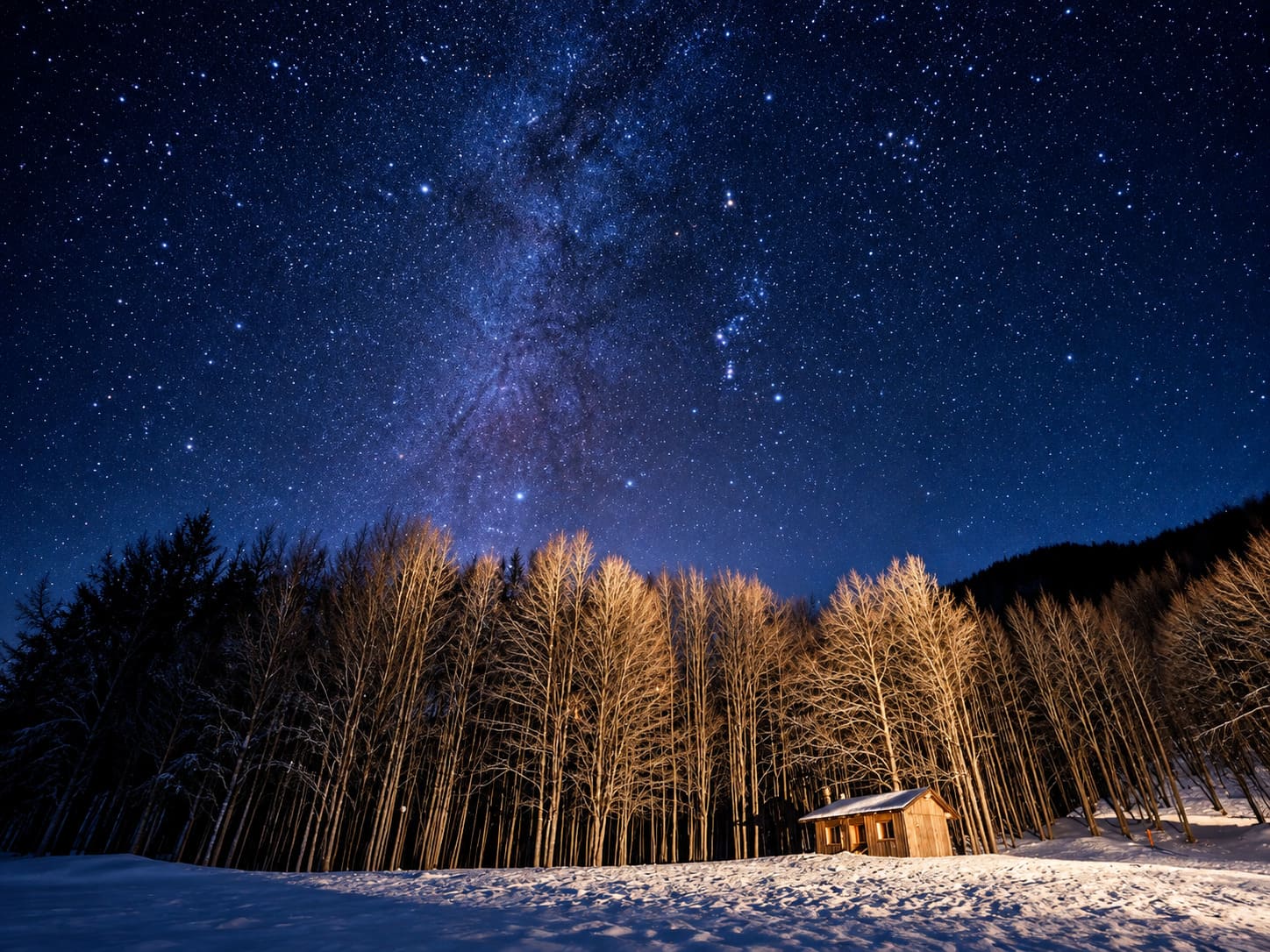
There are nights when Casentino seems to acquire another dimension. The dark outline of the mountains slowly disappears; the forest becomes a silent presence and above the trees there is nothing but sky. Here in Stia, on the edge of the National Park of the Casentino Forests, Monte Falterona and Campigna, astronomy has found an unexpected home: the Park Planetarium, a place devoted to education and observation, where space becomes something to understand as well as contemplate.
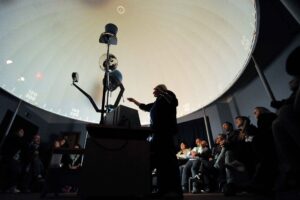
You do not have to be an astronomer. You simply enter, look upwards and allow yourself to be guided. Beneath the dome, the celestial vault is reconstructed: constellations, stars, the Moon, Sun and planets can be explored while simulating the passing of hours and seasons. A sky that seems motionless suddenly reveals its movements and rules..
At the heart of the experience is an instrument that also tells part of the story of astronomy education in Italy: the Galileo III planetarium, manufactured by Officine Galileo in Florence and donated by Florence’s former Institute and Museum of the History of Science. Beneath the dome it reproduces the northern sky and allows visitors to travel symbolically through space and time, seeing how the firmament changes with the seasons.
Yet in Stia the sky is not explored through projection alone. The Centre provides equipment for measurements and observations as well as audiovisual material, software, books and educational resources. During public events, the experience beneath the dome can continue outdoors with direct telescopic observation. On special occasions instruments are trained on the Sun, Moon, planets and some of the most fascinating objects in the night sky. Public evenings and Star Parties held throughout the Park turn theory into direct experience.
Even the outdoor square becomes a laboratory. The Sun Terrace features educational instruments used to determine the Sun’s height above the horizon, identify its passage across the meridian, understand the equinoxes and measure time through the movement of our star.
Inside, a camera-obscura sundial makes the connection between astronomy and everyday life even clearer. Sunlight enters through a tiny aperture and reaches a line inside the building precisely when the Sun crosses the local meridian. It is an ancient and remarkably simple principle, yet one that reveals something essential about astronomy: understanding the cosmos often begins by learning to read phenomena taking place before our eyes every single day.
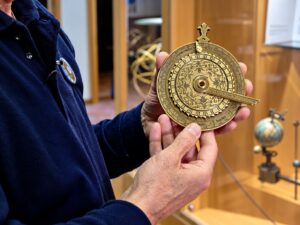
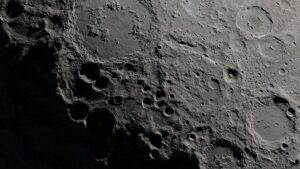
Modern equipment sits alongside armillary spheres, celestial globes, planispheres and historical scientific instruments. There is also a permanent exhibition devoted to rocks and meteorites, created with the Museum of Planetary Sciences in Prato. Its specimens include chondrites and impact rocks: fragments capable of reducing the immense distance of outer space to something that can be observed from only a few centimetres away.
Behind every observing evening lies something visitors see less of: preparation, knowledge and, above all, people. Educational activities are entrusted to trained and experienced amateur astronomers who adapt their language and subjects to children, students, enthusiasts and curious newcomers. Younger visitors begin with orientation and constellation mythology; later activities introduce the apparent motion of the celestial sphere, lunar phases, the measurement of time, calendars and the history of astronomy from Ptolemy to Galileo.
This commitment to sharing knowledge is what makes Stia special. It is not simply a matter of showing Saturn through a telescope or pointing out a constellation. It is about teaching people how to look. The two educational videos released by the Park follow exactly this idea, taking students on a virtual journey through what the sky above a National Park can tell us. Astronomy becomes a bridge linking science, landscape and the natural environment.
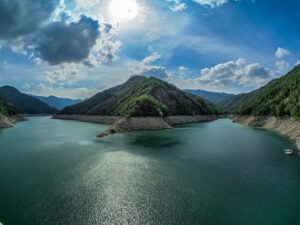
Then comes the simplest and perhaps most powerful moment. You step outside. The Planetarium’s activities frequently take visitors onto the trails, meadows and mountain ridges of the National Park. During astronomy walks, groups wait for sunset, watch the first stars appear and gradually learn how to recognise the patterns of the night sky. Previous events have included observations of Jupiter, Saturn, the Moon, comets, nebulae and distant galaxies, combining telescopes with naked-eye exploration of the firmament.
Here, landscape itself becomes part of the instrument. The forest is no longer simply somewhere to walk during daylight: at night it becomes the dark horizon against which the universe appears. During the Foreste Casentinesi Star Parties, amateur astronomers and visitors have gathered at locations such as Campigna, Fangacci and the Burraia meadows to rediscover the sky away from the brightly illuminated environment of urban life.
Perhaps the fascination of amateur astronomers lies in their passion for studying the sky, preparing their instruments and waiting for the perfect conditions to share the wonders of the universe. A pursuit driven by patience and curiosity, where every observation becomes a discovery. In Stia, among silent forests and starfilled skies, this passion finds its ideal setting: a place where the human gaze continues to seek answers in infinity.
Info: www.parcoforestecasentinesi.it