By Paola Butera
An interview with fashion artist Cinzia Verni, who transforms the fragility of matter into wearable sculptures.
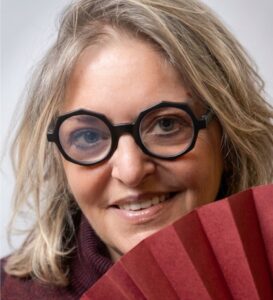
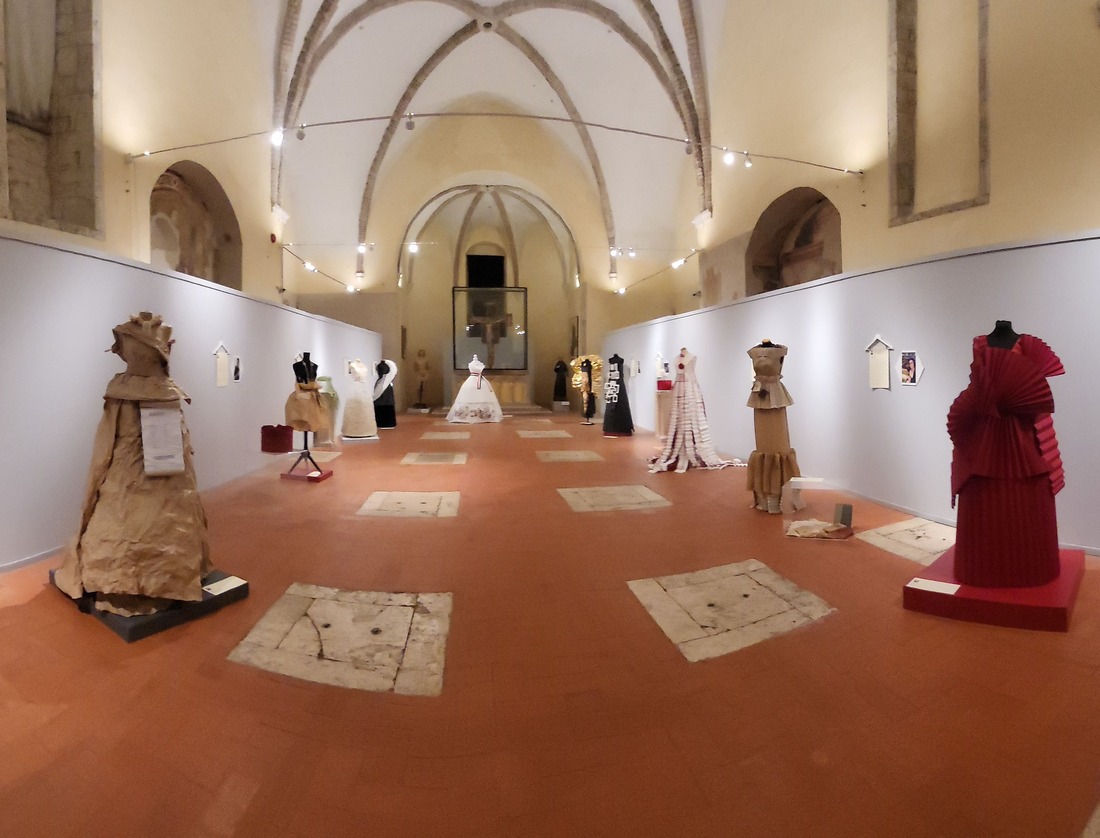
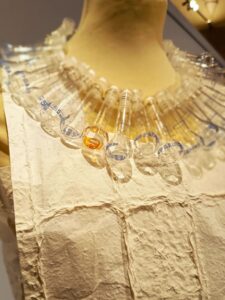
Cinzia Verni’s artistic journey is a captivating narrative that weaves together the elegance of Alta Moda with experimental research into paper as a medium. She took her first steps in the heart of fashion design, collaborating with Emma Bini, a designer for prestigious Italian icons such as Valentino (Oliver), Versace (Versus), Gianfranco Ferré (Oaks), and Fendissime. Her background is steeped in the rigor and aesthetics of the Great Masters. In 1998, Verni embarked on a personal quest, choosing paper and recycled materials as her primary expressive tools. She creates jewelry, installations, and, most notably, “sculpture-dresses” that have graced international stages, including the Venice Film Festival and the Lucca Biennale Cartasia. Her latest exhibition, “Donne da Raccontare” (Women to be Told), recently concluded in Corciano. There, Verni channeled decades of experience in design and artistic craftsmanship into a collective, profoundly human choral narrative. Her stylistic signature lies in her ability to “ennoble” paper, manipulating it through techniques ranging from weaving to material layering until it mirrors the texture of precious textiles. We begin our interview by asking her:
 Your recent exhibition in Corciano created a fascinating “short circuit” between the historical solidity of the medieval village and the delicacy of your works. How did the atmosphere and history of this place influence the staging and the perception of your garments?
Corciano is where I have lived for over thirty years; I’ve studied it deeply, and it is a village that exudes history. In my work, which has a contemporary and conceptual matrix, I sought to unite these two forces: the memory of the place and the abstraction of my creative mark. For this exhibition, I chose to represent twelve women, most of whom are tied to the territory and the village itself. They became symbols of a Corciano society built on deep roots. While the village represents history, I navigate the “geography” of concepts and symbols. Living alongside these people and local folklore, I wanted to project them into modernity, offering a vision of them that is almost futuristic. In this sense, paper is the perfect medium: it is fragile, yet it possesses an intrinsic strength that dialogues with the solid stone walls of Corciano.
Looking at your creations, one gets the impression that paper ceases to be paper and becomes silk, lace, or even armor. What is the creative process behind manipulating these textures? Is there a particular type of paper you are most drawn to?
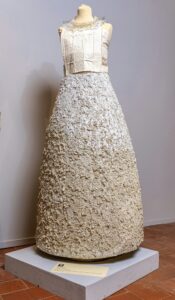
Paper is a fragile material that strengthens through manipulation and structural treatments. I favor Japanese papers or handmade varieties, which are the hallmarks of my production. However, my research never stops; inspiration can strike from a simple sheet of newspaper. My first works, for example, were made with the pages of Il Sole 24 Ore [Italy’s leading financial daily]. I was fascinated by the idea of the “New Economy”: the economy, like paper, exists in a precarious balance between strength and fragility. It is a material in equilibrium: think of the historical weight of ancient manuscripts versus paper that dissolves with a drop of water, returning to pulp. It is by playing with this pulp—modeling it layer upon layer—that I achieve a sculptural consistency for the dresses.
 Of all the types you use, is there one you prefer for the final result or ease of manipulation?
Handmade paper remains the most fascinating to me. It possesses a different kind of strength because it retains a link to its origin: cellulose pulp. The process—from fiber to beating, to the union with natural elements or binders—allows for the creation of stratified, moldable papers. These give me the most satisfaction: just a pinch of glue or a drop of honey is enough to bind the fibers and transform a sheet into pure, living matter.
A paper dress challenges the traditional concept of fashion’s utility. What do you wish to communicate through works that cannot be “lived in” in the common sense of the term? Is there a message of sustainability or a reflection on the ephemeral?
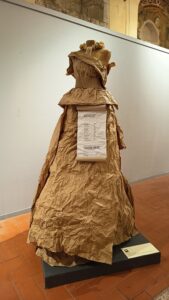
Actually, the idea that these dresses are purely ephemeral is a myth. Every work of mine is born from a concept—a phrase, an encounter, a suggestion—but my background in High Fashion allows me to give these creations a real sartorial structure. I have even made paper wedding dresses that are perfectly wearable. I dubbed this collection Haute Carture [a play on Haute Couture and Carta, paper]: a tailoring of wit and thought. Often, inspiration comes from meeting people with captivating professions. I think of the director of a large shopping center I met recently: a woman who manages complex relationships and conflicts with great awareness. For her, I imagined a “Receipt-Dress of Sentiment,” symbolically summarizing her day and her emotional load. Sometimes, three words exchanged with someone are enough for me to see the finished dress. It is a work of synthesis between reality and imagination.
Paper is incredibly resilient, yet it maintains a delicate nature. Do you think this duality reflects the women you chose to represent?
Absolutely. We women are fragile yet immensely powerful, capable of carrying the weight of the world. I think of womanhood as the ultimate pillar of families and businesses, taking on enormous responsibilities. This brings me back to the concept of Il Sole 24 Ore: a woman is “alone” (sola) for 24 hours, yet she shines like the sun (sole). It is a solitude that isn’t isolation, but a luminous, constant strength.
 These twelve dresses are deeply linked to Umbria and the village of Corciano. Can we define them as “emotional maps” of the region?
Yes, that is a fitting definition. By representing figures like the former Mayor of Corciano, I wanted to pay tribute to the whole of Umbria. She was a senator who brought our territory everywhere, and her figure was the perfect catalyst to tell our local history. But she isn’t the only one: every woman chosen has a story inextricably linked to this land. It’s not just about professionalism or strength; there is a visceral relationship between female identity and the Corciano landscape.
The exhibition is not just a display, but a collective story. How did you select these twelve protagonists, and what traits of their personalities did you try to “sew” into the paper?
It wasn’t an academic selection; I was looking for twelve different women representing various “statuses” and stages of life. I chose, for instance, a very young cardiologist: I watched her grow up and always perceived her as very formal due to her job. In her dress, I wanted to infuse that lightness she doesn’t always show outwardly. When she saw it, she was moved: she realized I hadn’t captured superficiality, but her playful and vital side. Then there is the director of the National Archaeological Museum of Umbria: a woman managing a major institution, an archaeologist, and a mother of five. My creative “transference” was immediate, thinking of the incredible energy she must radiate to make all those worlds coexist. Or the librarian, who is also a Gregorian chant singer: for her, the research on paper was guided by sound. You see, these twelve women are like trees in a forest: each has different roots, but together they create the vital energy that allows us to breathe.
 Beyond the icons you’ve mentioned, is there a figure closer to your personal history—a sort of “thirteenth woman”—to whom you would dedicate a dress or who constantly inspires you?
If I think of a woman who profoundly marked my path, I must name Marilisa Cuccia, the historic owner of the Spineta Abbey. For years, that abbey was a beacon of art, research, and culture—a place where thought reigned supreme. Marilisa gave me so much: she possessed an extreme aesthetic, that superior beauty I have obsessively sought in everything since I was a child. But her teaching wasn’t just aesthetic. She passed on a great sense of humanity and did so much for the land where I was born and raised, Sarteano. Through the ecology prize she established and the many conferences organized at Spineta, she created extraordinary opportunities for inner enrichment, bringing high-profile figures together to discuss vital themes. She was a woman of brilliant intelligence, capable of fighting until the very last moment with uncommon dignity and strength. To me, she was a constant source of inspiration. When I think of her, I see a woman with a formidable “structure” of soul and that pure energy we all seek—which, in the end, is found in simplicity and the very essence of things. Dedicating a dress to her would mean trying to weave together her sublime aesthetic with the strength of her cultural legacy.