By Giacomo Roggi
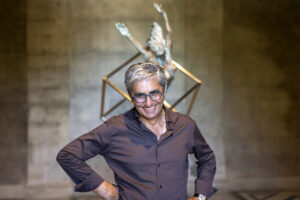
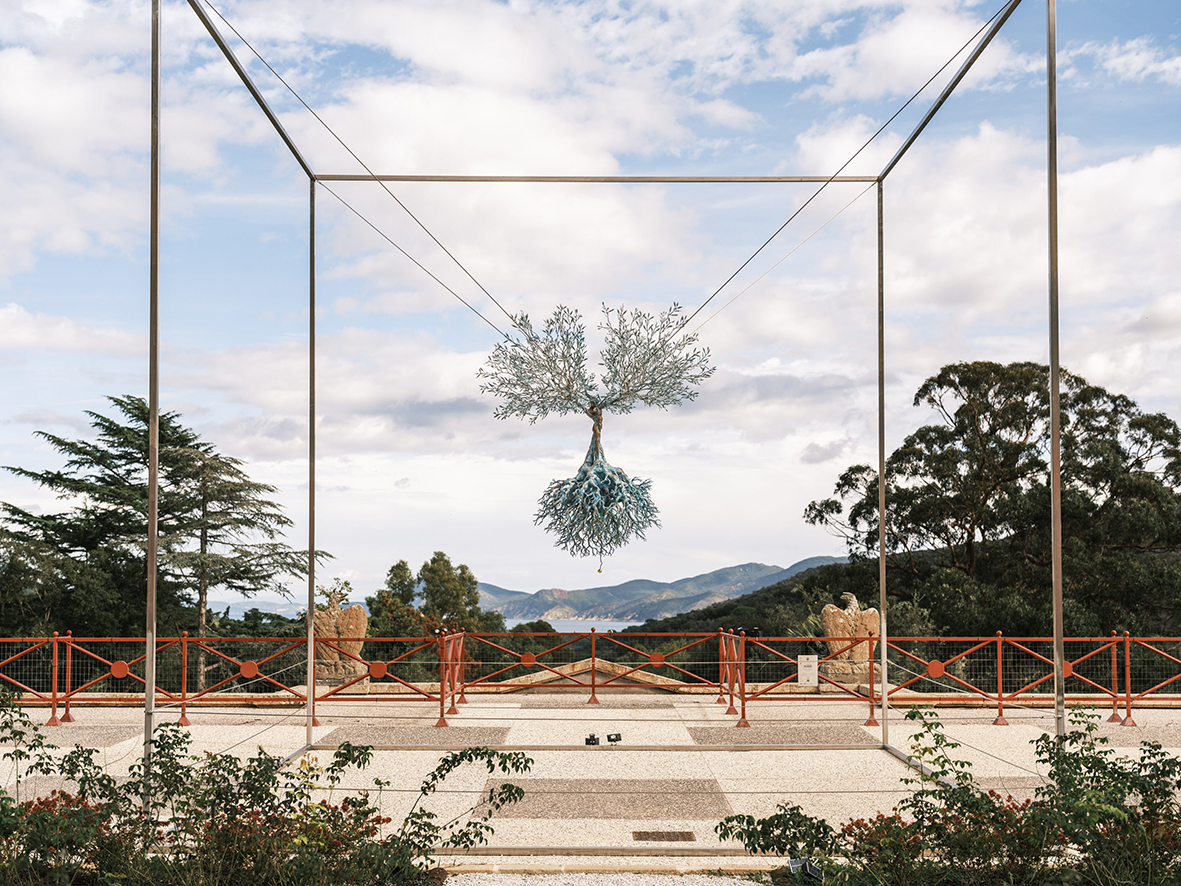
As 2026 draws to a close, it brings with it an intense year marked by milestones. Perhaps this was the year I saw my father, Andrea Roggi, cross more dreams off his wish list than ever before. In 2026, Andrea marked fifty years of creation. For an artist, this is not a finish line: it is a chance to look back and see how far he has come, how his art has evolved, to engage with the present and continue imagining the future. And it was within this ongoing thread of creation that another of his projects took shape this year. For an artist, having an idea in mind is a little like having an inner voice that keeps telling you to bring it to life. That voice gave rise to Vita Nova, Andrea’s first suspended work: a Tree of Life suspended in midair, unveiled for the very first time in the exhibition 50 Years of Creation on the island of Elba.
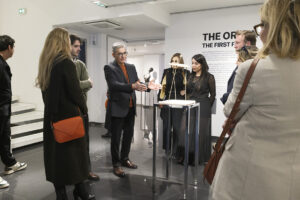
 It was 50 Years of Creation that opened our year, with its first official presentation in Paris at Galeries Bartoux. For the first time, an exhibition traced Andrea’s artistic evolution from the 1970s to today, with works never before seen (drawings, paintings, and sculptures from the private collection) that reveal the roots of the visual language audiences recognize today: the relationship between human beings, nature, and matter.
The launch of the Humanitas catalogue then took us to the stage at Florence’s Odeon. It was a way to revisit an exhibition that many Florentines still remember vividly, when the sculptures graced Piazza San Lorenzo, but above all to explore one of the themes closest to Andrea’s heart: the well-being art brings to a city when it leaves enclosed spaces and meets everyday life. We discussed this in a conversation with artistic director and global speaker Felicia Cigorescu.
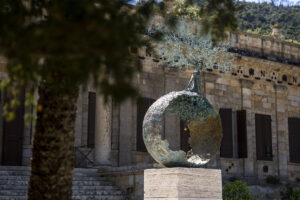
Then came the return of Apeiron, reinstalled at Villa Pisani after the Élan Vital exhibition in Paris. Seeing a work come to life again in a new place, in a different light and in a fresh dialogue with the architecture, is a powerful experience: proof that a sculpture never stops telling its story.
The most powerful emotion, though, came in Venice. At the 61st International Art Exhibition of the Biennale, I saw my father cross another dream off his list. Andrea took part with Potere dell’Amore in The Forest / The Undergrowth project, presented by the Republic of Equatorial Guinea at Palazzo Donà dalle Rose. Cast in bronze in 2026, the work revisits the Tree of Life motif and brings together the most recognizable elements of his visual language. The forest and undergrowth, understood as layers, invisible presences, and deep connections, are the same themes Andrea has explored for years: the relationship between human beings, nature, and transformation. Seeing this body of work in one of the most closely watched settings in international contemporary art was a moment I will carry with me for a long time.
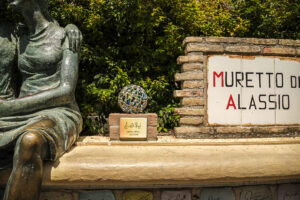
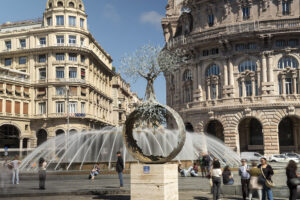
Summer brought us many emotions and a packed schedule, one event after another. With Mare Nostrum, we told the story of the Mediterranean as a place of memory, passage, and connection. In Liguria, the journey began in Portofino, with Lĕvĭtās overlooking the little harbor and the village’s colorful houses, then continued in Genoa, a city shaped by its relationship with the sea: KI in Piazza De Ferrari, Il Volo della Conoscenza at Porto Antico, Le Radici della Rinascita in front of Brignole Station, and Campana Incontro dei Popoli in Piazza Fontane Marose. In Alassio, at the final stop curated by Galleria Ravagnan and included in the LIGYES 2026 program, L’Amore Genera Vita opened onto the horizon at Molo Bestoso, while Immagina un Mondo Nuovo brought the theme of connection to the Muretto. There, next to the statue of the Lovers, a small work by Andrea will remain forever: his signature in the memory of one of the city’s best-loved places.
In Sardinia, between Porto Cervo, Arzachena, and Porto Rotondo, Mare Nostrum encountered a more archaic, mineral world of granite, Mediterranean scrub, light, and wind. The sculptures traced a route from Stella Maris Church and Piazza del Principe to the Giants’ Tomb of Coddu Vecchiu, while in Baja Sardinia, Il Continuum rests on a base of local granite, rooting it even more deeply in that land.
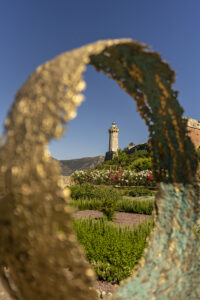
And then Elba, where 50 Years of Creation found its second chapter. Between Palazzina dei Mulini, Villa San Martino, and the Molo Elba in Portoferraio, the works entered sites steeped in Napoleonic memory just as the residences reopened after a major restoration. Drawings, paintings, sculptures, and recent works became part of the gardens, terraces, and historic spaces without interrupting the narrative, and on the terrace of Villa San Martino, Vita Nova became the image of this anniversary: balance, continuity, renewal. The exhibition will conclude in mid-December with the official presentation of the catalogue, created in collaboration with Giunti: the first to trace Andrea’s fifty years of creativity.
Looking back on these twelve months, I realize that 2026 was the year we gave shape to the impossible. A work suspended in midair, a Biennale, fifty years of work gathered into a single story. It was a way to look at the past, understand the present, and imagine the future. Because for us, beauty remains an ongoing movement. And fifty years on, that movement has not stopped yet.
Info: www.andrearoggi.com / info@andrearoggi.com