By Chiara Pietrella
Trigger finger is a condition that, if neglected, can severely limit daily autonomy. Timely physiotherapy intervention, associated with the use of the correct brace and a personalized exercise program, is the most effective tool to solve the problem and protect hand health over time. Our physiotherapists Giulia Pompili and Celeste Magara explain the best approach to deal with the problem.
Known in the medical field as “stenosing tenosynovitis of the flexor muscles”, trigger finger is a very common pathology that affects the tendons of the hand responsible for flexing the fingers and the pulleys within which they slide. It frequently affects the thumb, middle or ring finger, limiting the fluidity of movements and making normal daily manipulation activities painful or difficult. “Under normal physiological conditions,” the professionals explain, “the flexor tendons slide freely inside a sheath lined with synovial membranes, held close to the bone structures by fibro-osseous pulleys, in particular the A1 pulley, located at the base of the finger. Trigger finger is caused by an inflammatory or degenerative process that causes the tendon sheath to thicken or the formation of a small lump on the tendon itself. When the nodulous tendon tries to slide through the narrow pulley, it encounters resistance: during flexion the nodule manages to pass over the pulley, but in the subsequent extension it gets stuck, causing the typical phenomenon of the ‘finger that locks’, followed by a real painful jerk”.
 VL: How and when do the first symptoms appear?
G and C: “The clinical picture initially manifests itself with localized discomfort at the base of the finger at the level of the palm of the hand, which is accentuated by pressure. As the condition progresses, the characteristic symptoms appear, such as pain and a feeling of stiffness, particularly marked when waking up in the morning, the phenomenon of painful jerking during flexion-extension movements of the finger, the blocking of the finger in flexion, which in more advanced cases requires the help of the other hand to be extended, the presence of a palpable and painful nodule at the base of the finger, the reduction of grip strength and difficulty in precision movements”.
VL: Can physiotherapy help?
G and C: “Yes, the role of physiotherapy is fundamental. We frequently treat these problems in our practices: these are conditions that require a targeted approach and the awareness that resolution times can be very long and require patience, perseverance and adherence to the therapeutic plan. In the initial and intermediate stages, conservative rehabilitation treatment is the choice of choice to reduce inflammation, promote tissue healing and restore correct tendon flow”.
VL: Can physiotherapy alone be enough or do we need other specific aids?
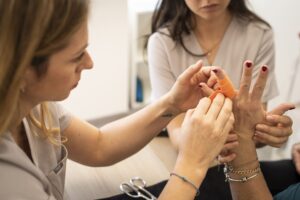
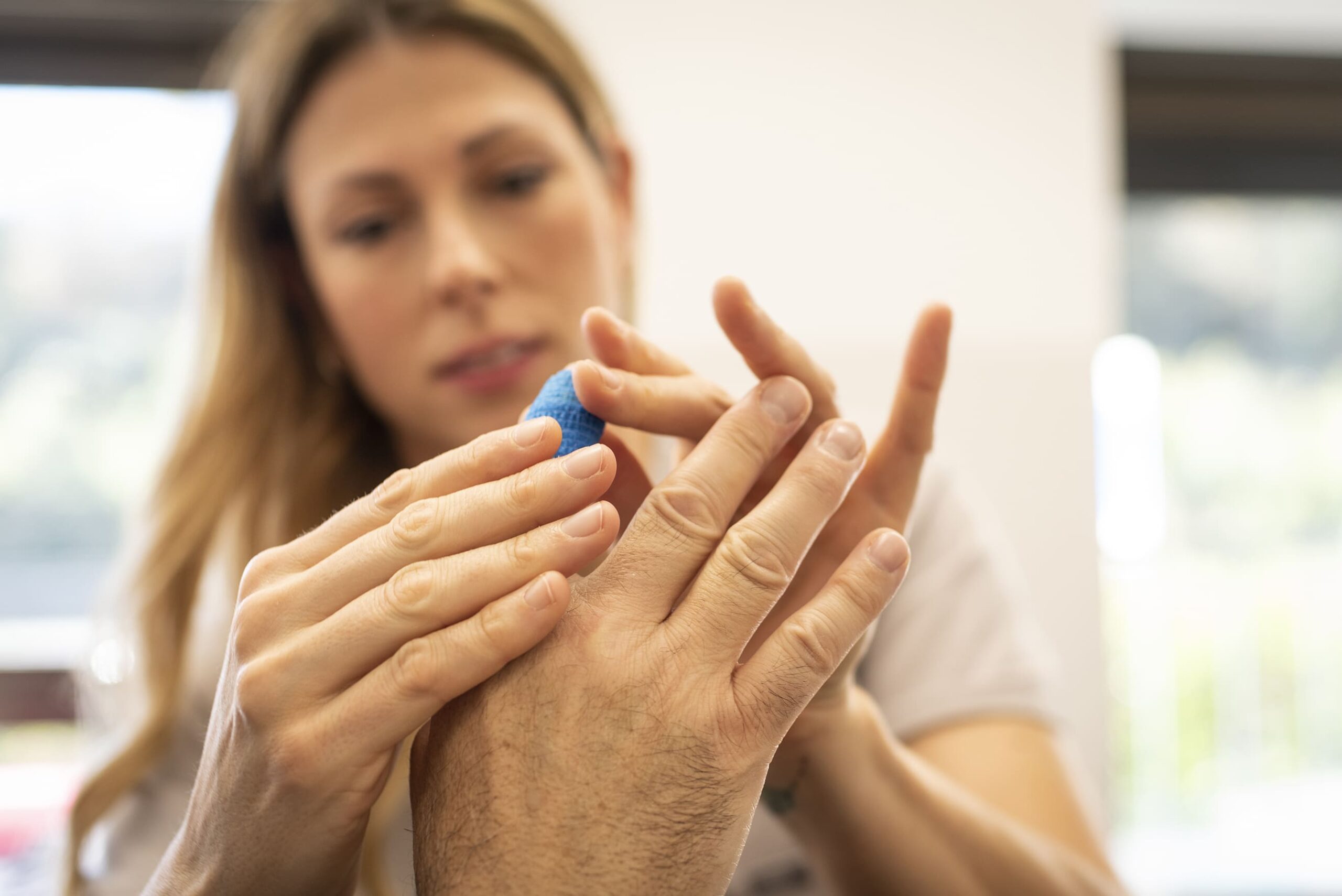
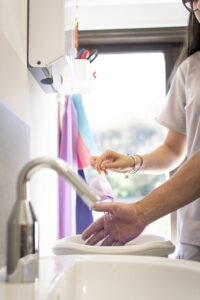
G and C: “One of the cornerstones of physiotherapy is the manufacture of custom-made braces made of thermoplastic material by our hand therapists. In fact, the brace keeps the joint in an optimal resting position, unloading the A1 pulley and preventing the nodule from continuing to rub and become inflamed. These devices make it possible to reduce pain and mechanical stress on the tendons, prevent joint blockage and eliminate painful jerking and maintain the residual function of the hand. Many braces are light, ergonomic, washable and wettable, designed to be worn during daily activities. To improve the quality and condition of the tissues and accelerate the reabsorption of inflammation, the physiotherapy program also integrates several other strategies, including analgesic and anti-inflammatory instrumental therapies, such as ultrasound therapy, to stimulate vascularization and promote tissue repair, and heat treatments such as paraffin therapy. The use of hot paraffin or heat packs helps to relax the muscles, soften the peri-tendon structures and reduce joint stiffness, creating the ideal conditions for exercise”.
 VL: Well, speaking of exercises: are there any specific ones to be performed at home or in the studio?
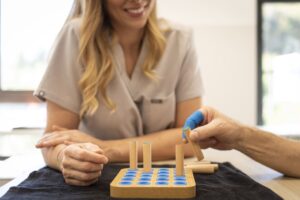
G and C: “Yes, a central element of rehabilitation is represented by the targeted exercises taught by the hand physiotherapist such as those of ‘Tendon Gliding’ for tendon sliding which consist of controlled movements to promote the isolated sliding of the flexor tendons and avoid the formation of adhesions. But also functional and mobility exercises to restore the complete joint excursion and fluidity of movements. Finally, motor reinforcement and control, which consists of exercises to restore the balance between the intrinsic and extrinsic muscles of the hand, reducing the direct load on the pulleys”.
VL: Can physiotherapy therefore avoid resorting to surgery?
G and C: “Conservative physiotherapy is always the first approach recommended when the clinical picture is mild or moderate, i.e. when the trigger is occasional or reducible and the onset is recent. A well-structured rehabilitation path allows in many cases to treat the problem and avoid invasive procedures. However, when physiotherapy is not enough, or in cases where the finger has an irreducible block in flexion with chronic pain, surgical consultation is necessary. The surgery, called ‘A1 pulley’, consists of the pulley section to instantly restore the tendon to slide. In the event that conservative treatment is not sufficient, we promptly send the patient to specialized hand surgeons, remembering that we are in constant contact and collaboration with the best hand surgeries throughout Italy, accompanying the person both in the choice of the surgical path and in the subsequent post-operative rehabilitation “.
Info: SIENA: Centro Medico Igea, Strada Massetana Romana, 12/6
GROSSETO: Studio Beside, Via Aurelia Antica, 46/scala C
Dott.ssa Celeste Magara: +39 345 5759866 / celestemagara05@gmail.com
Dott.ssa Giulia Pompili: +39 339 5651731 / giulia.pompili90@gmail.com