By Sebastiano Pedani
From London to deep Asia, to the hills of Chianti: Andrea Taviani’s extraordinary quest to redefine leather goods.
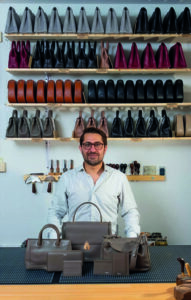 There’s an unmistakable scent that permeates artisan workshops, a hint of leather, wax, and slow time that seems almost at odds with the frenzy of the modern world. In an era dominated by fast fashion and ostentatious logos, encountering someone who has decided to take a step back to rediscover the art of patience is a precious rarity. This is the feeling one gets listening to the story of Andrea Taviani, a leather craftsman whose life seems like an adventure novel and whose work is a hymn to silent perfection.
Born in the United Kingdom to a French mother and an Italian father from the Sienese lands of Val d’Elsa, Andrea spent his first fourteen years in London. His family was immersed in the world of Italian restaurateurs across the Channel, but the call of his roots was strong. Returning to Italy in his mid-teens, he pursued studies to become a surveyor, following a path that seemed set towards a technical profession. But life, with its unpredictable irony, had very different plans in store.
Taviani’s cosmopolitan soul could not be confined behind the desk of a technical studio. His first major breakthrough came in the world of luxury menswear. For five years in Florence and then for another seven in vibrant Paris, Andrea immersed himself in the elegance of “bespoke.” As a boutique director and aesthetic tailor, he learned the art of men’s ready-to-wear, the intimate and refined contact with a demanding clientele, and the sacredness of perfect proportions. After a brief one-year stint in Geneva, his incessant desire to discover new perspectives pushed him eastward. Far away.
Vietnam became his new home for four years. A pulsating, rapidly expanding country where Andrea decided to open an artisanal ice cream business and coffee distribution. It’s a period he himself describes as wonderful, an immersion in a new culture that taught him a different way of approaching people, opening his mind and enriching him spiritually. However, the relentless pace and distance from home began to take their toll. After a two-and-a-half-month interlude in Taiwan, where he attempted a return to his origins by working as a surveyor again, he decided to unplug.
 Armed with only a backpack and a deep desire to understand the meaning of life, he embarked on a long journey through deep Asia. India, Nepal, Thailand, Myanmar. Far from the mass tourism routes, he lived in contact with local populations, sleeping in their homes, eating their food, learning to communicate beyond language barriers. A soul pilgrimage that, unknowingly, prepared him for his true vocation.
Destiny often lurks in childhood memories. As a child, Andrea’s grandmother travelled a lot and brought him leather bags as gifts. That dormant obsession with the structure, feel, and smell of leather reawakened powerfully. It was in Vietnam that Andrea bought his first leather-cutting blade. He began to frequent small local artisans, observing their hands at work, absorbing ancient techniques.
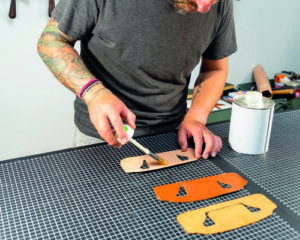
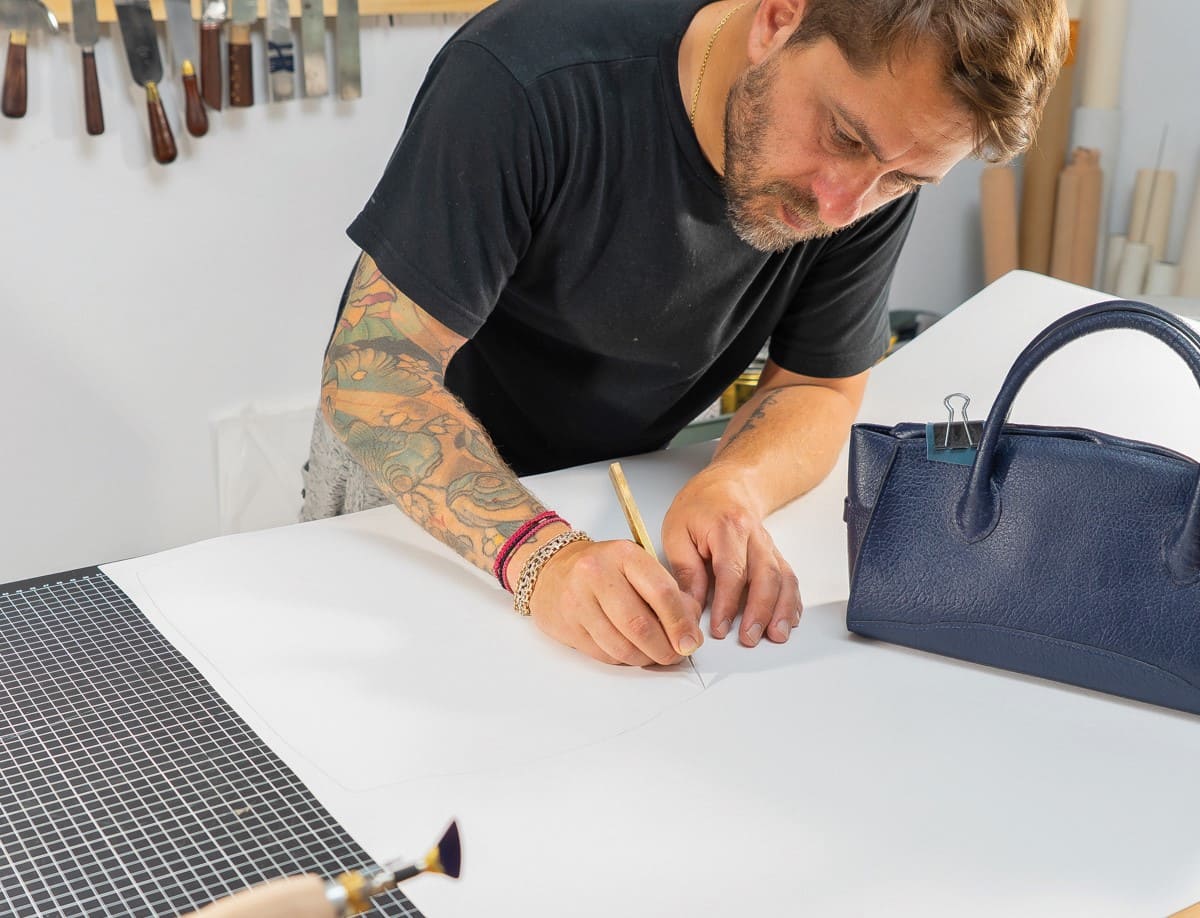
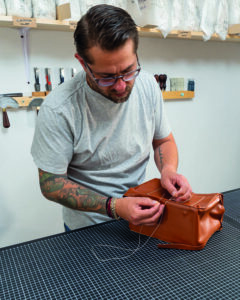
He then decided to return to Europe. He settled again in France and made a radical choice: he transformed his bedroom into a small atelier. He barricaded himself at home for two years. No traditional leatherworking school, no academic master, but monastic dedication. Hundreds, thousands of hours spent cutting, sewing, making mistakes, and starting over. Through obsessive study and endless practice, Andrea mastered the material. He began creating paper patterns, smoothing edges, and executing hand stitches with absolute precision. His room filled with the smell of tanning and leather dust, but also with the realization that he had found his path.
About three years ago, the circle closed. Andrea Taviani returned to Italy, to his homeland, to put down roots and give definitive shape to his dream. He officially launched his business: Taviani Firenze.
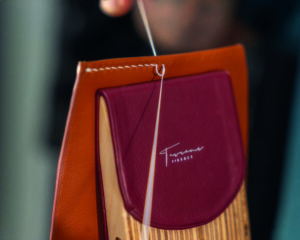
But the brand is not the usual expression of commercial Tuscan leather goods. Andrea’s vision is a fascinating cultural hybrid: the savoir-faire of Florentine tradition fused with extreme, almost maniacal, Japanese perfectionism. It’s no coincidence that the vast majority of Taviani Firenze’s current sales are destined for the Land of the Rising Sun. The Japanese customer seeks the absolute, rejects approximation. If Italian tradition sometimes tolerates imperfection, calling it “the charm of craftsmanship,” Taviani’s approach allows no flaws.
From pure lines to millimetre-precise stitching, each bag is a masterpiece of symmetry. The leathers chosen are exclusively of the highest quality: full-grain calfskin, goat, solid palladium or brass for the hardware.
Taviani’s positioning in the leather goods landscape is defined by two words: Silent Luxury. No gigantic logos, no blatant ostentation. Luxury is whispered, understood only by those with a trained eye to recognize excellent craftsmanship. Those who choose his bags don’t want to display a brand; they want to own an object made to last for generations.
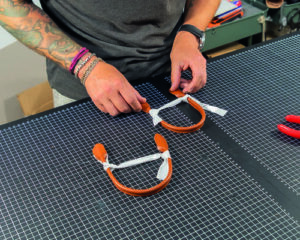
In this context, Andrea’s strong stance on sustainability also fits. He categorically rejects the trend of fake plastic leather, which is polluting and short-lived. True ecology, Taviani argues, lies in longevity. Using leather, a byproduct of the food industry that would otherwise be disposed of and transforming it into an object that lasts for decades, is the ultimate act of respect for the environment.
As his e-commerce continues to flourish, and production is divided between entirely handmade “made to order” creations and a limited production line, Andrea looks to the future. The goal? To one day open a physical space, a visible workshop where customers can enter, smell the leather, and admire the hands of the artisan infusing life into the material.
Andrea Taviani is a prime example of how, sometimes, it’s necessary to travel the entire world and get lost in distant countries, only to rediscover that one’s destiny was hidden in one’s own roots, ready to be shaped by one’s own hands.
Info: www.tavianifirenze.com