By Our Editorial Staff
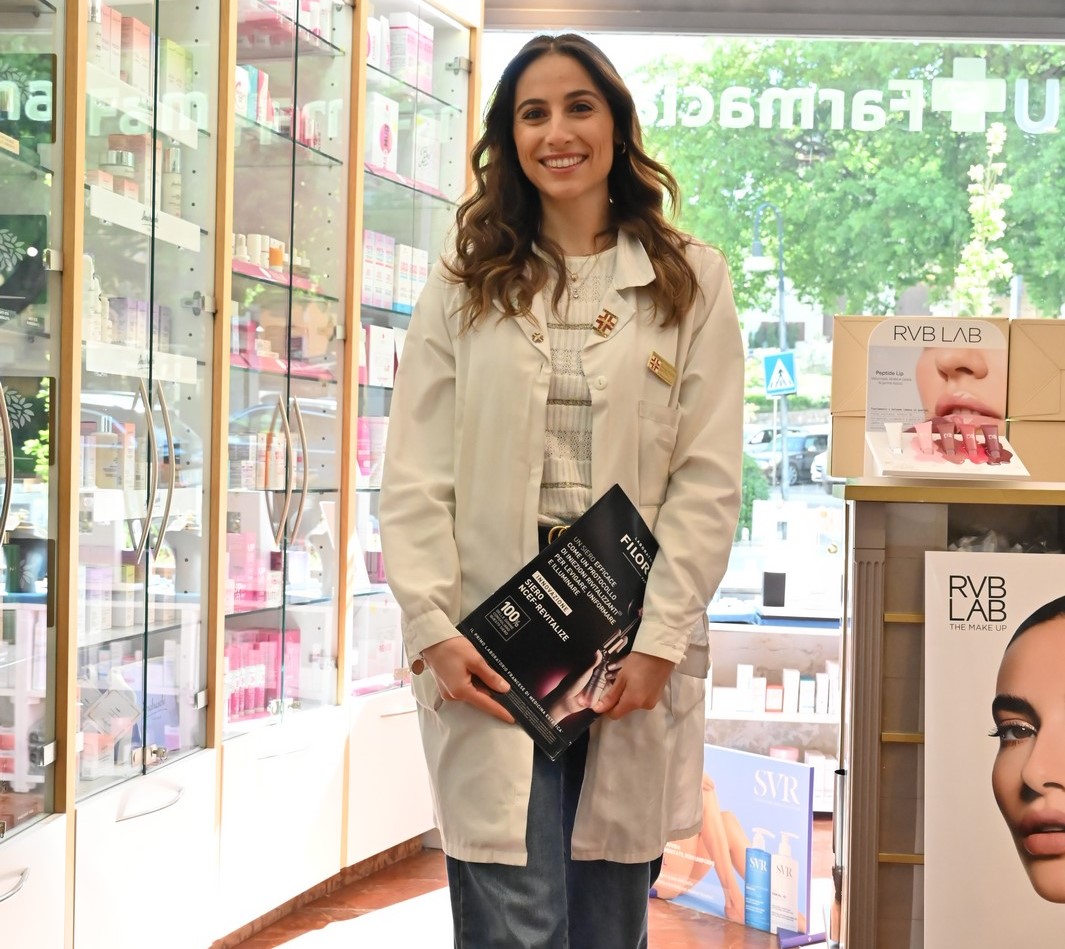
Interview with Federica Betti. Summer: It’s time for days spent outdoors, sunshine, aperitifs, and the beach.
Sun exposure certainly has its benefits: it stimulates vitamin D production, improves your mood, and gives your complexion a healthy, golden glow. However, to enjoy the sun’s benefits without taking risks, it’s essential to take the right precautions to protect your largest organ—your skin—which has a memory and doesn’t forgive carelessness!
Using sunscreen doesn’t mean giving up on a tan, but rather protecting your skin from premature aging, dark spots, and—above all—much more serious health issues.
But when we stand in front of the sunscreen aisle, confusion reigns supreme. Let’s try to clear things up.
What exactly is SPF and how does it work?
We hear about SPF (Sun Protection Factor) all the time, but what does it mean from a scientific standpoint?
In simple terms, SPF indicates a sunscreen’s ability to filter and block UVB rays, which are responsible for sunburn and skin redness. Specifically, it measures the ratio between the amount of time a person can spend in the sun without protection and the amount of time they can spend in the sun after applying sunscreen without getting sunburned.
SPF 30: 1/30 = 0.0333, meaning 3.3% of the radiation passes through, and 96.8% of UVB rays are blocked.
SPF 50: 1/50 = 0.02, meaning 2% of the radiation passes through, and approximately 98% of UVB rays are blocked.
“Total protection” (SPF 100) does not exist, and by law, this term can no longer be used.
It is important to remember that a good sunscreen must also protect against UVA rays, which are present year-round. They penetrate deeper into the dermis and are the primary cause of premature skin aging (photoaging), dark spots, and long-term cellular damage.
Chemical and physical filters: what are the differences?
To block solar radiation, sunscreen products use two main categories of filters:
Physical (mineral) filters: these act as actual “mirrors.” These are natural substances (such as zinc oxide or titanium dioxide) that reflect and scatter UV rays. They work immediately, do not penetrate the skin, are gentle and well-tolerated, and are perfect for children and those with very sensitive skin.
Chemical Filters: organic molecules capable of absorbing the energy of UV rays and converting it into heat that is harmless to the skin before it can cause damage.
A question I’m often asked is, “Why is it so hard to find sunscreens that contain only physical filters? If they’re so safe, effective, and well-tolerated even by the most sensitive skin and children, why aren’t they used on their own?”
I always reply that a sunscreen made solely of mineral filters would require a high concentration of powders (zinc and titanium) to achieve SPF 50, and the result would likely be a thick paste that’s hard to spread and leaves a visible white cast! In contrast, next-generation chemical filters give the sunscreen an invisible, lightweight, and pleasant texture! Therefore, combining the two types of filters allows companies to use less mineral powder (avoiding the “white cast” effect!) and fewer chemical filters (reducing the risk of irritation), resulting in ultra-lightweight textures!
“You only need sunscreen at the beach!”
This is something I hear all the time. It’s a very common misconception to think that sunscreen is just for the beach, but UV rays don’t discriminate! UVA rays, in particular, are subtle and deceptive—they don’t cause the typical immediate sunburn, but they penetrate deeply, accelerating the formation of wrinkles and age spots. What’s more, they can even pass through clouds and window glass! Therefore, it’s important to always protect yourself from the sun, no matter where you are.
It’s important to be generous with the amount you apply—most people use only half the amount of sunscreen needed. To cover your body properly, you need the equivalent of a coffee cup! It’s also important to reapply sunscreen every two hours and always after sweating heavily or swimming.
Excellence in Dermocosmetics: Laboratoires SVR
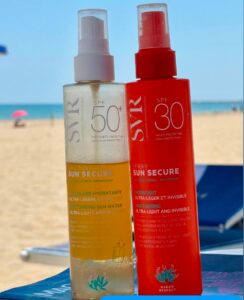
At our pharmacy, we take great care in selecting the products we recommend to our customers. When it comes to sun protection, we enthusiastically rely on the dermatological laboratory SVR, a leader in innovation and skin tolerability.
SVR stands out in the dermocosmetics industry for its rigorous scientific research focused on two key aspects:
Ocean Respect and Sustainability Patents: SVR has developed a rigorous, patented filtering system that guarantees very high protection against UVA, UVB, visible light, and infrared rays, while minimizing environmental impact. Their sunscreens pass strict non-toxicity tests on algae, corals, and marine microorganisms, protecting the oceans and biodiversity.
Endocrine Safety and Tolerability: SVR formulas are tested to ensure they have no harmful effects on the endocrine system and are formulated to minimize the risk of allergies, making them ideal even for hypersensitive or reactive skin.
Sensory textures with an imperceptible finish: invisible finish, rapid absorption, no white residue, and resistance to water, sweat, and rubbing.
SVR offers tailored solutions for the whole family (infants, children, and adults).
Sunscreen isn’t one-size-fits-all. The most suitable product depends on your skin type, sun exposure habits, and skin characteristics. That’s why advice from a professional can make all the difference, helping you choose the most effective solution so you can enjoy.
Info: Farmacia Betti Dr. Vito, Viale Trento e Trieste 63, Spoleto (Pg) / Tel: 0743 223174