By Marcello Salvestrini
We meet Bernardo Salvestrini, third generation of Volentieri Pellenc, the Poggibonsi-based company that has been designing harvesters and viticulture equipment for over sixty years. A story born in the sixties with the first artisanal plows, it grew thanks to the meeting – at the Montpellier fair in 1973 – between grandfather Gaetano “Nino” Volentieri and the young French inventor Roger Pellenc, culminating in 2001 with the joint venture between the two brands. Today, 140 employees, branches in Friuli, Sicily, and Verona, and the challenges of the present: mechanization of arboriculture, defense against late frosts, climate change, and increasingly prompt assistance. Today it is truly a pleasure for me to interview one of my grandsons – whom I have literally seen grow up.
Bernardo, tell me the story of the Volentieri Pellenc company, how it was born, and how long you have been producing agricultural machinery…
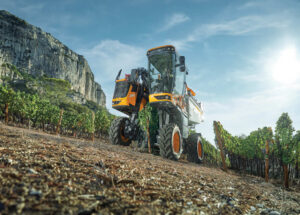
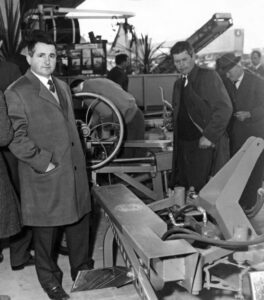
“Volentieri Pellenc was officially founded in 2001, but the story goes back to the mists of time, meaning we’re talking about the 60s. Alessandro Volentieri, my great-grandfather – Gaetano, known as ‘Nino’ in Poggibonsi – began designing and building the first plows and the first equipment for soil cultivation. We’re talking about years when viticulture wasn’t as advanced as we understand it today, and it was very difficult to approach customers or enter the market. Then my grandfather Nino, in 1973, went to France, to the Montpellier fair, the most important agricultural fair of the time, where he met Roger Pellenc, a young man who, not having the money to afford a stand at the fair, had parked a caravan at the entrance, managing to present his first ideas, not yet mass-produced: mowing bars, hydraulic shears to be attached to the tractor’s quick couplings, and more. My grandfather was fascinated by this young man’s talent, so much so that he began to collaborate and import French products or acquire patents in France, adapting or building machines for the needs of Italian viticulture. Volentieri grew and created the first tying equipment, adapting the equipment that Pellenc was beginning to build in series. In the early 80s, the first trailed machine for mechanized harvesting was designed. Meanwhile, Roger Pellenc also continued his evolution, investing in research and development, continuing to innovate, and we followed him on this path. The machines evolved and began to gain their place in the sector. In 2000, Volentieri, which by then designed and built machines for both harvesting and vineyard management, as well as producing the famous “Stima” trailers, received a visit from Roger Pellenc, who proposed joining forces. Thus, in 2001, Volentieri Pellenc Srl was born, which today, after 25 years, continues to be a point of reference and a production hub for trailed harvesters and viticulture and winery equipment”.
Explain how the large family you are part of has contributed and continues to contribute to your success.
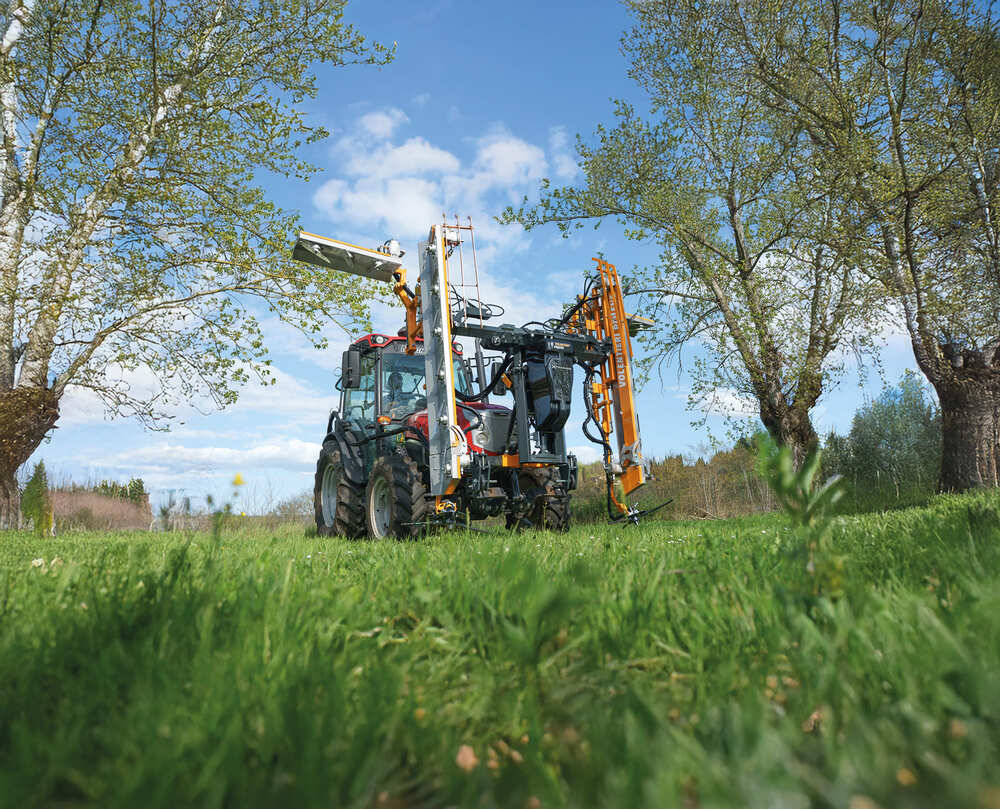
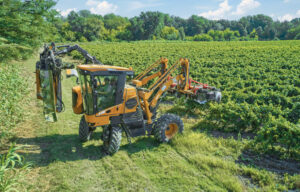
“What still distinguishes us is that, despite the company being 50% with the Pellenc group, we are still a family business managed by the generations that succeeded after the founder Gaetano Volentieri and later Angelo Moni. Today, family management sees Alessandro Salvestrini, my father, as president and commercial director, along with me and my cousin Matteo, and Sandro Moni, as general director for the production and administrative side. Then there are my brothers, Guglielmo, who manages communication, and Vittorio, who is involved in assistance. Today, we are 140 people in total; it’s a big family. In addition to historical production, we have expanded into the market for winery machinery, which handles grape reception, destemming, selection, and pressing. To this, we also add market diversification by opening up to the arboriculture sector. As in all sectors, labor is scarce, and those who cannot afford to maintain traditional systems that can only be worked by hand are renewing their systems with super-intensive or wall-trained systems that allow our machines to perform operations almost 100%, especially pruning and harvesting operations for fruit trees, olives, almonds, and pistachios. Another important technology that we recently introduced to the Italian market concerns frost protection: a machine that allows us to protect plants from late frosts through airflow”.
So, how have the markets changed over the years, and what are the new needs regarding equipment?
“Having direct contact with our customers, not only for sales but also for assistance, we are constantly listening to their current needs. We develop functional, innovative machines for seasonal use – which therefore require prompt assistance in case of malfunctions or breakdowns. The epochal change occurred with the replanting of all vineyards, which led to uniformity in research on planting densities and the preparation of entrepreneurs who pay attention to the results of certain equipment or machines that are justified not only from an economic point of view but also from a qualitative point of view. Another element to consider is the ongoing climate change: the seasons have changed, and the speed of work has also changed. I’m talking about speed in the field, organization regarding the timeliness of operations, not only for harvesting but also for aerial viticulture operations or soil cultivation; therefore, increasingly narrow working windows, increasingly tropical climates, and this requires a greater presence of suitable machines”.
And what about assistance?
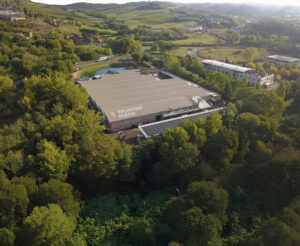
“It is strategic to have technologically advanced products that meet market demands, but it is even more crucial to have assistance that provides punctual service and follows the seasonality of viticulture. This has led us to make specific choices: in the main wine-growing areas and in areas where we have a significant fleet of machines, we have created direct Volentieri Pellenc branches. I’m talking about Friuli for the Prosecco market, as well as Sicily, which, being an island, requires targeted and punctual service. Last but not least, with a substantial fleet of machines, the Verona branch, which we opened in 2021 in Sommacampagna, with a spare parts warehouse and assistance. Where we are not present with branches, we dispatch our technicians from Poggibonsi with about twenty equipped vehicles and provide assistance with constantly trained after-sales service”.