
By Our Editorial Staff
Photo by Gianluca Benedetti (Neropositivo)
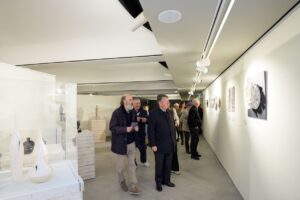
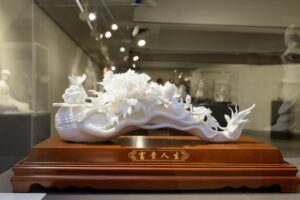
The exhibition “The White Road: Ceramics from Dehua to Gubbio,” inaugurated on November 14 at the exhibition halls of the Perugia Foundation at the Logge dei Tiratori in Gubbio, symbolizes a friendship agreement between the Municipality of Gubbio and the Chinese city of Dehua. Curated by Cesare Coppari and Ettore Sannipoli, the exhibition brings together thirteen ceramic artists from Gubbio alongside Chinese artists, offering a comparison between Dehua porcelain and local majolica. The central theme of the exhibition is the color white. The display will remain open to the public until January 31 in Gubbio, after which it will move to five municipalities in Umbria along the Ceramic Road, concluding finally in Faenza.
The critical text by the exhibition curators, Cesare Coppari and Ettore A. Sannipoli, discusses porcelain and maiolica and their historical intersections.

White is the color of porcelain, just as kaolin represents its bones and petuntse its flesh-this translucent mixture of earth and rocks fired at high temperature. It is glossy and smooth to the touch, similar to the shell of cowries which, during Marco Polo’s time, Venetians referred to as “porcelain.” The name that continues to resonate in Western languages to denote Chinese ceramics produced by the Tang, Song, Ming, and Qing dynasties, whose perfectly uniform and impurity-free white became an aesthetic model to be emulated even in Europe. This initiated a centuries-long quest that seemingly concluded at the beginning of the 18th century when Germans Ehrenfried W. Tschirnhaus and Johann F. Böttger discovered the composition of this precious ceramic material.
A Technical Challenge – The acceptance and dissemination of porcelain within European ceramics through manufactories such as Meissen in Germany, followed by others like the Royal Factory of Capodimonte in Italy, contributed to enriching a profound, ancient, and still vibrant relationship imbued with technical, aesthetic, and symbolic significance: that between ceramics and the color white. Already in maiolica-the terracotta coated with tin glaze of Islamic origin that spread across the Italian peninsula primarily from the 13th century onward-the color white served as a neutral base or background capable of enhancing the vivid hues of the patterns and decorations applied thereto. The white color, which later became dominant in European earthenware from the eighteenth century onwards, was popularized by manufactories such as that of Josiah Wedgwood, the English ceramics entrepreneur who went so far as to dispossess the Cherokee Indians of their kaolin-rich lands to satisfy the British bourgeoisie’s fascination with the purity characteristic of porcelain. This occurred after the Arts, Manufactures, and Commerce authorities proposed banning its importation as a luxury good. This situation necessitated replicating Chinese craftsmanship, including its recipes-not solely those concerning porcelain composition. It involved precisely controlling the high temperatures required to achieve the luster and brilliance of a color whose perfect uniformity and purity had long been known to depend on clay defects or firing errors, which could cause white to shift towards grayish, cream, or yellowish tones-far removed from ivory, sometimes pinkish, translucent, pearly, metallic shades with straw-like veins resembling goose plumage or even bluish hues seen in so-called blanc de Chine. This latter was chiefly responsible for spreading the “porcelain disease” among European audiences and beyond. A white already associated with luxury but progressively acquiring different meanings depending on cultural contexts and historical circumstances. White is a color already associated with luxury, yet it acquires different meanings depending on cultural contexts and historical circumstances.
The meaning of white – Edmund de Waal notes that “in China, white is the color of mourning,” referring to Emperor Yongle and the porcelain pagoda he commissioned in Nanjing: “What is white? It is the color of mourning because it absorbs all other colors. Mourning is also an endless refraction that breaks you into pieces, into fragments.” From this point begins a journey along the white path of porcelain undertaken by the English ceramicist and critic, who, while commenting on a mug by William Cookworthy, an 18th-century English Quaker, states: “Its whiteness too is a special whiteness. This porcelain mug, so uncertain in its craftsmanship, is an angelic vessel.” Indeed, for Emanuel Swedenborg-who had a strong influence on Cookworthy-the angels at Christ’s tomb wear “robes white as snow,” and “those who have not defiled their garments will walk with Me in white garments because they are worthy.” “White is truth; it is the shining cloud on the horizon announcing the arrival of the Lord. White is wisdom.” The Cherokee people of North America used white kaolin for their calumets not only because it is a fine earth that burns cleanly but also because white is a ritual color symbolizing peace. In Saint Petersburg, at the State Porcelain Factory, the whiteness of porcelain becomes “a revolution.” This is also true for Kazimir Malevich: “Sail forth! The white abyss of freedom, infinity, lies before us.” Indeed, “while other revolutionary artists create objects based on images, Malevich creates images derived from objects. Do you want a manifesto? Here it is. Take the idea of an everyday object and paint over it, whiten it, and thus you end up with an unusable teapot. A simple cup as revolutionary and militant porcelain.” Regarding Heinrich Himmler’s directives mandating that Allach figurines be cloaked in white or biscuit-white glaze, these were documented in the first concentration camp catalog, which stated that “White porcelain is the embodiment of the German soul.” This was in accordance with the strict principles of the great German critic Winckelmann: ‘The color white, being that which reflects the most rays, is most sensitive to the eye; therefore, its purity enhances the beauty of a well-formed body.” In China, the notion of “official porcelain,” which materializes in busts of Mao Zedong, becomes “a pragmatic whiteness that removes fear of error while creating these icons. A whiteness that made Maos shine with the same transcendence as any goddess of mercy or any Guanyin.” One could continue to follow the path outlined by de Waal up to the present day, discovering that white in ceramics is more than a color: it is substance, light, an emptiness filled with meaning. It holds a central role both in technique and artistic expression. It is both the starting point and, at times, the destination. This applies whether it is regarded as a symbol of purity and truth-thus positively viewed in the West, where it also assumes negative connotations when associated with the experience of foreboding death-or whether it is linked to concepts of old age, autumn, the East, unhappiness, and mourning as in China, where it is also seen as a symbol of virginity, purity, silence, and contemplation.
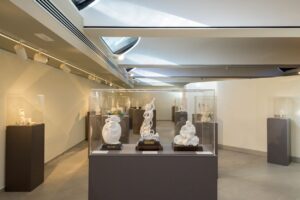
White is the color of an encounter – The aforementioned is sufficient to recall that the historical developments of the art of earth and fire, as known to us Europeans, owe much to the relationship with the East. Not only from that East which we can now consider close, from which came Greek vases and amphorae that traversed a “wine-colored sea,” or from the Middle East through which we learned the enchantment of capturing in clay the fire of infinite sand crossed by Saracens. But also from the East that we still regard as distant, which continues to astonish us with the purity of its porcelains, now arriving by airplane whose white contrail recalls the whiteness of paths once traveled by Venetian and Chinese silk merchants-paths that ideally reopen to foster human encounters that are both productive and creative. The White Road is the title of de Waal’s aforementioned research. We adopt it to represent a journey, an itinerary, a direction of a path intended to be followed or from which one comes-a navigation route, in short, a voyage. It symbolizes the relationship between two distant cultures, between two different ceramic traditions such as those of Dehua in Fujian with its China white porcelain and Gubbio in Umbria with its lusterware maiolica. Simultaneously, it may allude to desirable subsequent stages for an exhibition aiming to follow the Ceramic Road in Umbria. The presentation of white ceramics by the masters of Gubbio therefore holds a significant value of hospitality; it represents a tribute and an homage to their Chinese colleagues as a gesture of friendship and welcome. These white-clad artifacts nonetheless bear clear traces of indigenous production: in the materials and techniques, in the shapes, in the decorations including polychrome ones, and at times in the contrast represented by the black bucchero against the whiteness that “extinguishes all colors within itself.” Already correlating white porcelain with black bucchero entails analyzing similarities and differences between two types of ceramics that are very distinct in origin, technique, function, and historical context but can still be compared in an interesting manner. Indeed, these represent two pinnacles of ceramic art within their respective contexts: the former sophisticated, global, and a symbol of luxury; the latter austere, archaic, yet rich in cultural value. Comparing them with each other-and simultaneously with other materials such as majolica or earthenware-encourages reflection on how ceramics have always been both art and technology, intrinsically intertwined with cultural, religious, and social values. Returning to the topic of color, following Michel Pastoureau (2022), who examines the various ways in which the color white has been used, perceived, and symbolized in European society, it is evident that the dichotomy between white and black became predominant only in the modern era, particularly with the advent of printing, the spread of typography, and the development of modern science. When Newton decomposed white light into its spectrum, it altered the perception of white. No longer merely a symbolic color, white assumed a new perspective-scientific in nature-that categorized it as a “non-color” alongside black. However, in ancient and medieval Western societies, white was regarded as a genuine color equal to black, forming a triad of oppositions that also included red. The coexistence of black and red notably contributed to the grandeur of ancient Greek ceramics, which bridged Hellenic Eastern traditions with Italic Western ones when the Etruscans evolved Greek models into bucchero-a craft that Eugubian Polidoro Benveduti revitalized as Umbrian from 1928 onwards. This “black work” (nigredo) did not diminish the brilliance or metallic iridescence achieved by master ceramist Giorgio Andreoli’s alchemic creations (rubedo), whose incorruptible clay continues to make Gubbio’s ceramic tradition renowned worldwide for its reddish hues. Indeed, a century after its completion, this work in black finds a new phase of revival and purification through the white work (albedo) of the masters of Dehua, which engages us in a creative effort based on the awareness that between the white that breaks down and liberates them and the black that absorbs and retains them lie all the colors we are able to perceive.
Info: La Strada Bianca: Ceramiche da Dehua a Gubbio, 14 novembre 2025 – 31 gennaio 2026 / Fondazione Perugia alle Logge dei Tiratori, Piazza Quaranta Martiri – Gubbio / lastradadellaceramica@gmail.com