By Pierluigi Rossi
When Francis arrived in Arezzo, he said to Brother Sylvester: “Go, and in the name of God drive out the devils by crying aloud from outside the city gate.” As Brother Sylvester obeyed, the demons fled, and peace was immediately restored. The word devil comes from the ancient Greek διάβολος (diábolos), meaning “the one who divides.” At the time, Arezzo was torn apart by rival factions and families competing for power during a period of rapid civic, economic, and military growth.
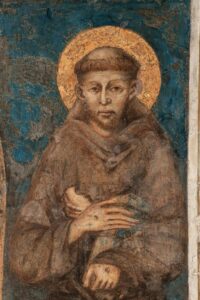 The miracle of the reconciliation of Arezzo’s families caused such a sensation that, a few decades later (1295–1299), Giotto immortalized it in the fresco The Expulsion of the Devils from Arezzo, painted in the Upper Church of the Basilica of Saint Francis in Assisi.
Giotto’s artistic genius made the turmoil of the city’s conflicts visible: demons hover above the walls of Arezzo, opposed to the spiritual world represented by Saint Francis in prayer and Brother Sylvester blessing the city. The fresco is considered the first recognizable topographical view of a city in the history of Italian art, featuring the Gothic cathedral on the left and the cluster of medieval towers on the right, symbols of the city’s turbulent communal life.
Through Giotto, Arezzo becomes a universal metaphor: its internal conflicts symbolize the struggles of humanity, caught between good and evil. The episode of The Expulsion of the Devils from Arezzo fully embodies Franciscan spirituality and humanism, a message that remains relevant today.
Although spirituality and humanism are distinct concepts, they can both guide our lives today just as they did centuries ago. In Saint Francis they become one: the human person is placed at the center, united with God through the appreciation of creation. The Canticle of the Creatures is the manifesto of his spiritual humanism, where the sun, moon, wind, water, and even death become brothers and sisters, placing humanity within a universal harmony.
Saint Francis may be regarded as the first humanist in Italian literature: in the Canticle of the Creatures, matter and spirit are not opposites but two dimensions of the same reality, to be celebrated and lived in their profound unity.
 “Praised be to you, my Lord,
for all your creatures,
especially Sir Brother Sun,
who brings the day and gives us light.
Praised be to you, my Lord,
for those who forgive for love of you
and bear illness and suffering.”
Spirituality arises from the very biology of the human body. Placing the value of the human person at the center is a spiritual act. The spirit is expressed through the functions that allow human beings to perceive themselves in relationship with others, with the environment, and with culture, giving meaning to life and transcending mere material existence. Spirituality gives rise to social life: it enables us to move beyond individuality and journey from the I to the We, making true community possible.
In Saint Francis’ time, Christian humanism was expressed through Charity, mercy, and service to others. Giving one’s own time to others represented the concrete passage from matter to spirit. Humanism means placing the human person at the center, valuing humanity, nature, and community life.
Every human being is a spiritual being, regardless of time or religion. Spirituality transcends matter and individuality, giving meaning to life itself. Upon these foundations, the Confraternity of Saint Mary of Mercy was established in 1263, later becoming the Fraternity of the Laity, of which I serve as First Rector. In 1315, the Archconfraternity of Mercy was also founded in Arezzo, where I serve as Governor. With humility, Franciscan humanism and spirituality continue to live on within the community of Arezzo.