By Simone Bandini
Let’s deepen our knowledge of the territory of Fabbriche di Vergemoli and Molazzana, talking about the ancient chestnut economy – which still resists in this area, thanks to the commitment of the administrators and private initiative. In this regard, we met the Pioli family at the historic Mill of Fabbriche di Vallico and talked with Stefano Bresciani about the Metati (archaic deposits for drying chestnuts) scattered throughout the area.
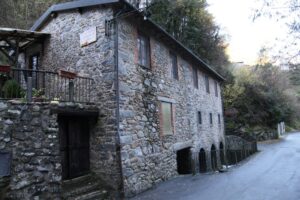
It is the Mayor Michele Giannini himself who introduces our visit to the mill: “The historic Mill of Fabbriche di Vallico, dating back to 1700, is an asset of great historical-anthropological importance. It preserves intact the architectural and mechanical elements of the traditional water mill, testifying to the ancient processing of flour and the organization of rural life. It is a tangible and intangible heritage, a symbol of the peasant culture of Garfagnana and the ability of the local community to live in harmony with natural resources. This place recalls in me the memory of community life and traditional rhythms. The educational visits and meetings with the local elders allowed me to understand the importance of these spaces in the economic and social history of Garfagnana”. It should also be emphasized that – a recent achievement – the milling activity is now ‘gluten free’.
The Council is committed to its promotion and protection through an articulated strategy, which integrates conservation, enhancement and sustainable use – in particular by providing for the complete renovation of the structure, adapting it to the requirements and standards set by the ASL and encouraging cultural events, educational workshops for schools and environmental and historical awareness programs, also favouring the connection with the surrounding area, developing hiking trails and mobility routes that make the experience accessible and consistent with the philosophy of sustainable tourism, educating visitors and residents to a respectful and conscious relationship with the environment and local history: “The historic mill of Fabbriche di Vallico plays a strategic role in the promotion of cultural and educational tourism and in local economic development. Guided tours and educational activities attract school groups and local history enthusiasts, contributing to the dissemination of knowledge of rural traditions, to the enhancement and ‘revival’ of old trades such as that of the miller.”
 All this has allowed and pushed many to resume the cultivation of typical products, especially chestnuts: “Overall, these places strengthen the territorial identity, positioning Fabbriche di Vergemoli as a sustainable tourism destination, capable of combining naturalistic and cultural attractions, generating a virtuous circle of economic, social and cultural development”.
The cultural formation of a new, alternative world, more attentive to the times of nature and society, also passes through these works: “Absolutely! The Mill reminds us of the skills of human ingenuity, sobriety and food culture, respect for natural cycles and the importance of its economic and social history, allowing us to combine past and present and contributing to the construction of a society that is more attentive to nature and community relationships”.
After this interesting exchange of opinions and visions, we tell you about our meeting with Stefano Pioli, directly at the historic mill of the town, nestled in the woods of Garfagnana. Together with his family, he now leads the agricultural and milling business, and tells us a story of recovery, identity and desire to innovate. The Pioli family now manages two sites: the historic mill of Fabbriche and that of Piezza, in the municipality of Gallicano: “In Piezza – explains Stefano – we work a bit of everything: chestnuts, corn, chickpeas, wheat, ancient grains, spelt. When we took over the management of the Fabbriche Mill, which took place about five years ago, the idea of separating the processes was born: here we only make naturally gluten-free products: chestnuts, corn, chickpeas. Everything else remains with the other mill”.
This approach has made it possible to enhance the historic mill as a place of clean and specialized processing, increasing quality and safety for those looking for uncontaminated flours. The family’s work stems first and foremost from agriculture: “We grow most of the raw materials ourselves.” The chestnuts are harvested in the family chestnut groves, dried exclusively in the traditional metati (which we will talk about later, ed.)
“We wanted to relaunch what had been forgotten,” he points out. And the public responded: the demand for ancient grain flours grows every year.
Also noteworthy is the recovery of mountain rye, a cereal that has almost disappeared in Garfagnana: “We relaunched it together with friends from Corfino. They use it to rebuild the thatched roofs of traditional huts. We transform the grain into flour”.
A bridge between past and future, where an ancient crop becomes an economic, cultural and architectural resource.
The mill is not only a place of production, but a social garrison: “Once the mill was the point where everyone brought their harvest. Giving it new life – says Stefano – has given courage to many to return to cultivation. Now they have a point of reference: our customers produce for home but, if there is more, we buy it.
It is a virtuous circle that helps to keep the lands alive, avoid abandonment and support young people who choose to stay”.
 The historic mill of Fabbriche is now also a tourist destination: “Many people come! Many have never seen a real working mill. They are fascinated and often come back”. During the visit you can observe all the stages of grinding, buy fresh flours and immerse yourself in an environment that has remained intact over the centuries.
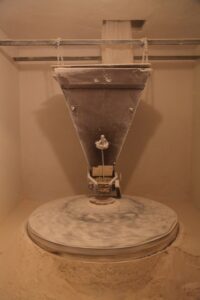
Stefano is keen to explain the importance of grinding: “Stone grinding is also called ‘cold grinding’: it does not heat the product and preserves its organoleptic characteristics”. Unlike industrial milling, in fact, the wheat germ remains in the flour, increasing flavour and nutritional value. You never get an ultra-refined flour, and that’s a good thing: “Overly refined flours are often the cause of intolerances and disorders.”
The historic mill produces type 0, 1, 2 and wholemeal flour, but not double zero, which would require the removal of the germ.
“By choice – concludes Stefano – we only value local products. And when they are not enough, we still stay in the Tuscan territory. It’s part of our identity.”
And so the Fabbriche di Vallico Mill, with its 300 years of history, continues to turn not only the stones, but also the memory, the agricultural culture and the economy of the valley. A great little centre of rebirth for the Garfagnana.
Finally, we move to the neighbouring Molazzana, on the other side of the valley. As already mentioned, we ask Mr. Stefano Bresciani about the ancient uses and crafts of the territory.
What is a ‘Metato’, what is its function? How many are there in the Municipality of Molazzana?
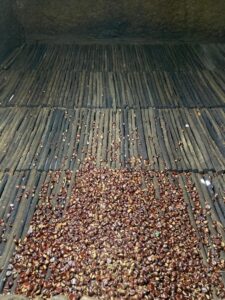
“The ‘metato’ – he tells us – is a building generally located in the chestnut grove that has the purpose of drying the harvested chestnuts that will then be transformed into flour. It is a two-storey building: on the upper floor, made with a floor of wooden sticks (called ‘cannicci’), the harvested chestnuts are placed to dry and, on the ground floor, a fire is made with large logs of chestnut wood covered with chaff (the dry skin of the chestnuts of the previous year) whose heat, slowly, dries the chestnuts above. Today there are few metato in operation, I think there are no more than five or six. In the 50s, just think, at Alpe di Sant’Antonio alone there were a hundred of them”.
But how important is the rural and mountain economy still for Molazzana? “By now the rural agricultural part of Molazzana is a marginal element. The farms have not had generational turnover and the environment has not favoured their survival, starting from the presence of wolves that have wiped out sheep and goat farms (in my case, in two years, I went from 40 to 6!), to the massive presence of ungulates that have in fact prevented the normal cultivation of potatoes and corn from continuing. Chestnut cultivation remains – but it has become necessary to fence the chestnut groves with exaggerated costs for the income that can be had. We are few, but we will hold on!”.
A message of strength and resistance to adversity, from these small municipalities of Garfagnana.