By Leonardo Massaccesi
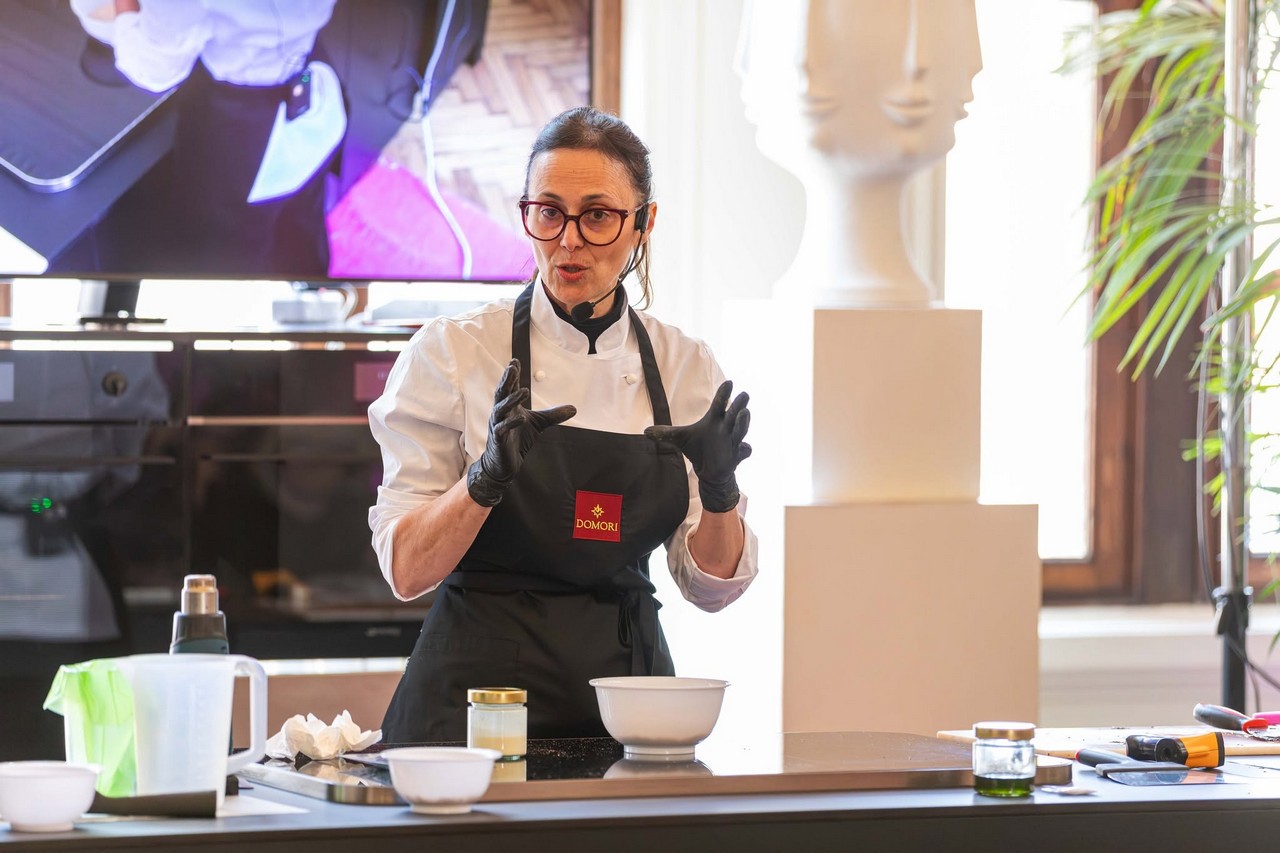
A portrait of Ombretta Moriconi: from her law degree to the chocolate and fine patisserie workshop.
Fate, as we know, has a curious sense of humour. You study law, qualify for a profession, work in a consultancy firm, and learn to navigate your way through codes, regulations and deadlines. And then, one fine day, you find yourself thinking about cocoa, cream and temperature.
 This is exactly what happened to Ombretta Moriconi, who didn’t enter the world of haute pâtisserie through family tradition or a sudden, early revelation, but via one of those detours which, on closer inspection, are often the most interesting. Motherhood was the catalyst. With the arrival of a child, the home kitchen becomes a place of experimentation; birthdays and afternoon snacks turn into little exercises in creativity, and what begins as an everyday activity starts, almost without warning, to take the form of a craft.
From this point onwards, her life story shifts literary genre: from a professional narrative to a coming-of-age tale, where chocolate is, first and foremost, a slow, patient, almost philosophical revelation.
Today, Ombretta lives and works in Foligno. Her recently established workshop occupies an entire floor beneath her home: one room dedicated to chocolate, another to cakes and individual portions. There is also a buffet area for light refreshments and a reception area – still a work in progress – intended for tastings and courses. But before this physical space came into being, there was a story of choices. When her husband, an officer in the Italian Air Force, was often away for months at a time, Ombretta decided not to delegate. She gave up the profession she had studied for and fought to achieve, because she did not want to entrust her son’s upbringing to others, however affectionate they might be. ‘I didn’t want the grandparents, even though they were there, to take the place of my own desire to be there,’ she says. It is a simple sentence, yet it already encapsulates the very essence of her future art: care, presence, and a refusal to settle for anything that is merely “good enough”.
Her husband once again happily complicates matters by giving her the complete series by Iginio Massari: seven volumes of the basics. But it is a polycarbonate mould, bought to make chocolate chess pieces for her son’s birthday cake, that marks the turning point. The chocolate stubbornly refused to come out of the mould. A minor domestic setback, from which a great curiosity arose: tempering, raw ingredients, processing techniques. Sugar paste, which she had initially experimented with, was soon abandoned without too many regrets, thanks to her discovery of the ‘Setteveli’, the famous cake that marked Italy’s triumph at the World Pastry Championships. Chocolate thus became a serious pursuit. A great deal of study, courses all over Italy, and then ‘trying, trying again, doing, redoing, and seeing that in the end you manage to achieve the result’.
 Life took her to Munich, where she moved for four years for her husband’s work. In that little Tower of Babel of Italians, Germans, English and Spaniards, her creations passed the most important test: that of the palate. As beautiful as in the photographs in cookery books, they stand up to comparison with those from professional patisseries. An informal, yet sufficient, endorsement. On her return to Italy, registering for VAT was the logical next step. First came collaborations with restaurants and other patisseries; then, since last summer, a space of her very own.
A woman with clear ideas. Just like her vision of haute pâtisserie: ‘A dessert does not make an impression through its height or its spectacular appearance. It must not overshadow the occasion, but rather frame it. It is remembered for its flavour even after the celebration is over, and there are no leftovers.’ Delicacy, refinement, a lasting taste. The overarching theme: chocolate. Everything in her workshop revolves around this ingredient, which she considers noble. And as such, it deserves the right presentation. ‘I love to colour it because I want to give it lustre, enrich it, embellish it.’
Chocolate is a noble ingredient and, as such, deserves to be made even more beautiful. Because it’s already delicious in its own right.
Shape, colour, packaging: everything draws attention to the star ingredient and plays a part in its story. ‘The experience begins even before the first taste,’ Ombretta tells us.
The quality of the raw ingredients is fundamental. “I use a lot of Domori, especially single-origin chocolates, for their distinctive notes that pair well with the fillings. I also work with other brands such as Callebaut and Valrhona.” And speaking of fillings: hazelnut paste from the Langhe, Sicilian pistachios, Avola almonds, fine candied fruit, Umbrian honey and other local specialities. Behind every piece lies the artisan’s patience, the artist’s eye, and the curiosity of someone who explores origins before daring to create a pairing.
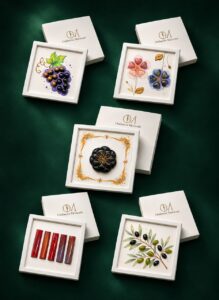
This is the concept behind the ‘Chocolate Meets Umbria’ range. A fresh idea – launched as recently as September, to coincide with the ‘Primi d’Italia’ festival – that is simple yet radically original: chocolate as a sentimental geography. No maps, no art history treatises. It all begins at the tip of the tongue. And the region is discovered through a small travelling museum of taste.
It begins with ‘Oro Verde’. The box of organic Moraiolo chocolates features an olive branch with twelve olives – twelve buds – in green and black. Inside, two cremini: one with lime and cardamom, the other with Sichuan pepper, to emphasise the tingling sensation of the new olive oil. A second version has recently been added, featuring a Leccino from Campello sul Clitunno – extraordinarily fruity and almondy – paired with almonds and dried pollen, or with bergamot, cocoa nibs and liquid ganache. A range already evolving, destined also for spreads.
Then comes the Sagrantino di Montefalco, elegant and powerful, which meets the Ecuadorian Arriba Nacional in an artistic ‘grape cluster’ where Passito and Secco interact without ever overpowering one another. It is a duel of courtesy. Jellies and ganache bring out the tannins and fruitiness of this divine nectar. Not a ‘wine-flavoured’ chocolate, but a portrait of the wine itself. It’s a lovely idea that this could become an alternative to a bottle of wine to take to a dinner party: another way to offer and discover this great Umbrian wine.
With Cascia Saffron, you embark on a three-part journey. The ‘red gold’ is no longer merely a colour, but the driving force behind a progression that evokes both a journey through the Middle East and the Umbrian hills.
It begins with saffron, camomile, pine nuts and orange paste; moves on to a Domori Essence with pistachio; and culminates in the most intense pairing: dark chocolate with a cocoa content of over 70 per cent and white sesame paste. Behind this lies subtle and rigorous technical work: different extraction techniques (alcoholic, prolonged heat extraction) because ‘saffron, if not measured precisely, is either not noticeable at all or overpowers the flavour’, he says. This is not a statement of principle: it is a method.
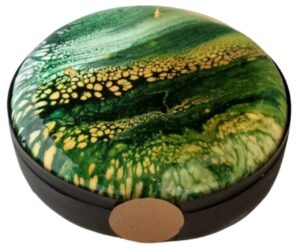
The Valnerina truffle becomes ‘Oro Nero’: a bar that echoes the almost flattened shape of the mushroom, black and embellished with gold. Inside, a 100% dark chocolate ganache enriched with grated truffle oil left to mature over time, and Umbrian acacia honey which lends sweetness without being cloying. Sweetness, woodland flavours and savoury notes in a single bite.
And finally, the Cannara Red Onion, bold and sweet-and-sour, encased in a shell of Sur del Lago chocolate and embellished with crumbs of Umbrian bread: tradition and innovation looking each other in the eye without blushing.
‘My grandmother always told me I had to study, otherwise I’d end up living on bread and onions.’ That old saying has now become a chocolate bar: 100% Valrhona chocolate, onion jam cooked in Modena balsamic vinegar, and crumbs of toasted, salted bread. A lovely family portrait, transformed into a taste experience.
The Cuore Verde d’Italia brings it all full circle: a mixed box in which twelve chocolates form two symmetrical flowers. A colourful work of art – but one to be savoured.
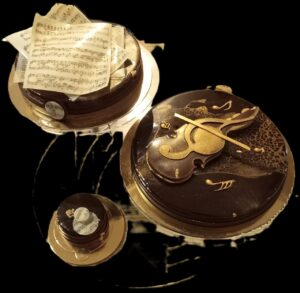
Unique and varied stories, each with a potentially surprising twist. For whilst it is true that the principle is the same for all of them – studying the ingredients, respecting their characteristics and crafting a flavour that lingers in the memory of the taster – it is equally true that the variations of each ingredient offer endless possibilities.
Just think how much a pairing (and therefore the flavour) can change when switching from one cultivar to another. In that sense, ‘Chocolate Meets Umbria’ is an open-ended project. ‘I’d like to add other exceptional ingredients and explore those already chosen in greater depth.’ Just like when faced with a chocolate, we can’t resist: a direct question, and Ombretta lets slip something about Trevi’s black celery. As for the rest… never has a wait been sweeter. The same goes for my dinner guests tonight. Unwittingly lucky, they’ll only have to wait a few hours. As for me, I’m faced with the arduous task of dodging questions about the menu and its surprises.
Info: Ombretta Moriconi Creazioni, Pasticceria – Cioccolateria
Foligno (PG) / tel. +334 663 3689
ombrettamoriconicreazioni@gmail.com
www.ombrettamoriconicreazioni.com