By Claudia Cencini
March will see the “blooming” of some of Pro.Rest’s most interesting projects, from the opening to the public of the crypt of San Primiano in Spoleto Cathedral to the completion of the renovation of the former slaughterhouse, which is set to become a laboratory for the restoration of cultural heritage, dedicated to ancient fabrics and metals recovered from areas affected by natural disasters.
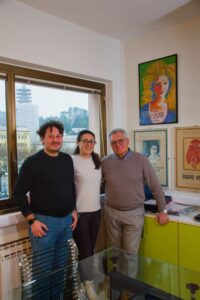 Pro.Rest, an acronym for “Progetto Restauro” (Restoration Project), is much more than that. It is one of Spoleto’s family-run businesses of excellence, headed by architect Bruno Gori, assisted by his children Riccardo, also an architect and designer, and Francesca, an archaeologist specializing in the Middle Ages.
We step into the world of Pro.Rest by meeting the founder, architect Gori, and his two children in the welcoming headquarters in Via Cacciatori delle Alpi, where sitting around a table feels more like a chat than an interview.
As we shall see, there is no shortage of interesting ideas and previews in a period full of upcoming deadlines.
Architect Gori, what do you do and, more precisely, what is your target market?
The name of the company says it all. When it was founded in 1990, the name came naturally. Specifically, we deal with restoration, architecture, and engineering in the broadest sense. our area of expertise mainly concerns historical, architectural, archaeological, and artistic heritage in all its forms, not only in our own region, which is extremely rich in this regard, but also nationally and beyond, without setting ourselves any limits.”
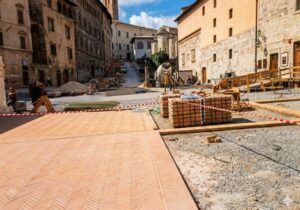
Confirming Pro.Rest’s constant and active presence in the city of the Festival are, among their projects, the repaving of Piazza Duomo, the restoration of various monuments and historic buildings, from the Caio Melisso theater to the renovation of the Arroni, COLLICOLA, and Zacchei Corvi Travaglini noble palaces, currently underway.
In reality, the story began in the 1980s with the transformation of the Rocca Albornoziana from a prison to an exhibition and cultural center, carried out by a team of experts, including architect Gori, under the direction of a scientific committee.
To go into more detail about your modus operandi, what is the approach that characterizes your company, which has been operating for over thirty years? This is no small feat in these times, relying on a successful combination of professionalism and innovation.
“We offer an integrated approach, based on multidisciplinary specialist skills and technical expertise gained from over forty years of experience in the sector,” confirms architect Gori. “What’s more, we start from our roots to look to the future,
using modern technologies to design restoration projects for assets that fall within our field of operation.”
Crypt of San Primiano, a treasure returned to the city
 Let’s talk about your current projects. What are you working on?
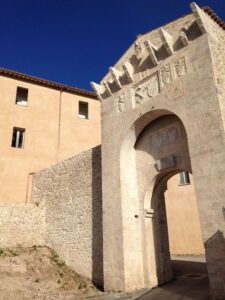
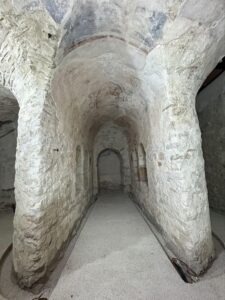
The restoration of the crypt of San Primiano has just been completed. The project was commissioned by the Superintendence of Archaeology, Fine Arts, and Landscape of Umbria, which also financed its implementation. It was skillfully carried out by restoration and conservation specialists from Tecnireco in Spoleto, who had to tackle the recovery and consolidation of ancient frescoes. Unfortunately, the paintings, depicting scenes from the Benedictine cycle dated by art historian Professor Maria Andaloro to the ninth century, were severely damaged by humidity and seismic shocks, requiring delicate restoration work. The crypt is part of the original core of Spoleto Cathedral: a ring-shaped crypt where Mass was not celebrated, but which had a processional function for the veneration of the saint’s relics. Prof. Bruno Toscano’s book “Spoleto Cattedrale e Città” (Spoleto Cathedral and City) mentions similar structures in Italy, including one in Turin and others in Trani, which I visited recently.
Finally, this space, which houses the oldest sacred building in Spoleto, is ready to be visited for the first time in over a century, since it was discovered and studied by archaeologist G. Sordini.
The former slaughterhouse is about to be reborn in a new guise
But the crypt of San Primiano is not the only challenge undertaken by Pro.Rest. Another, which is about to reach completion, concerns the restoration of the former Spoleto Slaughterhouse, a nineteenth-century monument bearing the illustrious signature of architect Ireneo Aleandri. The construction site is completing the renovation of this complex, which is about to change its appearance and intended use. The ancient Spoleto slaughterhouse has an illustrious history, starting with the architect who designed it in 1835.
Built in 1838, it served its purpose until the 1960s, when the construction of a new slaughterhouse on the outskirts of the city condemned it to abandonment and progressive decay. The fact remains that the building is one of the most significant examples of 19th-century architecture in the city, thanks to its elegant two-story structure overlooking a central courtyard.
Today, after decades of neglect, the complex is undergoing redevelopment and is set to be transformed into a large workshop and exhibition space with multifunctional objectives. The project is benefiting from funds from the PNRR “Macro Measure PNC Earthquake Area: Città e Paesi Sicuri, sostenibili e connessi’ (Safe, Sustainable and Connected Cities and Towns), managed by the relevant offices of the Umbria Region, which provides for the expansion of the management system for movable cultural heritage in a state of emergency. This includes the storage facility for works of art by S. Chiodo, which has been in operation since the mid-2010s, alongside which, again based on our design, a new storage facility for stone and large-scale materials has been built.
 The slaughterhouse completes the system with the creation of laboratories for diagnostics, training, and study in the field of textiles and antique jewelry, a niche sector that will require the employment of professionals who are already active or who need to be trained.
Church of San Salvatore in Campi, rising from the rubble
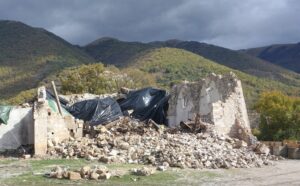
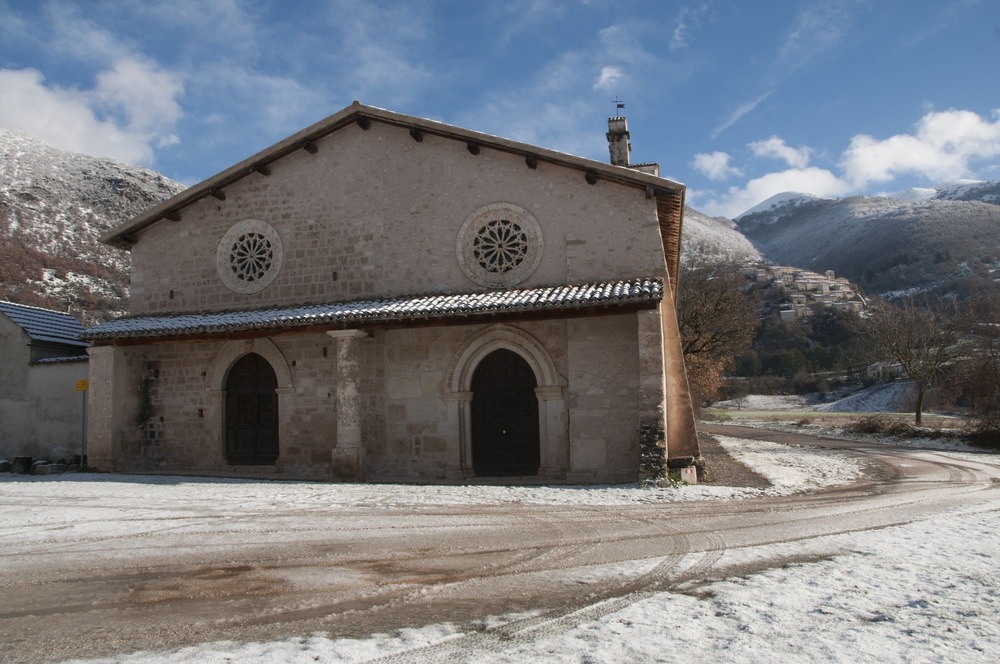
The icing on the cake is the project to recover, or rather restore, what remains of the earthquake-damaged church of San Salvatore in Campi di Norcia, in Valnerina. Although only fragments of walls survived the 2016 earthquake, the aim of the project is to restore the church to its original form and size, as architect Riccardo Gori explains:
“The project has already been approved and financed, and work is about to begin. In this case, it is a complex operation, as the monument is almost entirely on the ground.
The design also requires the recovery of the wall fragments and the blocks of the collapsed vaults, many of which are frescoed, their scanning, and their subsequent use to recompose the puzzle broken up by the earthquake.”
“In this challenge,” adds architect Riccardo Gori, “digital technology will come to our aid for the three-dimensional reconstruction of the collapsed vaults and the use of an algorithm that will help us ‘tie’ the pieces together by interacting with artificial intelligence.”
“In this context, the presence of an archaeologist will also be necessary,” adds Dr. Francesca Gori, “which will allow us to expand our historical and archaeological knowledge of the monument, both of the surrounding area, which in the past has already yielded elements and clues to its evolution over time, as demonstrated by part of the perimeter wall of the church built with reused Roman stone blocks. Restoring a part of their past that we still do not know.
From Spoleto to the world
Pro.Rest’s vision extends far beyond national borders and reaches abroad, with the drafting of international projects, such as the one launched in the Libyan archaeological areas in the Cyrenaica region and the more recent one involving the reconstruction of the ancient mosque in the center of Tripoli. Unfortunately, the political instability of the country and the international context have prevented its completion.
In recent years, Pro.Rest has been called upon to put its professionalism at the service of ambitious and eclectic projects. Among the most recent, we recall the feasibility plan for the reconstruction of Canova’s colossal horse, commissioned
by the Canova Museum in Bassano del Grappa, and the plan for the relocation of a section of the Roman aqueduct in the municipality of Lumezzane in the province of Brescia, designed for Anas spa Nord-Ovest.
But that’s not all. In recent years, thanks to the entry into the company of the youngest member of the family, Dr. Francesca, we have been able to expand our professional skills, allowing us to deal with archaeological interventions in a more timely and comprehensive manner. Just think of all the study and research activities, both textual and in the field, required for a territory as historically and archaeologically fertile as the one in which we operate.
“To achieve better results, it is important to design as a team, in collaboration with industry experts and institutions. Unfortunately, however, today we no longer have the skilled workers of the past, who not only carried out the work well and in line with the plans, but also passed on their art and craftsmanship to new generations and – concludes Gori senior – kept alive the lessons of the past to which our origins are linked. For this reason, it would be necessary to reactivate targeted training courses, which are even more important today with so many construction sites open. “.
Info: PRO.REST Srl, Via Cacciatori delle Alpi 1, Spoleto (PG) / Tel (+39) 0743 522173 / www.prorest.it / info@prorest.it