By Federico Minghi
Photo By Gabriele Forti
The Val d’Orcia and landscape therapy: when beauty heals the soul and redefines time.

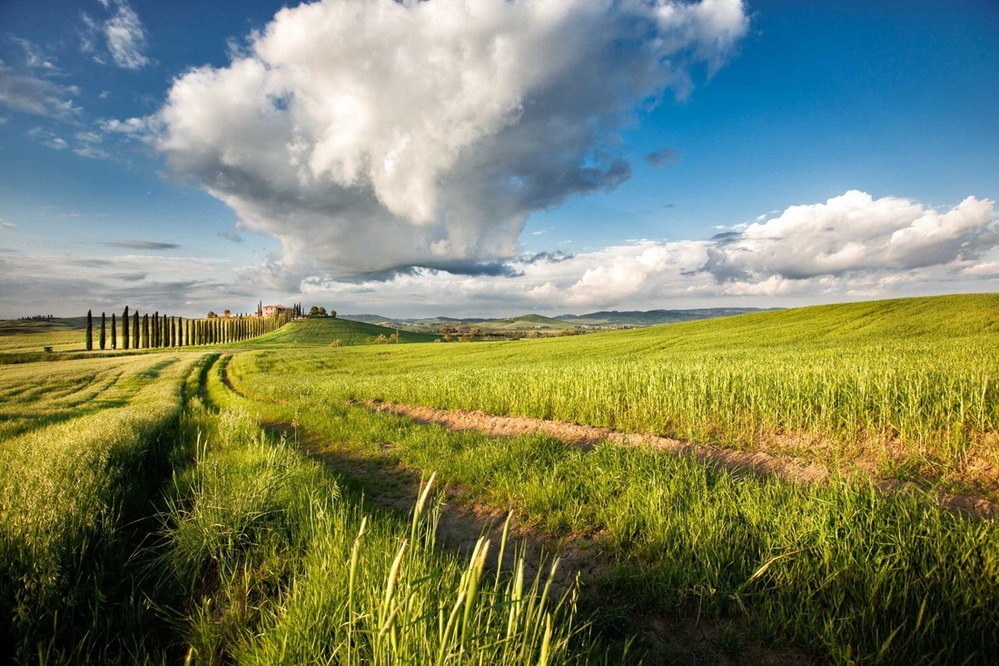
We live in an age of constant hyperconnection, where space is saturated and time is a perpetually fragmented resource. There is, however, a geographical and emotional boundary beyond which the noise of the world suddenly dies down, leaving room for a silence that heals. That border coincides with the sinuous profile of the hills of the Val d’Orcia. Here, between the golden Crete senesi and clay and the vigilant majesty of Monte Amiata, the earth ceases to be a simple geographical background to be transformed into an active therapy of the gaze and the spirit: landscape therapy.
This is not an academic definition, but a profound sensory experience that anyone who has travelled these roads knows well. Landscape therapy is the art of letting oneself be healed by the harmony of proportions. The hills of the Val d’Orcia, shaped over the centuries by the patience of farmers and the hand of Renaissance artists who made it an ideal of eternal beauty, follow one another like waves of solid earth. The cypresses, planted in perfect circles or arranged to trace the curves of the paths, are not just arboreal elements; they are suspension points, punctuation marks on a score of infinite serenity.
Walking at a slow pace along the dirt roads or stopping to watch the sunrise that lifts the fog from the valleys like a light veil, means tuning your heartbeat to a different frequency. The light here has a special density: it caresses the clay gullies, lights up the gold of the wheat in summer, colours the leaves of the centuries-old olive trees with silvery shades and is reflected, motionless and warm, in the thermal waters of Bagno Vignoni. It is a light that invites contemplation, that forces us to slow down and regain possession of the luxury of doing nothing, except existing in symbiosis with what surrounds us.
The landscape of the Val d’Orcia heals because it is loyal. It does not hide its scars, its summer aridity or its bare winters, but transforms them into a hymn to the changing beauty of the seasons. In this valley, the observer is never a passing stranger, but becomes part of the work of art itself. The wind that moves the foliage of the cypresses brings with it the scent of wet earth, wild rosemary and the ancient stone of villages such as Pienza, San Quirico or Castiglione d’Orcia.
Experiencing landscape therapy means, after all, understanding that beauty is not an aesthetic quirk or a superficial luxury, but a vital necessity of the soul. And the Val d’Orcia, proud guardian of its silence and uniqueness, remains there, unchanged and welcoming, to remind us that there is always a place where it is possible to return home.