By Claudia Cencini
Just a few minutes of Face Yoga a day are enough to rejuvenate and reconnect with yourself. Anyone can do it—it’s simple and it works, according to Coach Elena.
We live in a hyperconnected era without realizing that we risk losing the most important connection of all: the one with ourselves. The Face Yoga method can help us rediscover that connection—a technique accessible to everyone that brings tangible benefits to both body and mind, as Elena Stocchi explains.
Originally from Spoleto but now a citizen of the world, she joins us via video call from Germany, where she currently resides, even though Umbria is where her roots lie—where her family lives and where she happily returns whenever she can: “I grew up in the peaceful countryside of Spoleto, where movement was my first love. Ever since I learned to walk, dance has been my way of feeling alive—a rhythm that has accompanied me through the changes in my life. At age five, I started taking ballet lessons, and since then it has remained a constant thread in my journey. Dance has always been my anchor, especially during the most difficult times.”
From Umbria, she then spread her wings, traveling from France to Colombia, from the U.S. to England. “In Venezuela,” she says, “I discovered yoga for the first time.” COVID did the rest: “When the world came to a standstill because of the pandemic, yoga became my daily anchor. Moving my body gave me a routine, breath, and a deep connection with myself, when everything else seemed uncertain. That feeling of wholeness—body, breath, and mind moving as one—changed my life.”
With Elena, we delve deeper into the surprising and fascinating intricacies of this new branch of traditional yoga.
Could you give us a brief introduction to this discipline, explaining what facial yoga is, what it’s for, and how it originated?
Although it has relatively recent origins, facial yoga draws on the holistic essence of traditional yoga, which boasts roots stretching back thousands of years and emphasizes the unity of body and spirit, while preserving many elements such as mindful breathing, massage techniques, and specific muscle exercises. Toward the end of the last century, Japanese practitioner Fumiko Takatsu developed a facial exercise technique that, in addition to counteracting the aging of facial tissues, stimulates local muscles and strengthens the neck. Her story began with an accident that altered her facial appearance; from there, she conceived the idea of testing this new method on herself—a sort of facial physical therapy with tangible benefits.
Her method, based on traditional yoga principles adapted to the 57 muscles of the face and neck, works through targeted movements, massages, and isometric contractions that promote the elasticity of facial muscles and improve tissue oxygenation—the foundation of a healthy, radiant complexion. Today, Fumiko, who lives in the United States, successfully applies her method not only for aesthetic purposes but also to improve the condition of people suffering from facial paralysis, Parkinson’s disease, or other conditions.
 On your website, Face Yoga is presented alongside Somatics. What is the connection between these two disciplines, and why did you choose to integrate them into your method?
In my mind, they are already one and the same. The lexical root of the Greek term “soma” means body—a single, unified whole. Face Yoga and Somatics share a common focus on listening to and respecting the body, working on awareness, and the ability to reestablish a dialogue with oneself—a dialogue that is often distracted these days by external stimuli. A clear example is food: we no longer listen to what nourishment our body needs; we eat simply because we have to, and in doing so, we create dissociation and disharmony. With Somatics, many things can be brought back into balance, starting with the nervous system. Personally, I’m working toward becoming a somatic coach, focusing on the whole body using a method that differs from psychotherapy—which tends to focus more on revisiting the past (we’re not medical professionals)—while Somatics focuses more on the present and the future, paving the way to live better today and tomorrow.
The neck and face are made up of about a hundred muscles that weaken over time due to a lack of stimulation and physical activity. Can you explain how this discipline can help keep them toned?
Facial muscles don’t just weaken due to a lack of stimulation but because of a variety of factors, such as stress, bad habits, slowed blood circulation, reduced elastin and collagen production, a sluggish lymphatic system, and the natural aging process. Facial yoga is like going to the gym, but instead of weights, we use our hands with exercises designed to oxygenate the cells and promote the elimination of toxins. Bringing your hands back to your body—not to swat away mosquitoes, but to take care of yourself, caress yourself, and show yourself love—can lead to a radical change in your relationship with yourself. I touch my face to understand who I am, and I do so mindfully—not mechanically or haphazardly.
Our face also reflects the emotions we experience. Can stress, tension, and daily habits affect its appearance? How does Face Yoga help us regain a more relaxed and natural expression?
Of course, the face is a mirror of our emotions; the way we express ourselves, laugh, and carry ourselves leaves its mark. Even speaking different languages can affect expression lines, not to mention excessive cell phone use, which can lead to postures that contribute to premature aging and the development of a double chin. To counteract these and many other factors that alter facial features over time, Face Yoga employs a comprehensive set of targeted exercises whose effects are also significantly visible.
Many people think that Face Yoga is a kind of “anti-wrinkle exercise.” Is that a correct or reductive definition?
Face Yoga is much more than just exercises to smooth out facial wrinkles. Yes, it does that too (and how!), but at the core of this method lies the rediscovery of our relationship with ourselves and a deep reconnection with our true selves—a connection often lost amid the frenetic pace of daily life, which causes us to lose sight of who we are and what we want. In this sense, Face Yoga is synonymous with wellness—not just aesthetic, but also inner and spiritual—which allows us to live better with a more positive and motivational approach to everyday life.
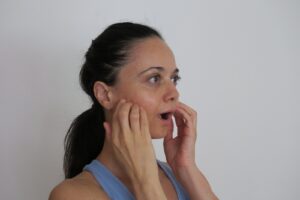
Can Face Yoga help counteract the main signs of aging, such as wrinkles, loss of firmness, and sagging skin? How does it actually work?
Face Yoga retrains the muscles of the face and neck to regain balance, and the results are visible: a brighter complexion, firmer skin, and fewer wrinkles. A grayish complexion that dulls the face’s radiance is a warning sign; Face Yoga detoxifies the skin, making it more luminous—a sign of health and well-being, both external and internal.
We’ve seen that facial yoga helps rejuvenate the face, especially for mature skin. How can it prevent the most annoying and dreaded wrinkles, such as the classic “crow’s feet” or drooping eyelids and cheekbones?
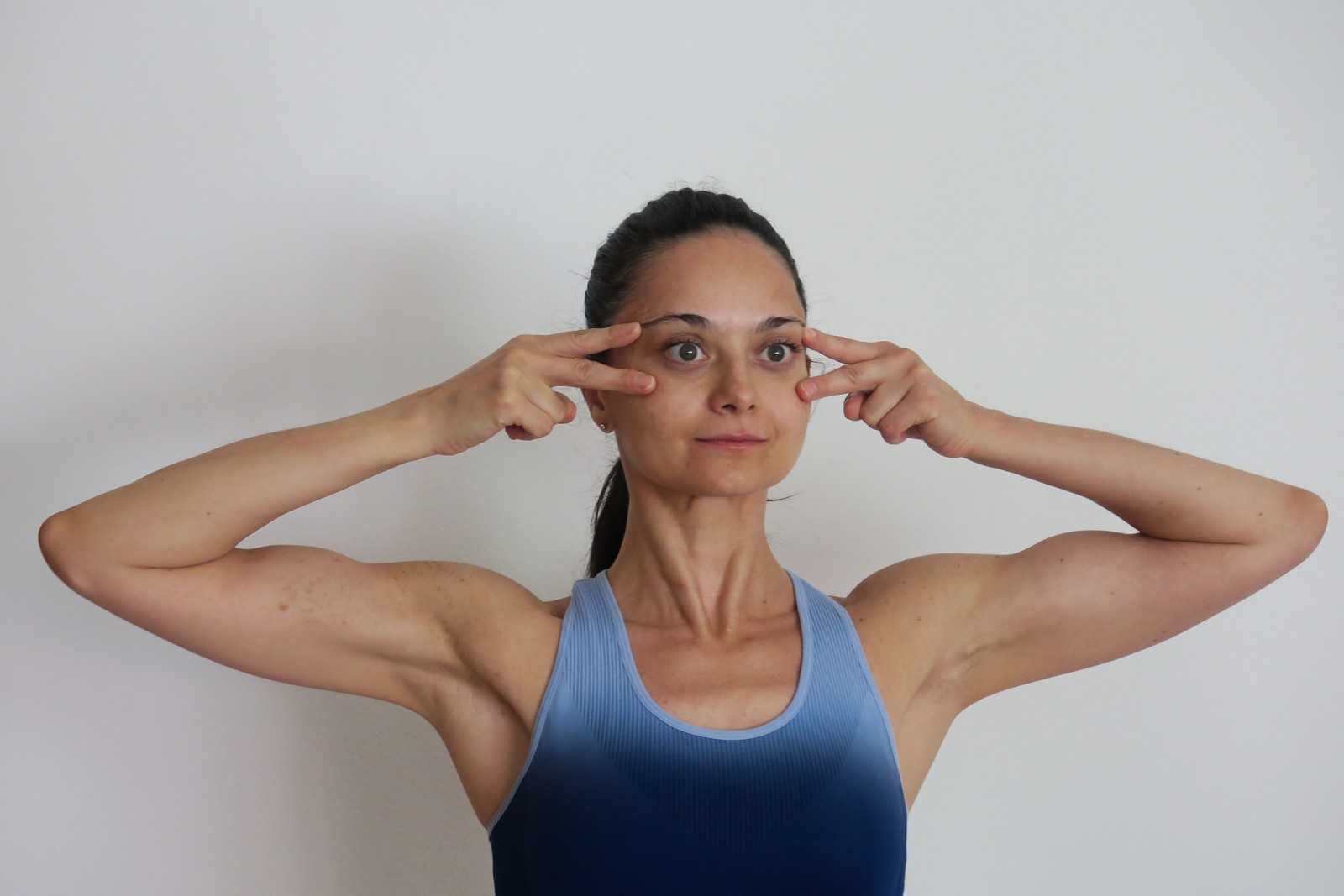
By acting directly on the facial muscles, both large and small. Over time, the larger muscles tend to dominate the smaller ones, leading to drooping eyelids and cheekbones that sag due to the effects of gravity. This process can be slowed by practicing facial yoga, for example, around the eyes and eyelids—areas where sagging can cause not only aesthetic issues but also problems that may require surgical intervention. Small muscles, resembling binoculars, are clustered around the eyes and connected to the scalp; by applying targeted pressure and massage, you can tone these muscles, reactivate fluid flow, and effectively counteract tissue sagging.
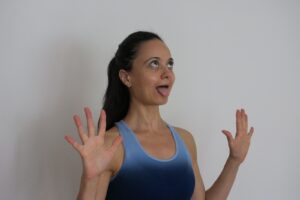
At what age is it recommended to practice it?
There isn’t a specific age range; let’s just say it’s never too late, but it’s best to start early to reap the many psychosomatic benefits of this practice over the long term, while developing a healthy relationship with your body. If you consider that physiological aging begins after age 25 (sic!), it’s a good idea to start addressing it while you’re still young; it goes without saying that the most visible benefits are seen in later life, thanks to a healthier and more youthful appearance. The important thing is to practice it consistently at any age.
How much time should you dedicate to this activity each day?
You don’t need to spend an hour a day practicing facial yoga; just a few minutes are enough to achieve tangible and visible benefits. You can even do it comfortably in bed or on the couch in the evening before going to sleep, preparing your face for a restorative night’s rest that counteracts fluid retention and helps you avoid waking up with those classic bags under your eyes. You can also do the exercises in the morning in front of the mirror while getting ready for the day.
Can you give us some simple examples of how to practice it?
Since the facial muscles are more delicate, it’s important to proceed gently with gentle exercises, tapping the skin with your fingertips or performing gentle circular massages to relax the skin—without applying excessive pressure—using slow movements that provide a pleasant sensation of relaxation and well-being. In the course I’ll be starting this October, I’ll begin with relaxation practices aimed specifically at rediscovering oneself and the joy of self-care.
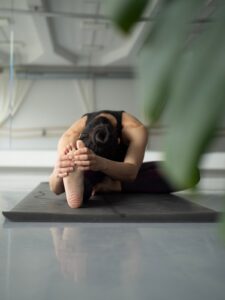 Beyond the aesthetic aspect, what are the benefits of Face Yoga?
Often, when we experience strong or mild emotional reactions, we unconsciously tend to clench our jaw, neck, and shoulders, resulting in muscle tension and harmful postures. Through targeted exercises that work on the nervous system via cyclical practices and actions such as tapping with the fingers on the areas affected by discomfort, you can soothe pain and restore muscle elasticity. More generally, Face Yoga also affects the psyche; by promoting inner harmony, it improves overall quality of life.
If you had to convince a skeptical person to devote ten minutes a day to Face Yoga, what would be the first benefit you’d tell them to expect?
It depends on how skeptical they are, but I’d like to answer with a story that happened to me recently. When I suggested to a friend of mine that she try it, she immediately cut me off, saying, “Face yoga isn’t for me.” Faced with her refusal—which she justified by saying she wasn’t interested in the aesthetic aspect—I asked her what she needed. She replied, “Inner peace,” giving me the opening to counter, “What better solution than Face Yoga?” That’s how I convinced her, by highlighting the dual benefits of this practice.
Thanks to Elena, we understand that Face Yoga isn’t just a way to observe our own faces, but an opportunity to reconnect with them. Slowly placing our hands on our faces, breathing, recognizing tension, and trying to let it go means pausing—at least for a few minutes—the noise of everyday life and reestablishing a gentle connection with ourselves.
The mirror, then, ceases to be a place where we search for flaws to correct and becomes a space for listening. Wrinkles, expressions, and the signs of aging are no longer merely things to be fought against, but traces of emotions and life to be embraced with greater awareness. The most important change may not be the one immediately visible to others, but the one we feel within: a sense of calm, presence, and reconciliation with our own image.
After all, Face Yoga doesn’t just promise a more relaxed face—it invites us to give ourselves time, attention, and care. Ten minutes during which we don’t have to look different, but simply rediscover ourselves. And it is perhaps precisely from this daily act of kindness that the most authentic beauty arises.
Info: Face Yoga & Somatics with Elena / Munich, Spoleto & Online
www.yogawithelena.org / elena@faceyoga-somatics.com / Tel. +49 163 666 6593