By Simone Bandini
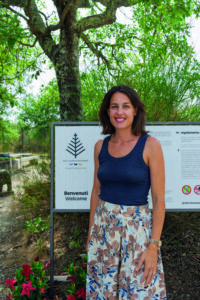
At the Chianti Sculpture Park, art is encountered while walking, amidst trees, light, and silence. It’s not a place to rush through, but a space to experience slowly, allowing yourself to be guided by the continuous dialogue between nature and contemporary creation. This is what Director Chiara Bozzi tells us, as she oversees the visitors, projects, and activities of one of the most original cultural sites in the region.
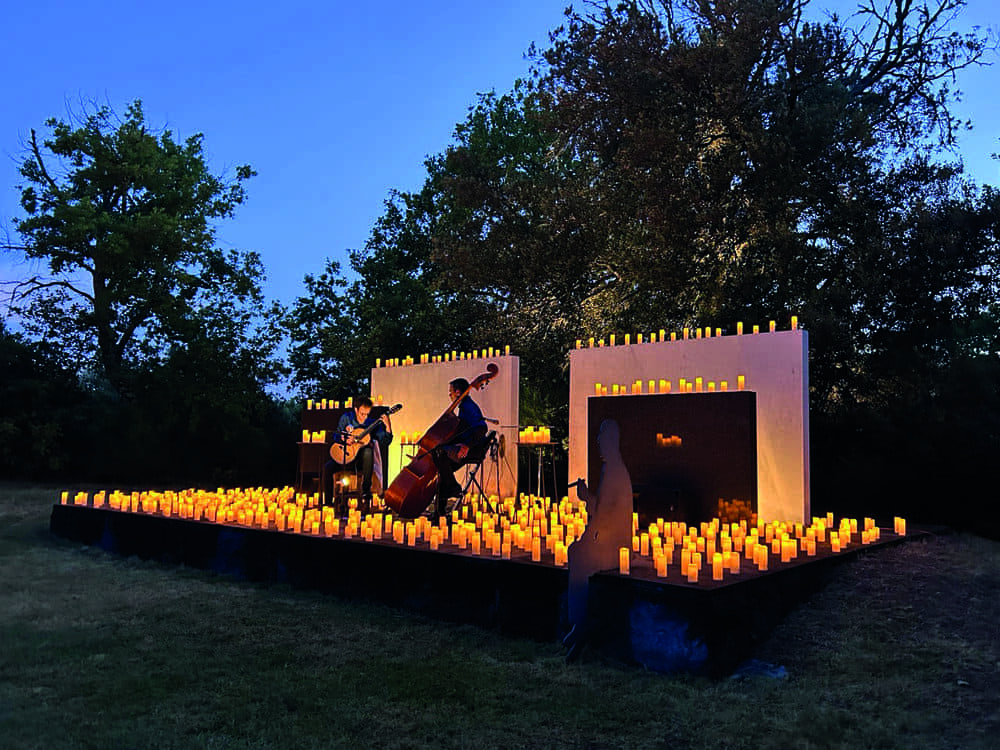
 The park’s summer kicked off with the first event of the sixteenth season of sunset concerts in the amphitheater. “We always hold them at 7 PM,” explains Chiara, “they last an hour and a half at most, and we try to offer different genres to appeal to diverse audiences.” Starting this year, alongside the music, there’s a new addition: a picnic-aperitif available by reservation, designed to be enjoyed before or during the concert. “We decided to offer it as a vegetarian option, with fresh items: a cold dish, a sandwich, two small sandwiches, and a flan.”
The musical programming truly reflects the park’s spirit: variety, curiosity, and openness. From the initial soul, jazz, and black music concerts, the offerings move to klezmer, a band inspired by Frida Kahlo, a big band, and international and Italian singer-songwriters. “The goal,” says Chiara, “is to satisfy a bit of everyone’s musical tastes.”
Chiara’s connection to this place goes back a long way. She lives nearby and started working at the park in 2014 while she was studying. After some experiences abroad and in other museum contexts, she returned permanently in 2018. Her path, encompassing languages, tourism, and art, seems to have naturally led her here. “I didn’t arrive here by chance,” she recounts. And indeed, today her role is an integral part of the evolution of the park, founded in 2004 by Piero Giadrossi and his wife Rosalba.
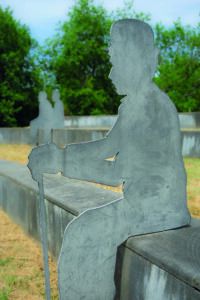 One of the most significant new developments in recent years is the opening of the area dedicated to temporary exhibitions, inaugurated in 2024, coinciding with the park’s twentieth anniversary. This space was created to complement the permanent collection and offer new perspectives, new languages, and new artists. “It was a bit of an excuse,” Chiara observes, “to also show how art, even in just twenty years, has changed, and to make space for emerging artists, both local and international.”
The current temporary exhibition is dedicated to the artist Li Yunfeng (Esther Li) and originated from an almost chance encounter. After visiting the park, the artist proposed a project deeply connected to her personal history and her cultural roots in Yunnan, in southwestern China. The result is “Love Never Fails,” an exhibition that explores human connections, time, and the female figure. “The message that resonates most,” says Chiara, “is that of shared time: true love is being together, being present.”
Alongside this exhibition, the park is also inaugurating a new semi-permanent installation by Marco Acquafredda, constructed from six hundred oak burls collected in the woods, chrome-plated in gold, and then returned to the landscape as small luminous traces. “They are like Hansel and Gretel’s breadcrumbs,” explains Chiara, “a way to get lost, but also to find your way back.” It’s a work that changes with the light, with the shadows, with the passing hours: just like many of the park’s installations, designed to exist in close relationship with the environment.
And this is precisely the key to the project: site-specific works, created for that location and capable of dialoguing with it. Nature is not a backdrop, but an active part of the artistic experience. This is also why the park collaborates with artists from all five continents; diverse countries, cultures, and languages, favoring multiple materials and approaches capable of harmoniously integrating into the landscape.
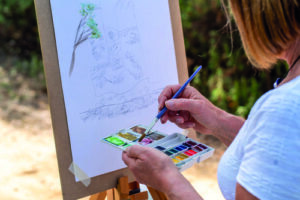
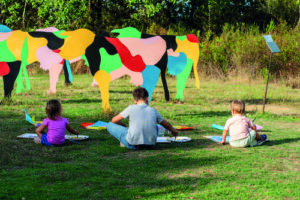
In recent years, the educational and outreach component has also grown significantly. The park organizes workshops for schools of all levels, guided tours, and activities for private groups. “Here, contemporary art is more accessible even to children,” explains Chiara, “because many works can be touched, observed up close, and compared with natural elements.” Tours are often customized, including in English, depending on the age and type of group.
There is also another important aspect: the park is increasingly becoming a place for naturalistic interpretation of the territory, with paths and activities that highlight the woods, biodiversity, and the relationship between artistic language and the environment.
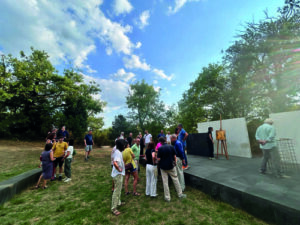
In Chiara Bozzi’s account, the Chianti Sculpture Park thus appears as a living place, in continuous transformation but faithful to its identity. A place where contemporary art meets nature without imposing itself upon it, and where every visit becomes an invitation not only to look, but to linger, listen, and be surprised.
Info: Parco Sculture del Chianti, SP 9 di Pievasciata, Castelnuovo Berardenga (Si) / tel. 0577 357151 / www.parcosculturechianti.it / info@parcosculturechianti.it