By Our Editorial Staff
The nice thing, sometimes, is that stories don’t announce themselves.
They sit next to you, order something simple, speak softly. That evening at dinner, Mirko was like that. No grand entrance like a world champion. Just a normal guy, with gentle manners, who, while breaking bread, tells the story of a life he has learned to balance. Like when you don’t win in the ring because you hit harder, but because you know how to wait.
Born Mirko Gori in 1974. Distinguishing features: multiple world kickboxing champion. Seven world titles to his name and an eighth belt, no less important, won on June 2: that of Knight of Merit of the Italian Republic for sporting achievements.
Between one chat and another, Mirko explains to me how kickboxing—born in the 1960s/1970s by merging karate, Muay Thai, and taekwondo—is one of the best choices for complete personal development: physical, mental, and emotional. It goes far beyond simple physical exercise. You train to face what life throws at you with clarity, balance, and self-respect.
As he talks, his face lights up: it is clear that for Mirko, this is not just a sport.
It is from this deeply held conviction, developed over time, that his new “challenge” was born: to bring this art into schools as an educational tool to talk about respect, awareness, and to combat bullying in all its forms—physical, verbal, social, and digital.
An idea that has also gained support from the UIR (Unione Insigniti della Repubblica Italiana), which has recognized its values and decided to officially endorse it.
A two-pronged project: body and mind
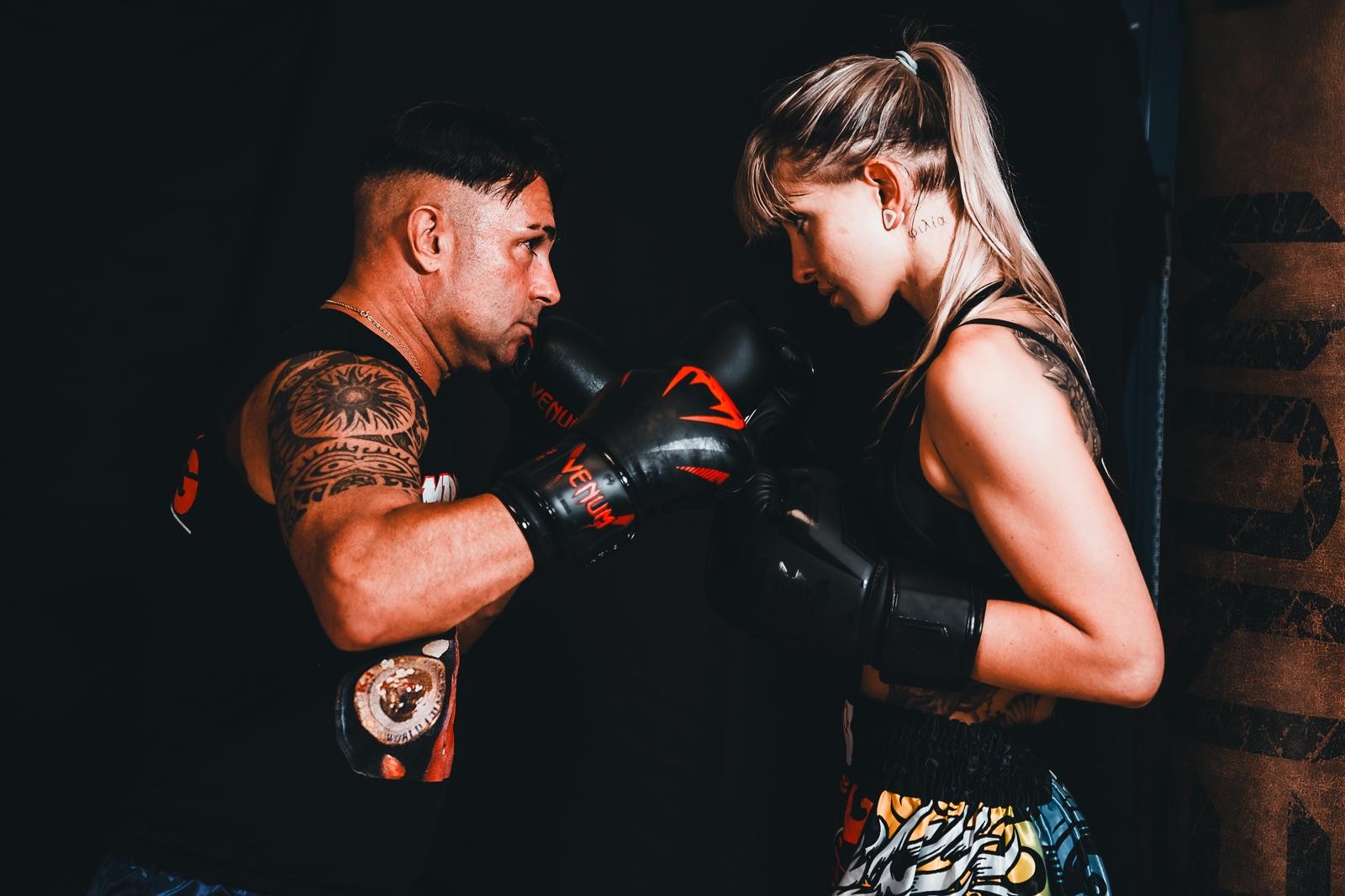
Alongside Mirko is another key figure: Sara Segoloni, a competitive athlete and psychologist, known in the ring as Sara Ares. “We work on two levels,” explains Mirko. “I deal with the physical side: posture, presence, space management, and emergency response. Sara works on the mind: emotions, stress, self-esteem, and the psychological consequences of bullying.” It is a comprehensive approach that helps young people not only to defend themselves, but above all to understand what is going on inside themselves and others.

Date zero: Cascia
The project already has a date zero that promises to set a precedent, literally:
When: Thursday, February 5, 2026 (from 8:00 a.m. to 1:30 p.m.)
Where: Beato Simone Fidati High School in Cascia (Perugia)
Who: Middle and high school students
No boring lectures: the course is designed to be practical, engaging, and immediately applicable.
Self-defense techniques, of course, for when all else fails. But with a strong focus on prevention. “Bullying arises when someone feels that they are only worthwhile if they take space away from someone else.” We will talk about posture, voice, and distance. About how to say “no.” When a young person perceives themselves as more capable, their way of being around others changes. They no longer communicate fragility.
Personal safety is a form of prevention and often becomes a resource for others.
Another pillar—covered by Dr. Segoloni—is understanding group dynamics. Because bullying is rarely a one-on-one duel: it is often a collective phenomenon, fueled by the silence of witnesses.
This is where education comes into play: understanding the dynamics of the “pack,” reading the signs of tension, and acquiring effective strategies to defuse conflicts before they escalate. Managing the emotional impact, maintaining clarity under stress. Just like in the ring.
“It’s a type of education that you then take outside the gym”: better listening skills, more self-control, more respect: for the instructor, then for the teacher, for your training partners, then for your schoolmates, who will later become your work colleagues. Respect for yourself. Respect for the rules.
A personal skill set that is a real competence.

A future to be “adopted”
Gori’s enthusiasm is contagious. He tells me how this is just the beginning of a series. After the success of past events, such as the one at the Palazzetto dello Sport Don Guerrino Rota in Spoleto in front of 700 students, the goal is to replicate the format wherever there is a need.
“The project can be ‘adopted’ by other institutions,” concludes Mirko, finishing his glass of water as if it were a post-match supplement. “We want to create a safe environment. The kids need to know that they are not alone and that they have the tools, inside and out, to face life.”
We say goodbye with a handshake that conveys confidence. I return home thinking that if our modern “Knights” are like Mirko Gori—champions who step down from their pedestals to enter classrooms and look young people in the eye—then perhaps, in the fight against bullying, we really do have a chance of winning.