By Rosina Fracassini
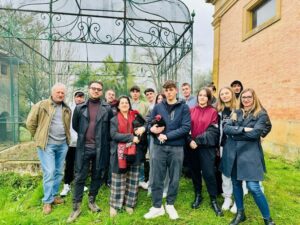
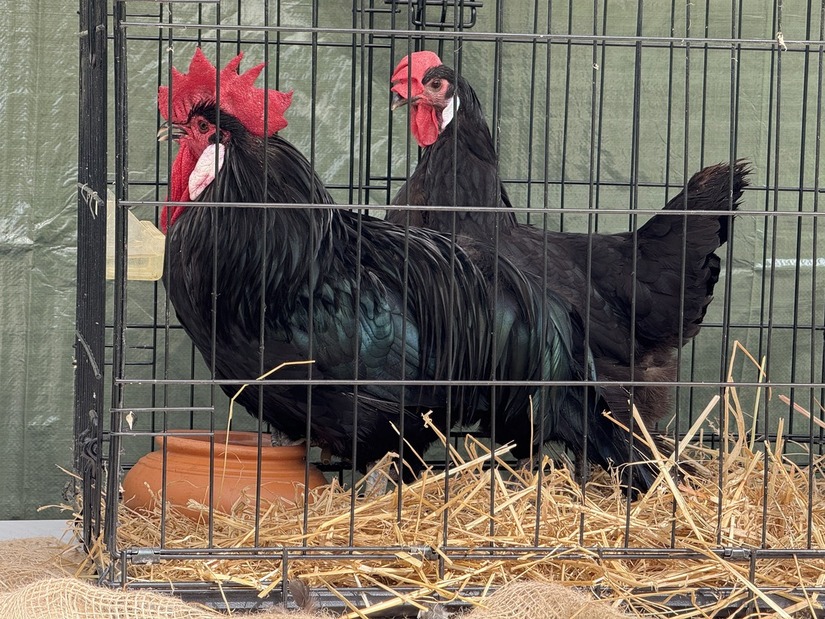
In the Chianti region—long a living laboratory of agricultural and cultural excellence—the Gruppo Archeologico Salingolpe of Castellina in Chianti has chosen to broaden its mission: not only the protection of historical and natural heritage, but also the preservation of animal biodiversity. Since 2019, the group has been leading a project dedicated to the rediscovery and promotion of the Valdarno chicken breed, the famed Black Rooster—the unmistakable symbol of Chianti Classico and a figure deeply rooted in the rural collective memory.
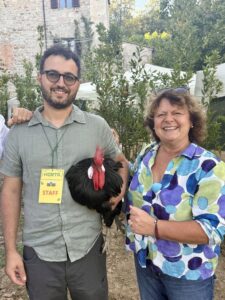 The idea was born from a simple yet surprising realization: the “land of the Black Rooster” no longer had any black roosters. Apart from a few specimens kept in a handful of historic farms, this native breed had virtually disappeared from Chianti’s countryside.
The Salingolpe Group thus decided to restore its visibility and dignity, bringing it back to where it truly belongs—among the courtyards, chicken coops, and olive groves of Chianti.
Thanks to the collaboration of Fattoria La Castellina, run by Tommaso Bojola, which provided large enclosed areas, the group was able to launch the first breeding projects. The initial stock was selected with the help of expert breeders and the Department of Agriculture at the University of Florence, to ensure a healthy genetic base consistent with the breed’s standards.
Hatchings occur both naturally, under brooding hens, and through incubators. The goal is not intensive production, but the reconstruction of a rustic, resilient population, capable of adapting to the local environment while maintaining its original traits.
In this spirit, the group has adopted a functional and zootechnical approach: focusing more on vitality, hardiness, and meat quality than on aesthetic perfection. Over the years, a network of breeders and enthusiasts has grown around the project—farmers, agritourism operators, and guardian breeders—who carry on the Valdarno line with passion, helping to make it visible again across the local landscape.
Each year, between 100 and 200 chicks are distributed, often free of charge, with the aim of spreading the breed and raising awareness of its conservation. Beyond its environmental value, the project has given rise to a beautiful social movement—a community of exchange, collaboration, and friendship built around a shared ideal.
Reviving an ancient breed, however, inevitably brings challenges. Many small-scale farmers, for example, prefer more productive breeds such as the Livorno or Isa Brown, but the Valdarno compensates with its hardiness, adaptability, and lively temperament.
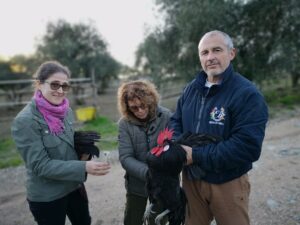
The main difficulties concern the lack of selective breeding, crossbreeding with other varieties, and at times insufficient attention to feeding and space management. For this reason, the group continues to organize meetings, training sessions, and widespread outreach to share good breeding practices and strengthen awareness of the breed’s value.
Collaboration with the University of Florence has recently led to the collection of biological samples for DNA analysis of the Valdarno breed, with the aim of studying its genetic variability and developing more effective breeding plans. The results of this research will be crucial for understanding the breed’s vitality and ensuring a more stable future for this precious example of local biodiversity.
Thanks to the commitment of many volunteers and the dedication of the Salingolpe Group, the Valdarno breed is slowly regaining its natural place—not as a mere exhibition curiosity, but as a living presence of the territory, embodying history, culture, and love for the land.
Info: Gruppo Archeologico Salingolpe, Via G. Verdi 34, Castellina in Chianti (Si) / www.grupposalingolpe.it / salingolpe@gmail.com / Photo Credits by Vito De Meo