By Our Editorial Staff
We meet again the architects Monica Rossi and Claudio Cencetti who talk to us in detail about the technique and aesthetics of renovation of a typical Sienese farmhouse in the countryside of Trequanda.
 A complex and stimulating challenge guided the designers on a path of balance between protection and innovation: on the one hand, respect for the historical memory of the building, and on the other, the desire to reinterpret it through a contemporary language.
The architectural and interior design intervention was curated by architects Monica Rossi and Claudio Cencetti together with the qualified team of the Archidomus Architecture Studio, of which they are founders. The Studio, with its consolidated experience in the recovery of historical architectural heritage, boasts a wide curriculum of projects carried out throughout Tuscany.
The technical and stylistic sum of this project aims at a superior balance of the architectural elements, achieved through targeted and tailor-made solutions: a dialogue between memory and contemporaneity, aimed at preserving the soul of the ancient farmhouse without renouncing a modern language: “The real challenge was to intervene with respect, allowing the past to continue to tell its story also through new design choices”.
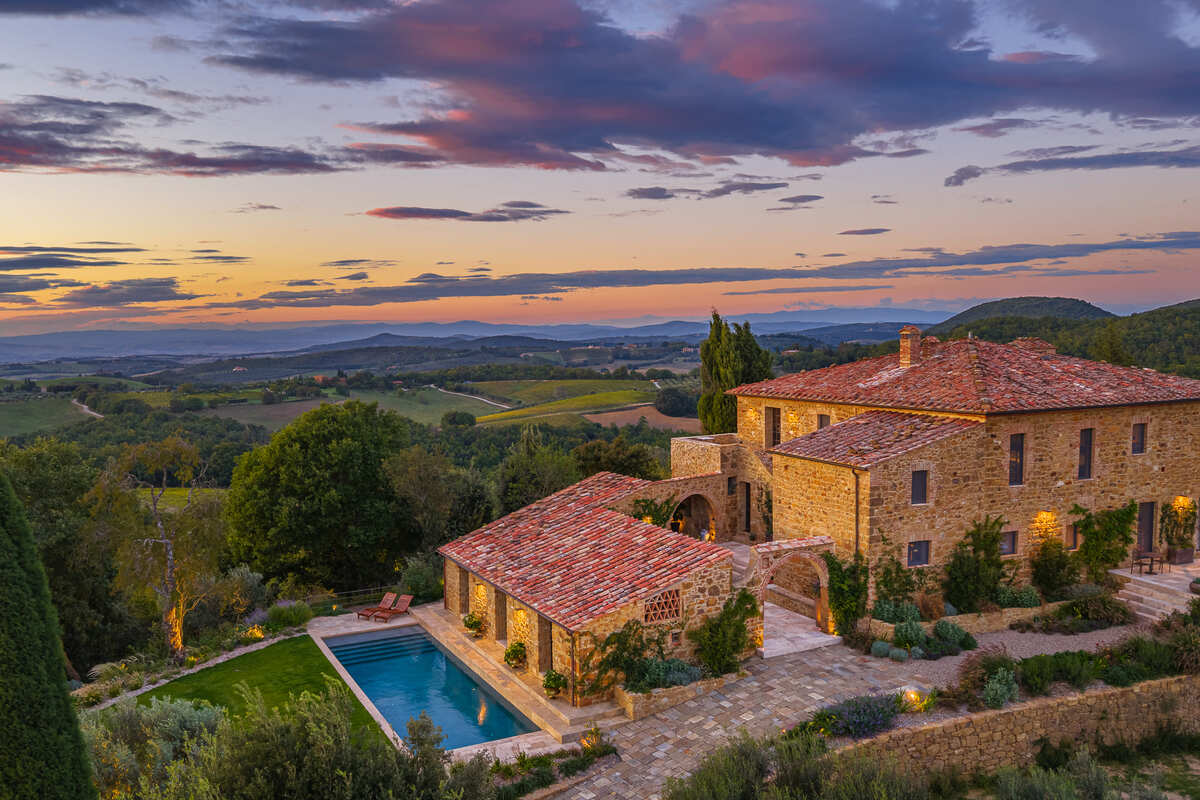
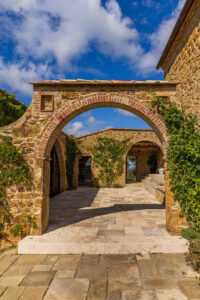
First of all, the intervention has preserved the clear legibility of the different volumes that make up the complex, enhancing the presence of two beautiful courtyards around which the architectural complex develops, the specific wall textures and allowing the original identity of each building to emerge.
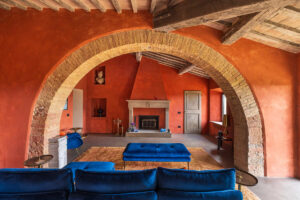
 In the interiors, the design language integrates current elements without neglecting the historical character of the building, avoiding forcing or artificial imitations. The plasters, applied by hand, respect and indeed highlight the irregularities of the underlying structure, while the pre-existing wooden structures have been recovered and brought back to life. The colour palette — composed of the natural shades of wood, lime and the materiality of polished concrete floors and reclaimed travertines — enhances the architectural qualities of the spaces and dialogues harmoniously with the furnishings.
It is a complete restoration of the old farmhouse, cared for with meticulous attention. Every detail is the result of an in-depth study and a constant presence on site by the designers, who have followed the evolution of the work step by step, collaborating closely with highly qualified workers. Architect Monica Rossi proudly points out: “The synergy with local artisans and companies — from the construction company to the carpenter, up to the blacksmith — represents an essential value, built over time through the selection of realities capable of guaranteeing high quality standards and contributing to the creation of unique environments”.
The choice of materials and furnishings is particularly refined: essential but sophisticated design elements, mostly designed and custom-made furnishings, are flanked by pieces of neoclassical taste, creating a balanced dialogue between eras and styles.
To unite and give rhythm to the spaces are the works of art, which become the true fulcrum of the farmhouse. Thanks to an extremely attentive client, with whom we shared the project and the great passion for art, the rooms have taken on an intimate and creative character, almost as if it were an atelier, where history, matter and light coexist in a natural, vibrant and refined balance.
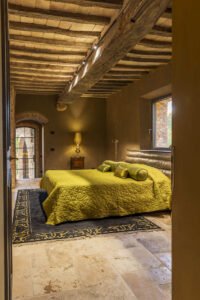 The restoration was followed with constant attention, step by step, thanks to an active presence on site and a close collaboration with local craftsmen and workers. It is precisely this continuous dialogue that has made it possible to develop tailor-made solutions and to take care of every detail with precision and sensitivity.
The selection and design of furnishings reflect the same spirit: pieces of contemporary design, essential and refined, alternate with elements of neoclassical taste, creating a harmonious dialogue between different eras.
Externally, the new design of the greenery is inspired by the tradition of Tuscan gardens, reinterpreted in a modern key. Around the building there is a system of gravel paths that connect the different functional areas: the ornamental garden, the relaxation area, the vegetable garden and the pool area.
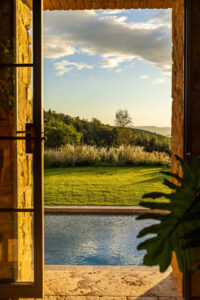
The central element of the intervention is the swimming pool, conceived as a blade of water that laps the historic building, establishing a direct dialogue between architecture and reflective surface. The basin, with a linear shape and infinity edges, discreetly approaches the stone masonry of the farmhouse, emphasizing its materiality and proportions through the play of relationships with the built.
The swimming pool was built near the lemon house, reinterpreted as a filter space between inside and outside. The recovery of the lemon house enhances its original function, hosting citrus fruits in large terracotta basins and becoming the scenic fulcrum of the garden.
 The vegetation is composed of native and drought-resistant species: cypresses to define the perspective axes, laurel and rosemary hedges to delimit the spaces, lavender and ornamental grasses to give movement and seasonality. The lighting, designed with low visual impact luminaires, emphasizes the paths, the plant wings and the surface of the water, creating an evocative atmosphere in the evening hours without altering the nighttime perception of the countryside.
Overall, the intervention is configured as a project of sensitive integration between architecture, water and vegetation, capable of restoring to the farmhouse a context consistent with the Tuscan tradition, but reinterpreted according to a sober and elegant contemporary language.
Info: Archidomus Studio di Architettura
– Via XXVIII Settembre 13, Chianciano Terme (Si) / Tel. 0578 30100
– Piazza della Chiocarella 5, Pienza (Si)
Architetti Monica Rossi (Tel. 335 8198461) e Claudio Cencetti (Tel. 333 3873462)
www.archidomus.org / info@archidomus.org / Instagram: @archidomus