By Our Editorial Staff
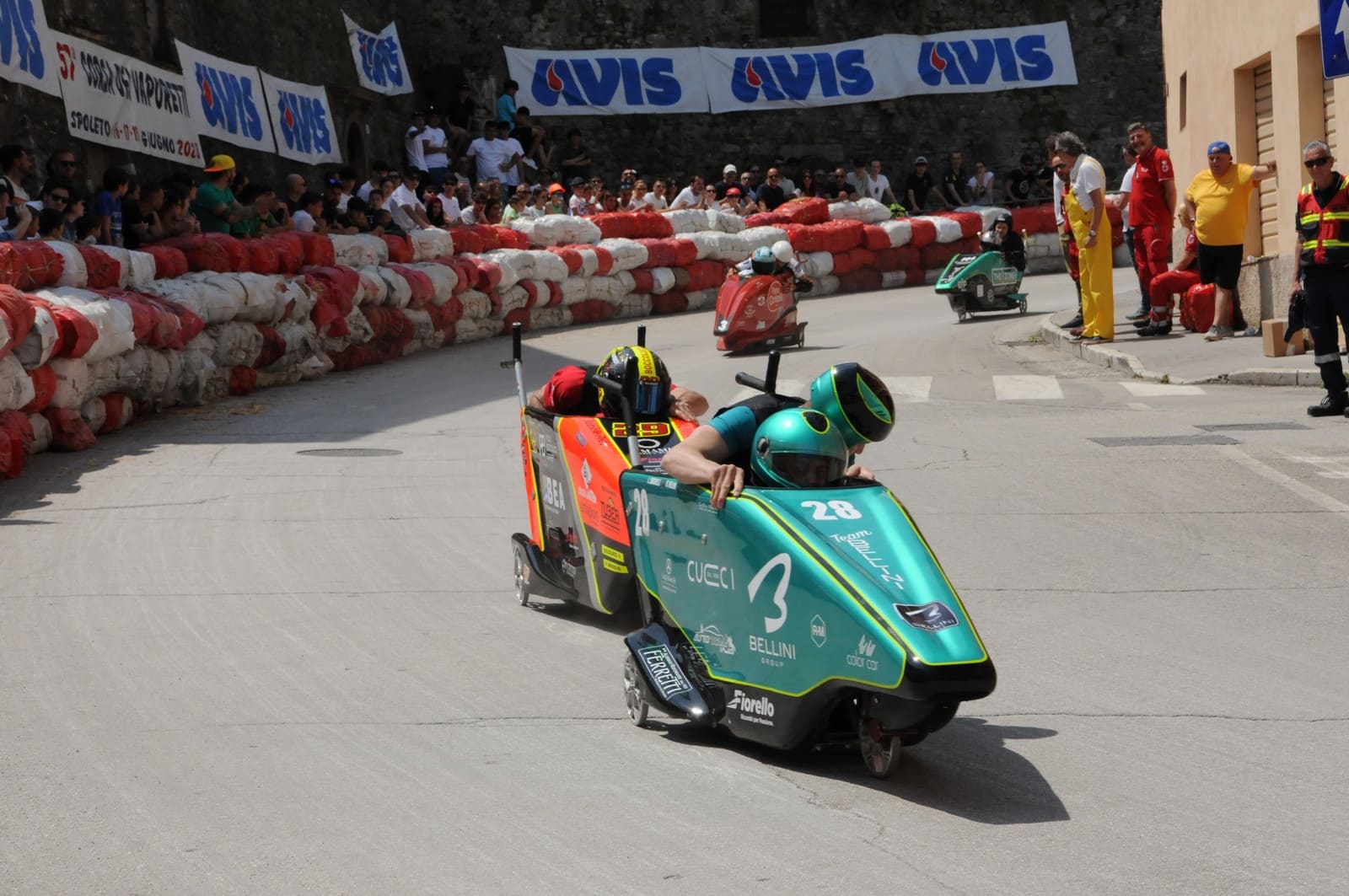
The historic Corsa dei Vaporetti is about to reach a milestone that reaffirms its status as the most beloved community race among the people of Spoleto.
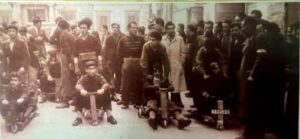
In Spoleto, they say you’re not a true Spoletino if you’ve never participated in the Vaporetti Race. Urban legend or truth?
The fact is that this event, which began in the post-World War II era and has continued to the present day—albeit with a few interruptions that disrupted its continuity—is cherished by families with the same devotion as a palio or, at the very least, as a defining event for their community. This explains the Vaporetto fever that takes hold from an early age, the desire to test their mettle in that wild race through curves and downhill stretches that ignites an almost futuristic passion for speed. Today, the Vaporetti are preparing to celebrate the 60th edition, which will take place from June 11 to 14. First, on the 11th, the crews’ presentation will take place; on the 12th, the practice runs; and on the 13th and 14th, the race. Then, on June 20, there will be a grand closing dinner with the election of Miss Vaporetto. Essentially, it is a race deeply felt by both the participants and the public, one that manages to engage just about everyone, because here, more than at other events, a strong sense of community. There are also those who have been passionate about it since childhood, training on the Collerisana slope or the Monteluco dirt road, with the idea that one day they would be the stars of the show.
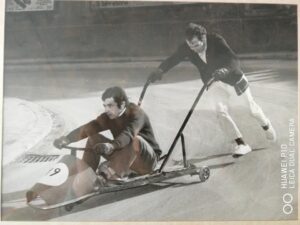
The Pusher (the one who pushes) and the Pilot
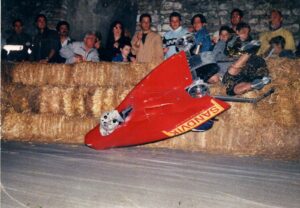
The team consists of two athletes: the pusher and the pilot. The pusher must be strong and physically fit to ensure a powerful initial sprint, while the pilot must be able to control the cart and make it fly. A clear head and determination are essential for the driver; precision and sangfroid are needed to tackle the curves and shape the course, otherwise there’s a risk of skidding into the bales lining the track or, worse, into some unwary spectator—even though the course is dotted with medical stations ready to intervene promptly in case of an accident.
A great deal of work goes into building the vaporetti; each participant builds their own, nowadays with professional assistance. There is competition, of course, but also a strong sense of sportsmanship: during a heat, common sense dictates that if a competitor falls, their vaporetto is promptly stopped by an opponent demonstrating said sportsmanship. This, too, contributes to making the race an occasion for socialization and friendly competition. The audience is diverse; many claim they are enthusiastic about this tradition, which now also draws people from outside the area to watch the race. The final is celebrated with a dinner for participants and supporters amid rivers of champagne and toasts, sealing the crowning of Miss Vaporetto, which brings the event to a spectacular close.
Steamboat or Mine?
It’s a short step from a steamboat to a steam-powered vehicle, as Fabrizio Luchetti, president of the organizing association, explains: “This race began in 1948, coinciding with the Festa della Matricola (Matriculation Celebration). The first race was won by the Ruggeri-Favara duo, but even before that there are references to the first rudimentary racing cars built by young people from Spoleto who ingeniously transformed bathtubs, wheelchairs, or wooden planks into vaporetti. We must, in fact, note that the “vaporetti” have a “pre-war” tradition and are called vaporetti because they resembled the steamboat that for a few years covered the Spoleto-Norcia route; it was a coach with all French drivers, likely because of the French company that operated the vehicle, to the extent that the drivers were called “chauffeurs”. From the very beginning, this board with two handles developed a strong appeal, becoming a favorite pastime for both children and adults. Beyond the name, it is still not entirely clear what inspired their origin. There are two hypotheses: one refers, in fact.
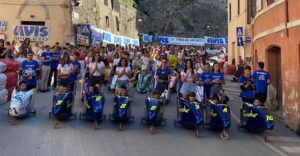
From Winter to Summer
Younger people don’t know—unless their grandparents have told them—that the first editions of the vaporetti didn’t take place in June, as they have for many years now, but rather in winter, on Epiphany.
The Befana race was inspired not only by the Matriculation Celebration but also by the miners’ festival held in the interwar years; on that occasion, carts were filled with sweets and gifts to be given to children. For a while, a second race was held in May; then, since the late 1990s, it has been held in June.
What Makes Them Unique
Similar races have always been held in Umbria and beyond, but what makes the vaporetti unique?
For Fabrizio Luchetti, President of the organizing committee since 2012, there are two reasons: “The enthusiasm they spark in young and old alike, and the fact that it’s the only race where four teams start together rather than one at a time, which unleashes an adrenaline rush that captivates and infects the crowd of fans and spectators.” The vaporetti bring everyone together; they have the power to foster teamwork not only during the race but also in the organization.
The president is keen to thank his predecessors: “In particular,” he notes, “those who revived the event after long hiatuses, such as the suspension from 1987 to 1995, when my brother Mauro and the then-president Settimio Leoni played a decisive role in resuming the race in 1996, or the hiatus from 2007 to 2011, where credit for the restart goes to AVIS, chaired at the time by Sergio Grifoni, a figure of great importance to the event. Furthermore, at various times, other figures such as Oreste Fienauri and Roberto Fagotto have distinguished themselves and undoubtedly contributed to writing the history of the vaporetti. A heartfelt thank you to AVIS for the constant support provided in every edition, to the institutions, to the Diocese which has welcomed all our requests, to the CARISPO Foundation which has always supported us, and—in addition to the municipal and regional public administrations—to the local population whose enthusiasm has enabled this race to continue to this day and to look toward the future”
A top-notch event, but what a lot of work!
Fabrizio Luchetti highlights the efforts made in recent years to make the Corsa dei Vaporetti accessible online as well, through a high-impact social media presence and a video channel. Putting together 60 crews, Bringing together 60 crews, including 12 underaged and 4 all‑female teams, is no small feat: “The great thing is that this year we received more applications than we could handle from minors,” explains the president, “which gives us hope.”
In his many years at the helm of the event and with a background as a pusher, Luchetti makes no secret of the fact that there have been, and still are, problems. Of course, given the scale it has reached, it is no longer an amateur competition, but has become an event that mobilizes a massive crowd and requires significant investments, including in safety ones: “Today it’s not easy to raise money from sponsors, whether public or private,” admits Luchetti. “As for local businesses, I’m seeing a lack of coordination; sponsors are scarce—an unease also stemming from the entrenched crisis our city has been facing for years. This is one problem; another is the lack of generational turnover, though I have faith in the young people.”
The upcoming edition promises to be exciting from an organizational standpoint as well. Three giant screens will be set up under the direction of “Strani Rumori,” a leading multimedia company based in Trevi (which, among other things, covers Bocelli’s concerts around the world), along with 10 high-definition 4K cameras positioned along the route. The entire event will be live-streamed, attracting thousands of viewers. It is possible to stay updated on all the latest news and highlights of the race via the official Facebook and Instagram profiles—@vaporetti_spoleto—which we invite to follow.
In short, the vaporetti certainly don’t show their age, even though the way they’re raced and built has changed; what hasn’t changed is the passion that drives those who build and pilot them.
Info: Associazione Vaporetti Spoleto ASD, Via F.lli Cervi, 19/21 – Spoleto (PG) / www.vaporettispoleto.it