By Our Editorial Staff
An ancient tradition has it that Foligno – in the centre of Italy, which is at the centre of the Mediterranean, which is at the centre of the world – is precisely “lu centro de lu munnu“. If in the nineteenth century this focal point was identified in the “lu tribbiu”, i.e. at the intersection of the main streets of the historic centre, around the first half of the twentieth century it was identified in the red skittle placed in the centre of the billiard table of the central bar of Foligno, the historic Gran Caffè Sassovivo, along Corso Cavour.
Whether it is really the perfect centre of the world is all to be verified, but certainly Foligno has always been a bit “in the middle”: for its important railway hub and for its commercial vocation, for its strategic position that makes it a perfect base for visiting Umbria (even by train or bicycle), for the historical, cultural, sporting and food and wine events that over the years have brought many tourists here and finally because Foligno is a real jewel of history, architecture and nature.
Over the centuries many important people have had a connection with the city. Among them Frederick II of Swabia, who lived his childhood here; Dante Alighieri, because the first copy of the Divine Comedy was printed in Foligno and St. Francis of Assisi, who frequented the city that was the scene of some fundamental episodes of his life.
Foligno Franciscan city
Francis began to “be” St. Francis in Foligno. In fact, he came to Piazza della Repubblica, which hosted a large market like many squares of the Middle Ages, to sell fabrics and his horse to find the money necessary for the restoration of the church of San Damiano in Assisi. By stripping himself of his possessions, he made a revolutionary gesture, his first evangelical act, commemorated here by a marble plaque affixed to the façade of the Palazzo delle Canoniche and by a singular and fascinating bronze sculpture, the “Deed of sale of fabrics” by Pietro Battoni.
In the following years a small Franciscan community was born in the city, near the current Church of San Francesco, built on the ancient chapel of San Matteo. Here, according to tradition, Brother Elias had a dream of the imminent death of the Saint, who drew inspiration from it to add to the Canticle of the Creatures the verses dedicated to “our sister bodily Death”.
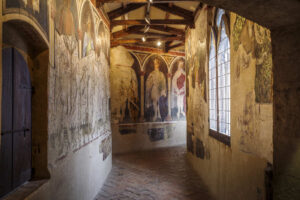
The figure of St. Angela of Foligno, who lived in the second half of the thirteenth century, a Franciscan mystic and tertiary, is linked to St. Francis. The Church of San Francesco has now become the Sanctuary of Santa Angela da Foligno and houses the remains of the Saint.
The historic centre of Foligno is also crossed by the Via Francigena di San Francesco (stages 9 and 10), an important pilgrimage route that connects Assisi to Spoleto in this section.
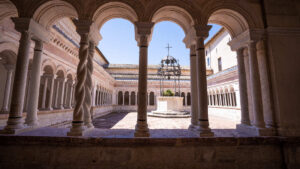
Art and culture in the historic centre
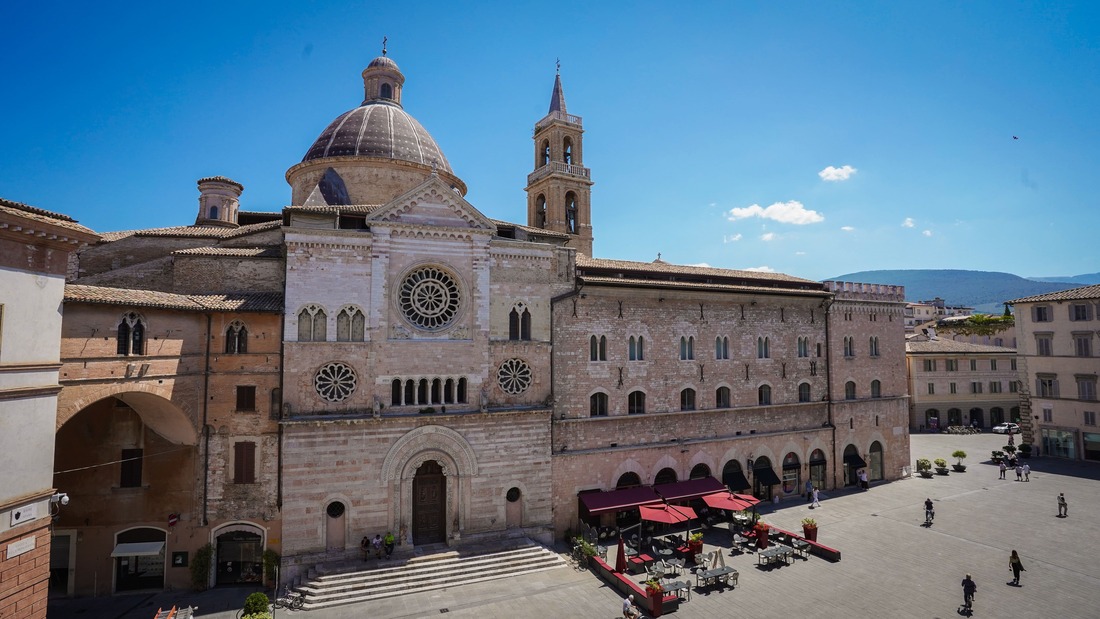
To visit Foligno you can start from Corso Cavour, the main pedestrian street of the city that leads straight to the central square, Piazza della Repubblica. Here overlook the main buildings of the city, first of all the beautiful Cathedral of San Feliciano, recently restored, with the adjacent Palazzo delle Canoniche seat of the Diocesan Museum.
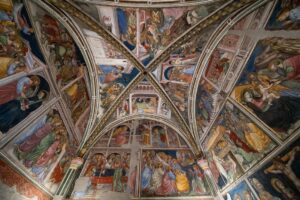
In front of the cathedral stands the imposing Palazzo Comunale, an elegant neoclassical example and not far away Palazzo Orfini, home to the ancient Foligno printing house which now houses the Museum of Printing. On the other side of the square is Palazzo Trinci, home of the lords of the city from 1305 to 1439. It is absolutely worth entering to visit its splendid interiors: Home to the City Museum, it is an extraordinary testimony of late Gothic architecture, famous for its fifteenth-century pictorial cycle attributed to Gentile da Fabriano and for the Chapel completely frescoed by Ottaviano Nelli. The visit of the centre continues among museums, churches, oratories, squares and facades of the ancient noble palaces: discovering Foligno, in fact, also means looking up often to see the evident evidence of a city with a past rich in history and culture, marked by the vocation for trade and exchanges since medieval times.
Among the works of art not to be missed, the Baptism of Jesus by Pergino, kept at the Oratory of the Nunziatella and the Cosmic Magnet by Gino De Domicis, an amazing contemporary work set up at the former Church of the Holy Trinity in Annunziata.
Villages and nature outside the city
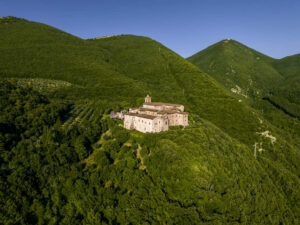
In spring and summer, the vast territory that extends just outside the historic centre offers many opportunities to enjoy lush nature and the enchanted atmosphere of small villages.
The hills that harmoniously surround the city are part of the Assisi – Spoleto olive belt: recognized as an agricultural heritage of world importance by the FAO, currently towards the Unesco candidacy, here the excellent extra virgin olive oil of these areas is born.
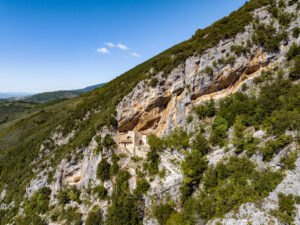
Just above the olive belt, immersed in a protected park, stands the imposing Benedictine complex of the Abbey of Sassovivo, which is certainly worth a visit and a walk in the centuries-old holm oak forest that surrounds it.
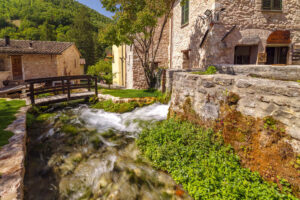
Another of the most fascinating areas is undoubtedly the Valley of the Menotre River, where nature meets history and water is the protagonist. Here you will find enchanting villages such as Pale, known for its karst caves, the ancient Hermitage of Santa Maria Giacobbe, the climbing routes and Rasiglia, called “the village of waters” for its streams and canals that flow through alleys, stone houses and ancient factories. The Altolina Park, which surrounds this valley, offers hiking trails surrounded by nature and breathtaking views, with waterfalls and cliffs that make every walk an unforgettable experience.
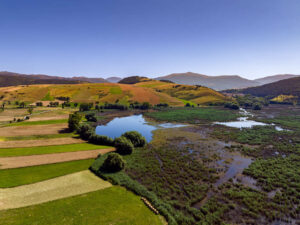
Going up towards the Apennines you reach the Colfiorito Park, a protected area known for its high-altitude marsh, one of the most important in central Italy. A landscape of rolling plateaus that is home to numerous species of migratory birds, ideal for birdwatching and nature photography. The park offers paths, viewpoints and two museums, naturalistic and archaeological. Gastronomic excellences are much appreciated, from cereals to legumes, up to the renowned lentil and IGP red potato.
In fact, coming to Foligno also means enjoying a quality food and wine offer, linked to tradition and local products.
Info: Ufficio Informazioni e Accoglienza Turistica (Iat) Valle Umbra / Porta Romana, Corso Cavour 126, 06034 Foligno (Pg) / Tel 0742 354459 – 354165 / email: servizio.turismo@comune.foligno.pg.it / www.comune.foligno.pg.it/turismo/ facebook e instagram: visit.foligno