By Beatrice Botticelli
“The commercial side, however important and personally rewarding, has never fully appealed to me. What I found stimulating, however, was the chance to take on a need, a problem—the idea of turning a helping relationship into a profession”. It is from this very precise image of his own work that Gilberto Ballerini begins the story of over forty years of activity at Audiomedical (in Pistoia, Via Panciatichi 16), a company founded in 1982, when the world of hearing aids in Italy was still a vague concept and the equipment was very different from what it is today.
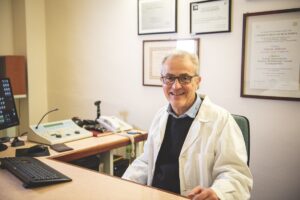
Before that, Ballerini had gained experience in radio: as an editor at Radio Pistoia during the early years of independent broadcasting (he recalls how, in 1978, he was active in the local area with interviews and radio reports on the kidnapping of Aldo Moro), at a time when listening and communicating already meant becoming part of people’s lives. Then came the introduction to the hearing aid sector and a profession that was still in its infancy: “I imagined a scenario that didn’t yet exist”, he recalls.
“There were no clearly defined professional roles, technology was rudimentary, and knowledge of hearing was far more limited. But together with other colleagues I was studying with in Milan at the training school organised by our professional association and taught by professor Azzo Azzi, we sensed that in that context there was an opportunity to establish a profession”. At first, the work also involved pharmacies, inviting people in, and devices being offered in a context that was still heavily commercial. But even then, Ballerini was looking for something else: “My goal has always been to be able to combine a personal lifestyle with a field of knowledge in which I could be useful”, he explains.
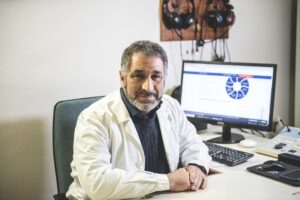
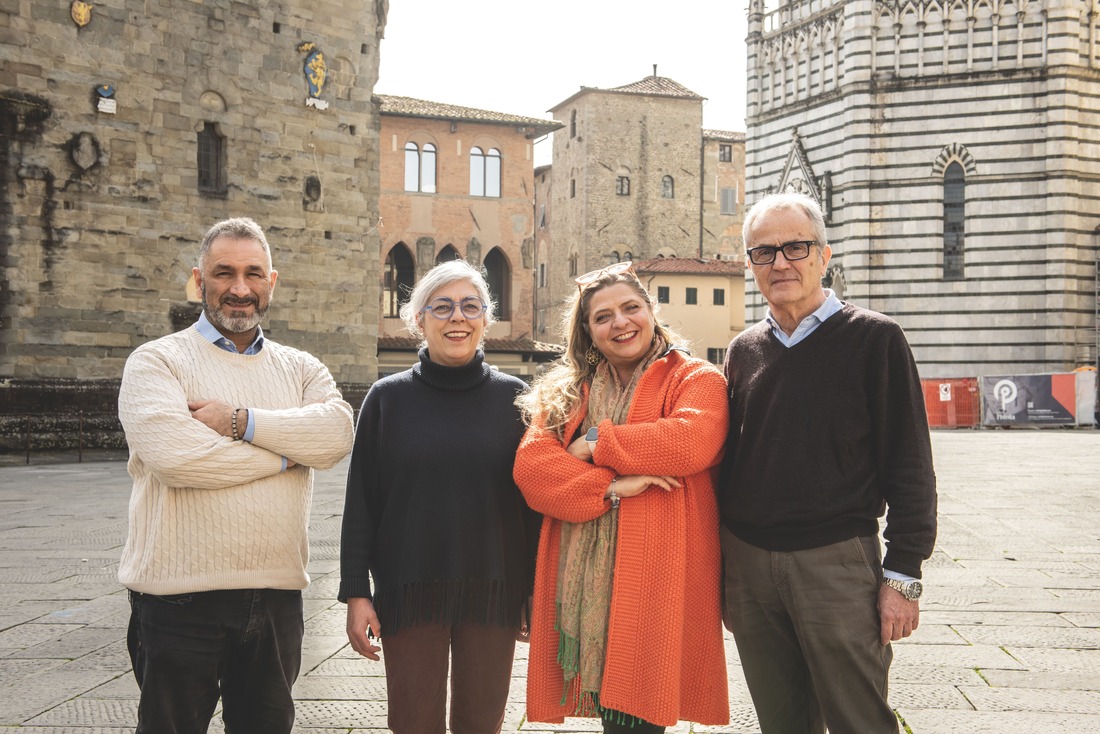
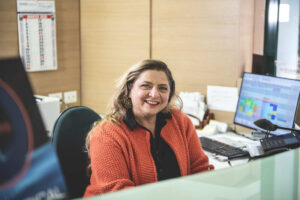
“The idea of beauty that could emerge from this activity was precisely that of entering into a relationship characterised by highly technical skills that had a profoundly human significance”. A vision that has solidified over the years, becoming the hallmark of Audiomedical. This approach is also consistent with the values promoted by Anap – the National association of professional hearing aid practitioners – which served as the sector’s long-standing reference point prior to the establishment of the Tsrm-Pstrp healthcare association in 2018. On this basis, Audiomedical has consolidated its business, which today relies on a team comprising the owner, Gilberto Ballerini, and Giuseppe Marazia, both hearing aid technicians, supported in reception and administration by Elena Bernardini, co-owner, and Elena Maltinti, a qualified sign language interpreter.
“The real difference lies in how you approach the person in front of you: someone who entrusts you with a health issue can be perceived simultaneously as a client, a user, or a patient”, observes Ballerini. “If correcting hearing is reduced to selling a hearing aid, we lose the meaning of our work. If, on the other hand, we recognise the person and the importance of the relationship, then everything changes: the language, the time you devote, the responsibility”. Because the crux of the matter is not just hearing but being able to engage in communication. “To quote Hellen Keller, the deafblind American journalist: Blindness separates people from things. Deafness separates people from people”, adds Ballerini.
“For years, talking about deafness was difficult”, he continues. “There was a sense of shame, but above all, there was a lack of awareness. Deaf people were perceived as people who couldn’t understand”. This is one of the reasons why Audiomedical has invested heavily in prevention and health awareness: research into quality of life, public meetings, and initiatives focused on communication. Because “information is already prevention”, says Ballerini. Since 2005, this vision has been firmly intertwined with that of Giuseppe Marazia, who arrived in Pistoia after gaining experience in the hearing aid sector but, above all, having grown up in a family environment where hearing aids were part of everyday life. “My father was in this trade when the profession didn’t even formally exist”, he explains. “He had a technical background in electronics, back when the focus was mainly on repairing devices. I grew up in that environment, right from childhood”. The meeting with Ballerini took place during his university studies. Then the collaboration began to take shape: “When I arrived here, I found exactly what I thought this profession should be: a focus on the individual, autonomy, responsibility”.
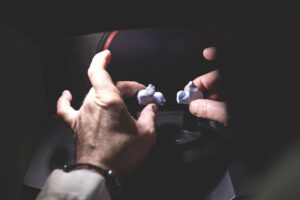
For Marazia, the point remains the same: “Many people still say today: ‘I sell hearing aids’. For me, it’s not just that. The hearing aid specialist acts as a bridge between a health issue—hearing loss—and its correction. The hearing aid comes later”. First come the time spent listening, raising awareness, and the journey that helps the person accept and tackle the problem: “The first few hours of our work are often spent on this: guiding the person from recognising a difficulty to saying ‘I’m going to do something about it now’”. Meanwhile, technology has changed profoundly. Today’s devices recognise sound environments, pick out voices and improve the signal-to-noise ratio. But, as both observe, that is not enough. “Technology helps enormously”. explains Ballerini, “but today we also know much more about how the brain works: attention, memory, concentration and emotion all play a part in understanding”. And it is precisely here that the health service should be called upon to meet technology: in the ability to transform innovation and knowledge into a bespoke pathway, where the professional act does not amount to simply handing over a tool, but to taking genuine responsibility. “The challenge today”, concludes Marazia, “is to remain true to this approach to the profession, amidst increasingly intense market pressures. But that is also why we continue to do it”.
Info: Audiomedical, Via Panciatichi, 16 – Pistoia / Tel. 0573 30319 / www.audiomedicalpistoia.it