By Riccarda Riccò
At the foot of Monte Cimone, where history meets untamed nature, discover a thousand-year-old village that welcomes ski lovers – and so much more.
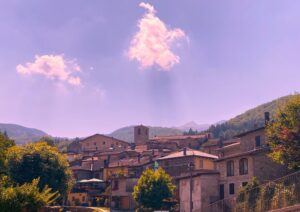
 On the slopes of Cimone lies a pearl nestled inside its shell: Riolunato, a precious jewel of stone houses and slate roofs, its perfectly preserved historic center embraced by the Apennine mountains and tucked away at the bottom of the valley, along a bend in the Scoltenna stream.
Like a gem hidden in its casing, Riolunato is hard to see from the main road. You have to stop, visit, and discover it. Take your time, breathe deeply, savor each moment, and let life move at a slower pace. The historic center’s heart is Piazza del Trebbo, and the village is best explored on foot. And, as an old farming tradition reminds us, the sweetest almond is found in the smallest shell.
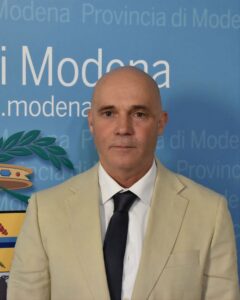
The town’s mayor, Lorenzo Checchi, knows this well. He smiles as he says: “Although Riolunato is the smallest town in the province of Modena in terms of population, it truly has so much to offer: culture, nature, and age-old traditions. In terms of scenery, there’s the Polle area, already an important ski destination and now attracting renewed interest thanks to the summer opening of the lift that takes visitors up the mountain. Then there are the beautiful Pollina Falls on the Rio Monio, where the water tumbles down cascades tens of meters high. They, too, have recently been developed and now draw huge numbers of visitors.”
Polle, skiing, Pollina, waterfalls, river.
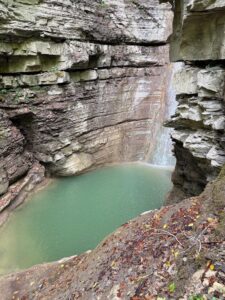
Water, life. Water gushes from natural springs and fountains, flows through a rugged, untamed gorge – one of the deepest in the Modenese Apennines – and, along the canyon’s ravine, passes rocky ledges and smaller drops that create little waterfalls and natural slides before the Rio Monio flows downstream into the Scoltenna.
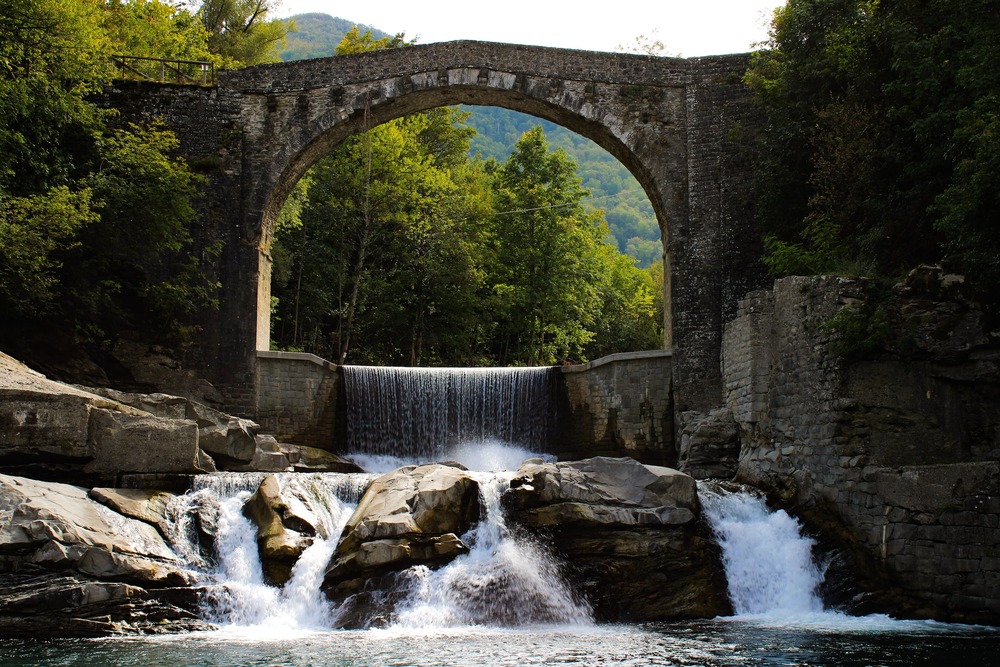
Water and moonlight, pure poetry: the ancient stone humpback bridge over the river is called Ponte della Luna, or Moon Bridge, and right beside the medieval village, the stream traces the distinctive crescent of the silver moon – perhaps the inspiration for the town’s name: Rio Lunato.
Pollina Falls lie right beside the remains of an old, ruined mill, historically known as the Pollina Mill. This is the most spectacular spot, thanks to a single, striking vertical drop of nearly 20 meters, plunging into a large round pool carved into the rock by water erosion and known as the “giant’s pothole.”
Or perhaps the town takes its name from the Rio de Lonata (now called Rio Torto), the local river that descends from Monte Cimone, once known as Alpe Lunata.
References to water are endless, and they tell us so much.
At 1,280 meters above sea level, Le Polle was simply a mountain place “where water pulses and springs from the earth.” Today it is much more: a modern ski hub in the Cimone ski area and the true economic engine of Riolunato. The historic centre is the cultural heart of the municipality, while this mountainside hamlet is the lifeblood of its modern economy – the Frignano’s white gold, bringing in revenue, growth, and jobs.
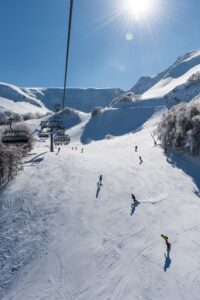 “We really focus on winter and skiing,” says the mayor, referring in particular to après-ski events in the Tuscan-Emilian Apennines, where Le Polle in Riolunato is the undisputed center of the entire Cimone ski area.
“They’ve now gained national attention,” Checchi explains. “People come from outside the region to see these parties held after the lifts close. There’s a significant turnout at the Tana del Lupo mountain hut.”
Mountain parties, valley festivals, and the beauty of a village dating back to the 1400s, where every corner whispers, every coat of arms tells a story, and every doorway is an ornament.
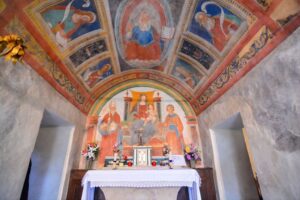
Among the sights are the stone nativity scene in Groppo, built by Giancarlo Amidei; the sacred fresco from 1462 on the façade of Casa Gestri; the noble residences; and the parish church of San Giacomo Maggiore, with its altarpieces from the school of Guido Reni. There are also historic churches and ancient Romanesque parish churches in the surrounding area. In Castello stands the Oratory of Caio, where visitors can admire a 1516 fresco – a treasure of Renaissance art known as the “Sistine Chapel of the Apennines.”
The local food and wine scene rounds out the experience, with inns and restaurants recognized for their quality. And then there are the accommodations: “We’ve gone from three or four thousand overnight stays a year to twelve thousand,” the mayor explains. “The number of non-hotel accommodations has soared – from 3 or 4 to 36 or 37- with lots of B&Bs, room-and-breakfasts, and short-term rentals. It’s a remarkable sign of the area’s growing appeal to tourists. Of the 1,200 households, 800 are second homes.”
 The climate is a draw in both summer, when it’s cooler than in the lowlands, and winter. If winters aren’t cold enough for snow, snowmaking systems keep the slopes open. “The municipality has made a number of costly improvements, and together with the consortium, we’re working in tandem to extend the period when people can enjoy the ski slopes,” says the mayor, adding: “Beyond that, we’re active all year round and always looking to offer new experiences, facilities, and services – for example, Parco della Luna.”
The area is thriving, as shown by the many families who have moved back from the city to Riolunato, thanks to expanded Wi-Fi coverage and remote work. But in the end, why? Why leave the comforts of the city and live in the mountains all year round? For the history, nature, sports, or climate? The mayor’s answer comes down to just three words: quality of life.
Info: Tourism Office, tel. 0536 75119 / e-mail: turismo@comune.riolunato.mo.it / www.comune.riolunato.mo.it
SAGRE AND EVENTS IN RIOLUNATO
Traditional Scoccino: an ancient game in which participants compete by striking the tips of hard-boiled, colored eggs together.
Easter Monday, from 2 p.m. in Piazza D.A. Battilani
Maggio delle Ragazze: ancient European rites celebrating the arrival of the warm season. In April, the young men bring good wishes to families and young women. In May, young celebrants parade through the historic village amid flowers and festoons, with traditional songs and dances in the square.
April 30 and the second Sunday in May (every three years – next edition in 2028) in the historic center
LunaRio Fest, “The Apennines’ Summer New Year’s Eve,” organized by the Lunario di Maggio Association: food, music, and street performers, including fire-breathers.
The first weekend of July in the historic center
Castello Country: “A night with the rams”: a themed party featuring live music, DJ sets, food stalls, and entertainment (such as face painting, cotton candy, popcorn, and a foam party).
The third Saturday in July in the historic center, Castello hamlet
Feast of Saint James (Patron Saint’s Festival): food stalls serving local specialties (e.g., burlenghi and crescentine).
Around July 25 each year in the town center
Festival Stralunato: art, theater, and puppets. Street performers, storytellers, crafts, and traditional tales in farmyards.
August 8–16 in Riolunato and its hamlets
Summer Chestnut Festival, organized by the Pro Loco Association: traditional treats such as hot chestnuts, ciacci with ricotta, chestnut fritters, and castagnaccio.
August 8 or 9 in Piazza D. Antonio Battilani
Trebbo Festival, organized by the Pro Loco Association: a historic festival featuring local specialties such as polenta with meat sauce and mushrooms, crescentine, local desserts, and live music.
August 11 in Piazza Don Antonio Battilani and Piazza del Trebbo.
Feast of Saint Rocco, organized by the San Rocco Association: a historic festival featuring local specialties, entertainment, and live music.
August 16 in the historic center, Castello hamlet
Santa Elisabetta Communal Feast, organized by the Canepai Committee: an outdoor evening food event featuring burlenghi and crescentine.
August 22 in Via dei Canepai
Ricotta Festival: live, locally sourced milk processing, local music, and entertainment.
The second Sunday in October in the historic center
Getting Ready for Christmas: Christmas markets and the Winter Festival: markets and tastings of local specialties. From 2 p.m.: burlenghi, desserts, mulled wine, hot chocolate, roving live music, and Santa Claus’s arrival. Set-up of the “street of Nativity scenes.”
The first Saturday in December (organized by volunteer associations) and during the Christmas holidays (organized by the Riolunato Pro Loco) in the town center.