By Chiara Sebastiani
In Villetta, in Garfagnana, four generations have built a personal way of understanding furniture: starting from wood, from the knowledge of the territory and from the idea that every home must have something unique.
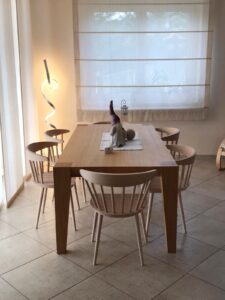 Before kitchens, wardrobes and custom-made furnishings there were chairs. And there was a man who, to build them, went directly to people’s homes. He was Vittorio, Martina De Cian’s great-grandfather, the first chapter of a family history that still has its center in Villetta, in Garfagnana. At the time there was no showroom, nor a company in the sense we know it today. There was a small artisan workshop and a direct relationship with those who needed a piece of furniture, a chair, something that would serve their home. A patient work, made of wood and hands, which over the years would grow together with the family.
Grandfather Saverio then took up the baton, who continued to carry on the tradition, until the next generation was passed on. It was Maurizio, Martina’s father, and her uncle Vittorio who continued the path in Villetta, progressively expanding the work. The small workshop began to deal with more complex projects, until the opening, between 1990 and 1991, of the factory that still houses the carpentry and the historic showroom. The kitchens progressively became the heart of production, then came the other rooms of the house: living area, sleeping area, bathroom. In 2011 the story was enriched with another chapter, with the opening of the Gallicano showroom. It was here that Martina, as soon as she finished school, entered the family business, together with her brother Michele and cousin Matteo. Today, Martina is primarily responsible for the Gallicano showroom, while Maurizio is mainly based in Villetta, where he continues to closely oversee the work and production. Four generations, therefore, and a story that continues to grow while maintaining its link with the place where it all began. Garfagnana is a land where wood has never been just a material. It has been a resource, an element of the landscape, a daily presence. For De Cian family, the link with this material has become a form of belonging over time. Chestnut, traditionally linked to the territory, continues to be used, but today other essences such as oak, alder and Canaletto walnut enter the projects following changing tastes and sensibilities. “Garfagnana has perhaps given us more of a love for wood and the input of creating wooden furniture,” says Martina. And also a style that, although it has evolved, retains something immediately recognizable.
Then there is another form of link with the territory, perhaps even more suggestive: the recovery of wood. It can be an old chestnut board, a beam, a door that has been part of a house. Materials that could be destined to be discarded and instead find a second life by becoming a new table or a new piece of furniture. It has happened that it is the owners themselves who bring old boards to the carpentry shop asking to transform them into a table. “You still bring a piece of history into your home,” says Martina. And there is an inevitable consequence: no table can be the same as another, because no table has exactly the same story. This is perhaps the most interesting feature of De Cian’s way of working: the idea that a piece of furniture can be designed around a person and not simply chosen from a series of pre-defined possibilities.
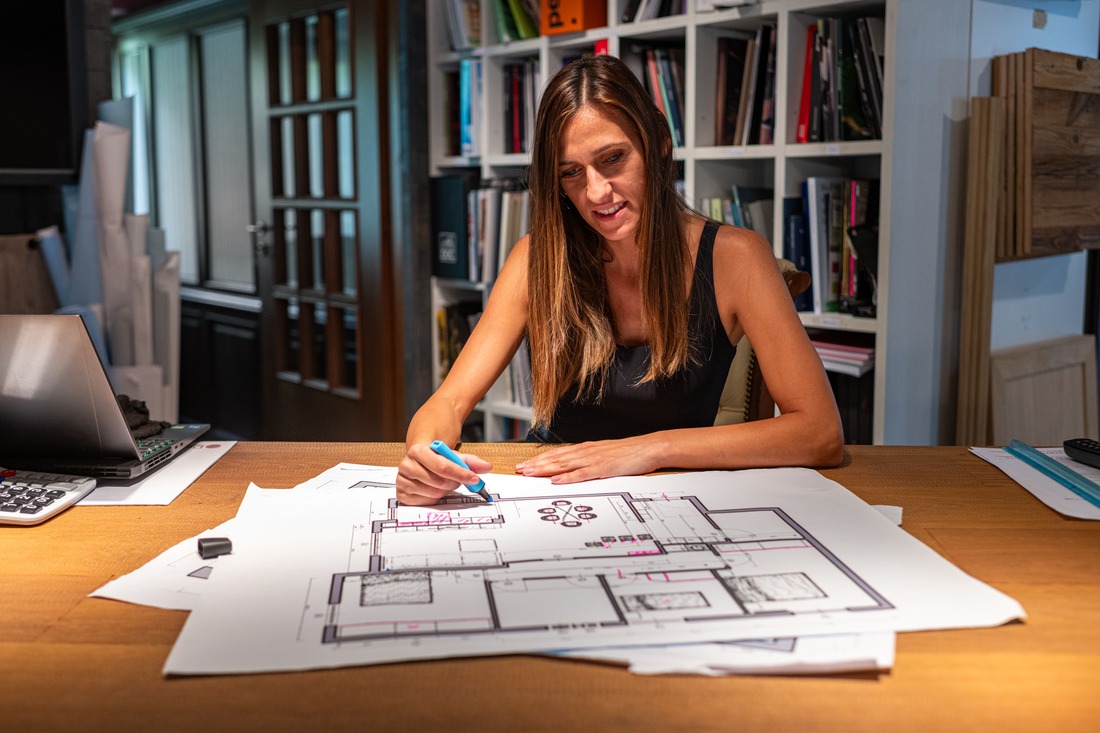
Every project begins by listening. From the measurements of a room, of course, but also from the way in which that room is experienced. You can start from a sketch, from an idea, from a very concrete need. Then the project takes shape, is studied, designed and finally passes to carpentry work.
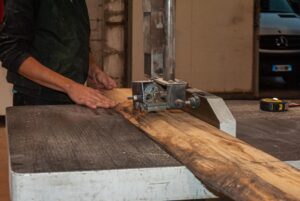
Here, technology has changed the tools, but it has not erased knowledge. Numerical control machinery today allows a precision that once would have been unthinkable; however, the work remains linked to the knowledge of the material and the possibility of intervening on the project, modifying it, adapting it. This is how a tradition can continue without remaining stuck in the past.
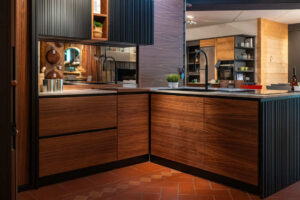
Homes, after all, also tell the story of change. The rustic kitchen that was once almost the norm today gives way to more modern lines, open spaces, islands and peninsulas and increasingly personalized solutions are sought. Organized pantries, solutions to take advantage of every centimetre, larger and extendable tables, walk-in closets and wardrobes designed to adapt to increasingly compact rooms.
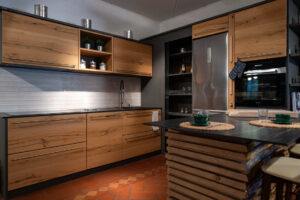
But there is one aspect that, listening to Martina, seems to cross the entire history of the company more than fashions and transformations: the relationship with people. When we ask her to describe the soul of De Cian, she speaks of a family environment, of hospitality, of the possibility of creating a relationship that goes beyond the moment in which a piece of furniture is delivered. “Let’s become friends,” she says. And it’s not just a figure of speech: some continue to make themselves heard even after twenty years. Perhaps this is precisely the meaning of a story that has reached the fourth generation. Not only having preserved a business but having preserved a way of being inside one’s work. Martina’s great-grandfather built chairs and went to people’s homes. Today De Cian designs and builds entire environments, has modern technologies and two showrooms. Yet, entering the historic headquarters in Villetta, that distance seems to be shortening. The wood is still there. And with it the idea, simple and far from obvious, that a house can tell the story of those who live in it. Not through something already seen, but through objects designed for that space, for those people, for that story. A story that, for four generations, has continued to take shape in wood.
Info: Arredamenti De Cian
Showroom: Via Fondovalle, Gallicano – Lucca
Showroom e falegnameria: Via Stazione, Villetta San Romano in Garfagnana – Lucca
Tel.: 379 275 85 80 / info@decian.it / www.decian.it