By Paolo Sebastiani
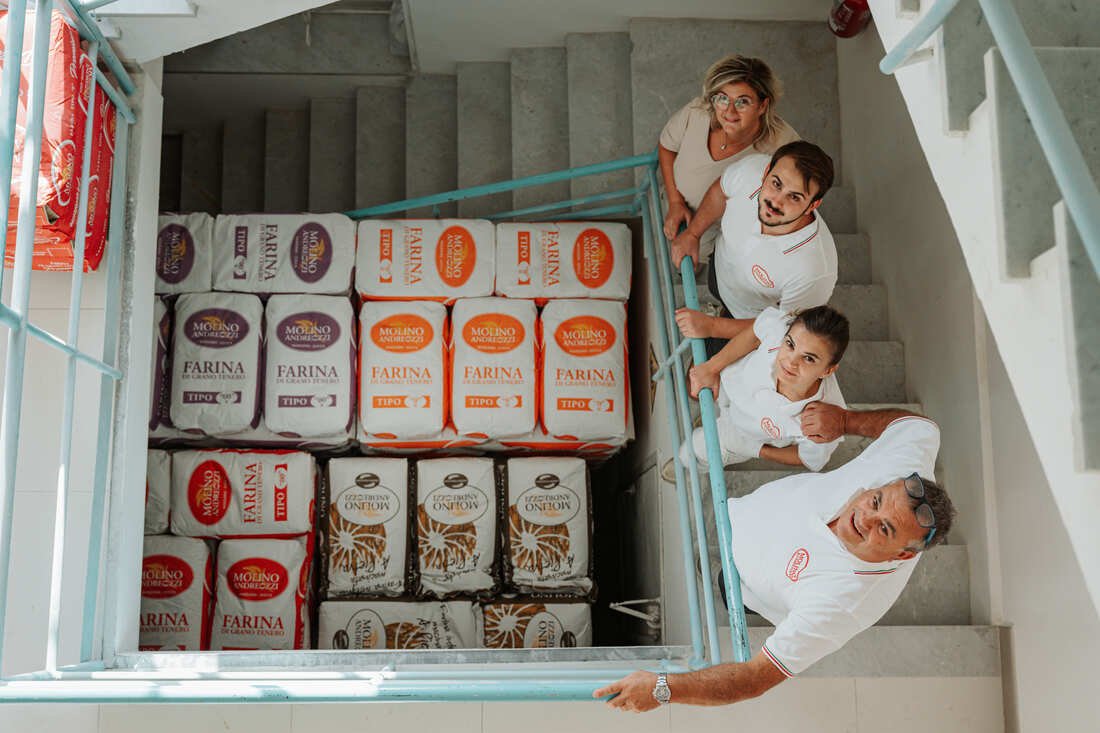
From the old mill in Balbano to a modern plant, the history of the Andreozzi family goes through more than a century and a half of transformations. Today Valter, Manola, Giada and Giorgio continue to build it together, with an eye to the future.
 First there was the sound of water. The wheel of the old mill in Balbano turned following the current and around that sound the story of the Andreozzi family began. A story that has its roots at least in 1850, a date reported on a lithograph of the old mill found years ago, and which since then has gone through generations, wars, technological transformations and moments in which continuing seemed anything but obvious. Today the noise is that of machines. But the thread that unites past and present has remained the same: a family working together.
Valter joined the mill as a boy, in 1977, when he was still attending school. He did it together with his brothers, learning a job that, as often happened then, was learned above all by being close to those who already knew him. His father Adriano had carried on the business after the previous generation, also going through the epochal transition from the power of water to electricity. The old mill in Balbano belonged to a world in which flour was first and foremost a necessity. The real turning point came at the end of the nineties. In 1998 Valter’s father died, the following year his mother, but the family decided to move on.
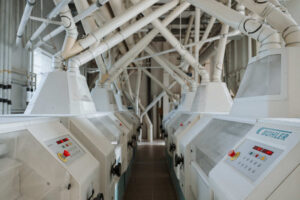
In 2000 Valter, together with his brothers, began an important phase of modernization. He went to Milan, to the Ipack-Ima fair, and from there the idea of buying new machinery was born. New plants arrived, new technologies and a modernization process began that would continue in the following years. Between 2009 and 2011 a second major intervention arrived, with new technologically very advanced Buhler rolling mills. It was necessary to change in order to continue. But without losing what made that mill a family business. Manola also entered this new phase, who took over the administrative part in 2005. Her presence marked another important step: the mill was no longer just the job inherited from the previous generation, but a business to be rethought and built day after day together.
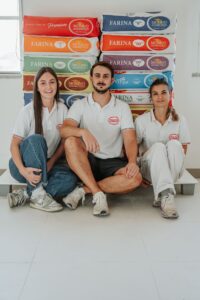
Then came the children. Giada, after her studies and a first work experience, chose to return to the mill not out of obligation, but out of conviction. “It was a personal choice. We really believed in it. We have passion,” she says. Giorgio, on the other hand, practically grew up inside the mill. His memories begin there, among the bags and the noise of the machines: as a child he saw his parents working and already imagined his future in that place. After finishing school, he attended training courses for millers in Switzerland, thus deepening the skills necessary for working in the mill. Two different paths, therefore, which both led to the same choice. And today everyone has their own role. Giada follows the laboratory and quality control, as well as the relationship with the wheat. Giorgio takes care of production and sales. Manola follows the administration, together with Chiara, Giorgio’s partner. Valter continues to be a central presence, with almost fifty years spent inside the mill. It is precisely this division of tasks, together with the possibility of confronting each other every day, that makes the family dimension of the business concrete.
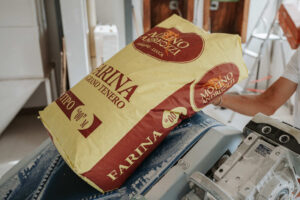
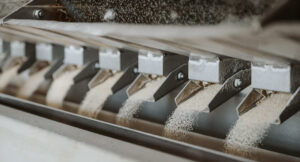
In the meantime, what arrives in the bags has also changed. Once there were mainly two or three flours; today there are many more and they meet much more articulated needs, also following the new demands of consumers. All are produced with top quality grains chosen with care and passion. The mill has chosen to maintain a stone mill for the processing of wholemeal, but much of the process takes place through modern systems and control systems. The wheat is analyzed, cleaned and subjected to checks before milling. A combination that the Andreozzi family summarizes in a simple way: the safety and precision of technology together with the possibility of maintaining a direct relationship with the product and with those who use it.
Customers also tell the story of the mill. Not large numbers concentrated in a few relationships, but many small artisans, bakers and professionals, each with their own needs. “We don’t have a hundred big customers. We have a thousand, very small ones. Each with its own needs, each with its own character.” It is a dimension that requires presence, constancy and attention. And perhaps it explains why, despite technological evolution, the word family continues to have such an important weight.
The story of the Andreozzis, however, does not stop at Valter, Manola, Giada and Giorgio. Giada has a son, Alberto, eleven years old, who also grew up inside the mill. “When he was a child he used to put himself on sacks. He was born with the noise of the mill.”
No one yet knows which path Alberto will choose. And perhaps this is not even the point. From the old mill in Balbano to today’s, the machines, techniques, flours and people’s needs have changed. What has remained is the ability of a family to go through change without losing its link with work.
First it was the sound of water. Today it is the modern rolling mills and plants. Tomorrow it will be another sound.
The story of Molino Andreozzi, meanwhile, continues.
Info: Molino Andreozzi, Via di Balbano, 896 – Balbano (LuU) / Tel. 0583 548026 / www.molinoandreozzi.com / info@molinoandreozzi.com