By Paola Butera
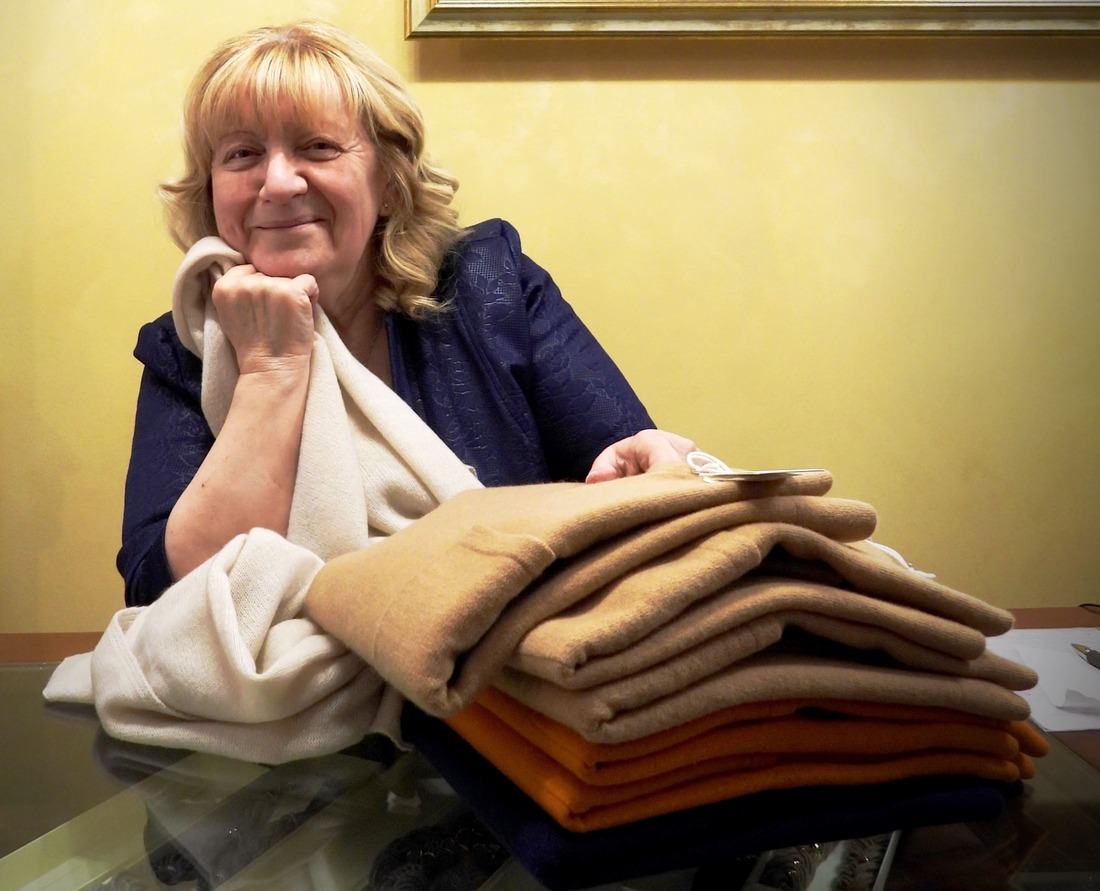
There is a unique atmosphere in Maria Contigiani’s workshop: a mix of the colors of precious yarns and a creativity that never rests. Sitting among spools of cashmere and cutting-edge machinery, Maria exudes a contagious energy. Hers is not just a company; it is a laboratory of ideas where Umbrian tradition constantly challenges modernity. A woman with a brilliant mind and an untiring innovator, Maria has made “doing things well” her life’s mission. I asked her to tell me how she managed to transfer the soul of Gualdo Tadino into a precious thread.
What is your first memory related to wool?
My first tactile memory dates back to when I was four years old in my hometown Loro Piceno in the province of Macerata. I remember being captivated watching a neighbor crochet. One day I asked her, “Can I try?” She was skeptical given my age, but she was stunned to see how naturally I started my first chain stitch. From then on, I never stopped: double crochet, single crochet… it was a primal instinct.
By age six, thanks to my mother, I already knew how to use knitting needles. While I was learning the alphabet at school, I was making my first knit-and-purl t-shirt at home. My mother passed down a technique that is difficult for everyone at first: the purl stitch. While it was an insurmountable obstacle for many, it became familiar to me immediately.
At thirteen, after finishing middle school, she encouraged me to “learn the trade” by sending me to a lady who owned a knitting machine. In an era
when mass-produced ready-to-wear didn’t yet exist, I learned instantaneously; it felt as if my hands already knew those mechanical movements. Seeing my enthusiasm, we bought my first machine: a Swiss Dubied. That was the turning point. I began collaborating with a representative from Macerata who provided me with wool and patterns on behalf of large companies. At sixteen, however, came my true “school” of knitwear: a company working for Luisa Spagnoli. There, I learned the meaning of millimeter precision: measurements, finishing touches, quality control. If you wanted to learn to work “well,” that was the place to be.
Later, I bought a second machine to produce beanies and balaclavas, items that were in high demand in the Macerata area at the time. My mother joined me, alternating hard work in the fields with her passion for knitting. Then came marriage and the move to Gualdo Tadino. I brought the two machines my parents had bought with me. I still remember a sweater I made for my husband over forty years ago: the seams are still invisible and perfect today. The real entrepreneurial breakthrough happened in ’87. During a period when my husband was facing a work crisis, I decided to take the big step: I registered as an artisan and opened my first workshop. It was a small space, often overrun by the chaos of my young children playing among the machinery, but it was the official start of my story and that of my children, who now work in the family business and have contributed to its technological development.
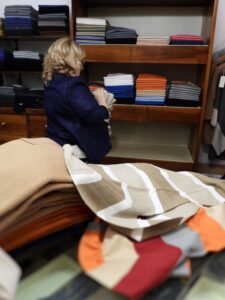 The market is often dominated by industrial logic. How has your sensibility as a woman influenced your choices?
My philosophy can be summed up in one obsession: things must be done well. The economic value doesn’t matter; whether I am paid ten or a hundred euros, the commitment and quality control remain identical. As a woman, I had to face daily skepticism from executives of large firms, but I always let my work do the talking. Since 1987, we have worked for the biggest names in fashion: from Cucinelli to Prada, and Fedeli. My sensibility lies in preferring a “good” product—controlled and cared for—over the logic of high volume.
How was your brand born?
About twenty years ago, thanks to a regional grant for small artisans. We started with some trade fairs in Düsseldorf and then in Florence, where we caught the eye of a Japanese buyer. He was so impressed by the collection that he ordered three hundred garments: a huge number for us back then. That encounter took me to Japan in 2004 to present the pieces. The client wanted to show his audience the face and the hands of the person creating those sweaters in Italy. It was the trip of a lifetime, an immense recognition.
Who is the typical Maria Contigiani Cashmere customer today?
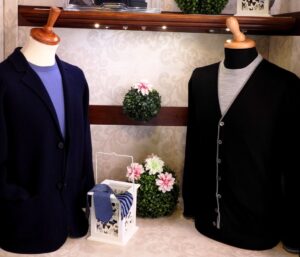
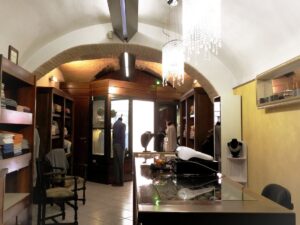
About ten years ago, we opened our Atelier in the center of Gualdo Tadino, and various customers come there—some just passing through, but they remain loyal. I would define our target as “Sporty Chic.” We cater to women looking for a refined garment, away from flashy logos. Also to men looking for a timeless classic, like a crew neck or a V-neck in cashmere or merino made to perfection, who prefer to buy from an artisanal producer rather than from big designer labels.
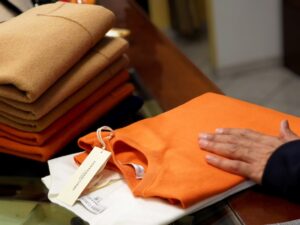
We only use noble yarns: cashmere, extra-fine merino, silk, cotton, and linen. Furthermore, every one of our sweaters carries a small treasure: a sample of the original yarn attached to the tag. It is an invitation we extend to every customer: “Keep it.” We are among the few to offer a dedicated repair service: should the garment suffer a small tear or accidental wear, we welcome it back to the workshop. Thanks to the original yarn and our technical expertise, we restore the sweater to its original beauty. This is an exclusive service, available both in the boutique and via shipping, because a high-quality garment deserves to be eternal.
In an ancient trade, how do technology and manual craftsmanship coexist?
Technology is fundamental; it allows for craftsmanship that was unthinkable in the past. However, innovation must rest on a foundation: the structure of a sweater, the armholes, the proportions all derive from handiwork. If you know the basics, technology becomes a powerful ally.
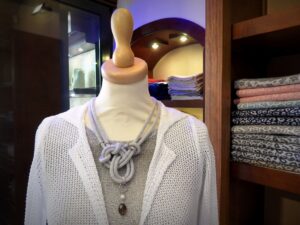
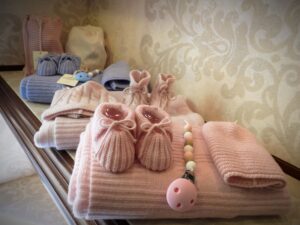
But creative recycling is also important. For us, cashmere is a precious, almost sacred raw material that allows for no waste. From this deep ethic of sustainability comes our line of accessories and micro-creations: scarves, gloves, hats, and a line dedicated to children, made with the same care as our main garments. Then there is a personal whim of mine: Necklaces born from a careful study that reinterprets the aesthetic of macramé. But unlike common nylon versions, we create our “rope” starting from a single strand of cashmere. Through complex steps and multi-ply processing (up to ten threads), we transform leftovers into luxury tubulars and cords, which are then strictly hand-woven.
It’s not just recovery; it’s conscious design. Every gram of yarn is elevated to give life to unique artifacts where artisanal technique meets respect for resources. Technology today also helps us communicate: you can have the most beautiful product in the world, but if you remain invisible, you won’t survive.
Finally, what advice would you give to a young woman who dreams of opening an artisan shop?
The most difficult thread to hold onto is the balance between private life and business. I was lucky enough to be able to work from home, managing my time between family and knitting needles, often late into the night. When I think about where I’ve come from and how many sacrifices I’ve made… Last year, I received the ‘Umbria in Rosa’ award from the Province of Perugia for transforming knitwear into a language of elegance and identity. With my brand, entirely Made in Umbria, I have been able to preserve and renew the tradition of cashmere. My advice to young women today is: “Learn the trade.” You cannot improvise. Opening a business today requires solid competence, patience, and fierce determination. Mastery of the technique is the foundation of every success.
Info: Maria Contigiani Cashmere – Corso Italia,12 Gualdo Tadino (PG) – www.mariacontigiani.it