By Our Editorial Staff
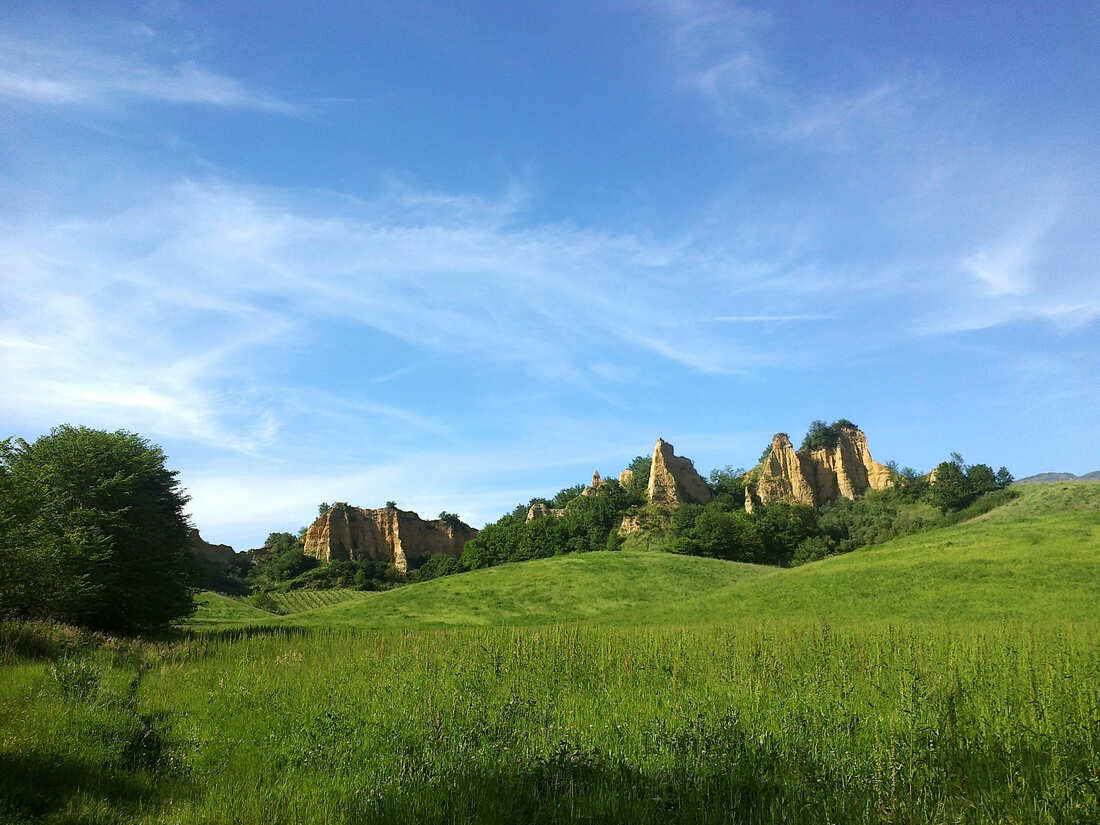
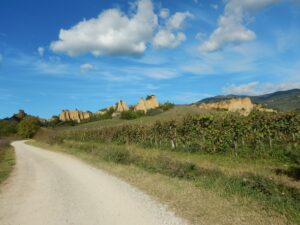
“Our territory has many unique features, stretching from the Balze cliffs to the Pratomagno mountain, passing through the scenic Setteponti road, allowing you to discover wonders and beauties such as the Tower of Arnolfo di Cambio and the Abbey of Soffena in Castelfranco, the Romanesque church of Piandiscò, the fields of irises in bloom, the Balze trail, the popular and religious festivals in our squares, and the culinary specialities of our traditional restaurants and farmhouses. Nature trails and paths are waiting to be explored and enjoyed, such as the Acqua Zolfina trail. Relaxation, walks and good food await you!”
Books, Municipality & Exhibition Space
“Furthermore, the Municipal Administration, aware of the cultural and social value of art, promotes local talent through its literary initiatives, offering dedicated public spaces for exhibitions and literary events”.
Wanda Capodaglio National Competition
“The Municipal Administration also hosts the Wanda Capodaglio National Competition, promoted by the Wanda Capodaglio Association and dedicated to young talents in Italian theatre.
The competition, which honours the legacy of the renowned actress and theatre teacher, represents a valuable opportunity for young performers to express their talent and engage with the tradition of Italian theatre”.
Antonella Grassi
Councillor for Culture and Tourism of the Municipality of Castelfranco Piandiscò
 Iris Festival
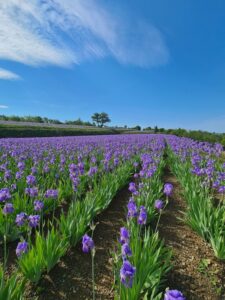
On Saturday 9 and Sunday 10 May 2026, the second edition of the Iris Festival will take place on the lawn of the Abbey of S. Salvatore in Soffena, Castelfranco di Sopra, in the municipality of Castelfranco Piandiscò.
The cultivation of irises (Iris pallida) is one of the traditional agricultural activities of this land and involves entire families. In May, you can walk alongside expanses of purple flowers and, along the Setteponti road, in Grania, Castelfranco di Sopra, you can find the Cooperativa Toscana Giaggiolo, which brings together over 200 producers and was the first in Italy to use a distiller to produce the prized iris butter. It is a pleasure to linger among the small fields and terraced slopes that climb up towards the hamlets of Caspri and Pulicciano, witnessing the continuation of an ancient local agricultural tradition.
Programme
SATURDAY 9 MAY
– 9:00 am Opening of the event
– Trekking “Iris Walk”
– From 10:00 am to 11:00 pm children’s play areas with educational wooden playground equipment, painting workshops on canvas open to all, comedy theatre performances, iris market and exhibition stands, food stalls
– Guided tours of the Abbey of San Salvatore in Soffena
– Opening of the photography exhibition, painting exhibition inspired by irises and display of school competition works
– Concert on the lawn of the splendid Abbey of San Salvatore in Soffena
 SUNDAY 10 MAY
– From 9:00 am to 11:00 pm children’s play areas with educational wooden playground equipment, painting workshops on canvas open to all, comedy theatre performances
– Opening of the photography exhibition, painting exhibition inspired by irises and display of school competition works
– Award ceremony of the project with the Don Lorenzo Milani Comprehensive Institute
– Guided tours of the Abbey of San Salvatore in Soffena
– Iris Symposium (Conference): “The Value of Sustainability”
– Concert on the lawn of the splendid Abbey of San Salvatore in Soffena
– 11:00 pm Acknowledgements and closing of the event
What to look for in… Castelfranco
In 1299, Florence decided to found another town on a hill along the pilgrimage route now known as Setteponti, as a bulwark against the hostile Arezzo. To attract settlers, they were guaranteed ten years’ tax exemption as well as land on which to build their homes. In return, however, the inhabitants had to construct the town walls. From the almost square Piazza of the so called “Terranuova“, with its coat-of-arms-adorned town hall, the main streets radiate out at right angles, much like a Roman castrum. The old town centre is remarkably well-preserved, which has earned it the distinction of being named ‘one of the most beautiful villages in Italy’.
Abbey of San Salvatore in Soffena
Just outside the village, the complex comprises the church, the cloister and the monastery. The abbey is first mentioned in a document dating from 1014. In 1090, by a papal bull issued by Pope Urban II, it was entrusted to the Vallombrosan monks along with other properties. Etruscan and Lombard remains attest to a long tradition – indeed, the place name Soffena is Etruscan.
Worth seeing are fragments of 15th-century frescoes inside the church, including works by Giovanni di Ser Giovanni, known as ‘lo scheggia’, the brother of Masaccio, and by Pariotto di Cristofano, his brother-in-law. Open Monday (2nd and 4th oft he month closed), Wednesday, Friday from 2.15 pm – 6.45 pm, Tuesday, Thursday from 9.15 am – 1.45 pm, 1st and 3rd Saturday from 9.15 am – 1.45 pm, 2nd and 4th Saturday from 9.15 am – 12.45 pm, 2nd and 4th Sunday from 8.15 am – 1.45 pm, free entrance.
Church of St Thomas
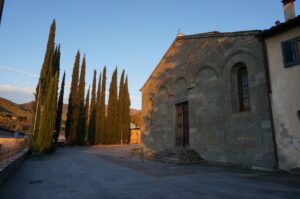
Built at the same time as Castelfranco, it was extended in the 17th and 18th centuries and restored in 1932. Little remains of the original building; even the elegant portico is a reconstruction dating from 1755. On the gabled façade with a central medallion stands the fine 18th-century portal leading into the single nave, covered by wooden trusses and ending in a chancel with a dome. The bell tower, erected in 1882, replaced the older bell gable. The interior, comprising a single nave, preserves numerous 17th- and 18th-century furnishings.
Church of St Philip
Dedicated to St Philip Neri, a native of Castelfranco who was canonised in 1621, the church was built in 1631. The elegant Baroque façade is constructed of sandstone, featuring plaster panels and four pilasters. The three-nave interior features a dome-covered chancel, accessed via a large triumphal arch resting on fluted pilasters and Corinthian capitals. Above the high altar hangs Matteo Rosselli’s The Ecstasy of St Philip Neri (1640).
Arnolfo’s Tower and the ancient walls
Castelfranco, one of the Terre Nuove of the Florentine countryside, was designed by the great medieval architect Arnolfo di Cambio, a native of Colle Val d’Elsa. For the Florentine Republic, the tower-also known as Porta Campana—was intended as the symbol of the town and was built on the side facing Florence. Part of the ancient walls is still preserved today, offering a pleasant walk through the historic centre.
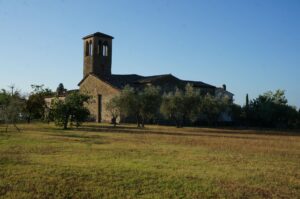
Town Hall
The Town Hall, or Palazzo del Podestà, dates back to the time of Castelfranco’s foundation and was built to house the town council, the captain of the league and, subsequently, the podestà. The façade features the surviving coats of arms of the successive podestà, as well as inscriptions commemorating specific events. The figure of Saint Philip Neri was painted in a niche on the façade around 1717 by the Florentine painter Nicoló Pintucci.
What to look for in… Piandiscò
The village, with its thousand-year-old parish church, lies at an altitude of 350 metres. Mills were built along the little river Resco, which is why the village still winds its way down the valley today.
Parish Church of Santa Maria a Sco’
The church stands at the top of the village, turning its back to the Setteponti road. Its three apses and slender bell tower welcome visitors with harmonious simplicity. The earliest record of the church dates back to 12 March 1008. The façade, overlooking the valley, is defined by five arches supported by tall pilaster strips. Inside, the atmosphere is simple and pure: soft light filters through the mullioned windows, enhancing its sober elegance. The columns are also decorated with motifs inspired by rural life and nature. A fresco depicting the Madonna and Child is attributed to the painter Paolo Schiavo.
Chapel of Casabiondo
The Chapel of the Immaculate Conception is a religious building in Casabiondo, a hamlet situated above the village of Piandiscò. First mentioned in Renaissance times, it was renovated at the end of the 17th century in a Baroque style which, although restrained and derived from the late Mannerist period, is rather rare in Tuscany.
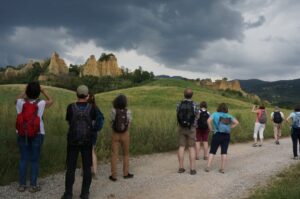
The Pratomagno mountains towards Gastra and Poggio alla Regina
Piandiscò and Castelfranco offer access to the Pratomagno mountain via paths marked in red and white by the trekkiong association CAI. From Casabiondo, a dirt track leads towards Gastra and another to the ruins of an ancient medieval castle, Poggio alla Regina.
What to look for in…Faella
In the 13th century, the church of San Michele and a castle stood on a hill near the present-day village. No visible trace of these buildings remains today. The village itself, known as ‘Failla’ or ‘Favilla’, was originally situated in the upper part of the Faella stream valley, on the steep and rugged cliffs calles „balze“. In the centuries that followed, the village came under Florentine rule. On 27 July 1944, Faella was severely damaged. To slow the advance of the Allied forces, German troops blew up buildings, roads and bridges. Much of the village’s historic built heritage was thus destroyed.
Church of Santa Maria
The first official records of the Church of Santa Maria date back to 1260 and are found in the Book of Montaperti, an official document that bears witness to the war between the Guelphs and the Ghibellines at that time. Over the centuries, the church has undergone various alterations, including a radical renovation in the 18th century.
Horse Race
The identity of the people of Faella is deeply rooted in the Horse Race, traditionally held in July during the patron saint celebrations in honour of San Vitalissimo. The race has taken place since 1858.
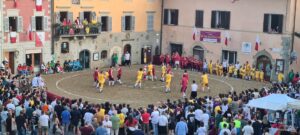
Ring Game
on 26–27–28 June 2026
The “Ring Game” is a medieval historical re-enactment held in the main square of the historic centre of Castelfranco di Sopra, in the municipality of Castelfranco Piandiscò. The event was created in 2019 through the initiative of a group of local residents and young people. The game draws inspiration from the historic Florentine Calcio Storico as well as other traditional Tuscan games. It combines elements of rugby and basketball and features a competition between the town’s four gates: Porta Aretina, Porta Buia, Porta Campana and Porta Montanina. Each team, made up of seven players, competes on an 18 x 18 metre dirt field, aiming to pass the ball through a ring positioned three metres above the ground. Teams score points by successfully passing the ball through the ring, with matches played over two halves of 20 minutes each. The setting is particularly striking, with the Palazzo Comunale—featuring an eighteenth-century fresco of the patron saint San Filippo Neri—overlooking the field, along with the central Piazza Vittorio Emanuele.
This vibrant tradition actively involves the entire community, beginning with the medieval costume parade through the streets of the town, which sees many young people engaged throughout the year.