By Our Editorial Staff
Two different ways of crossing a place that never stops surprising you.
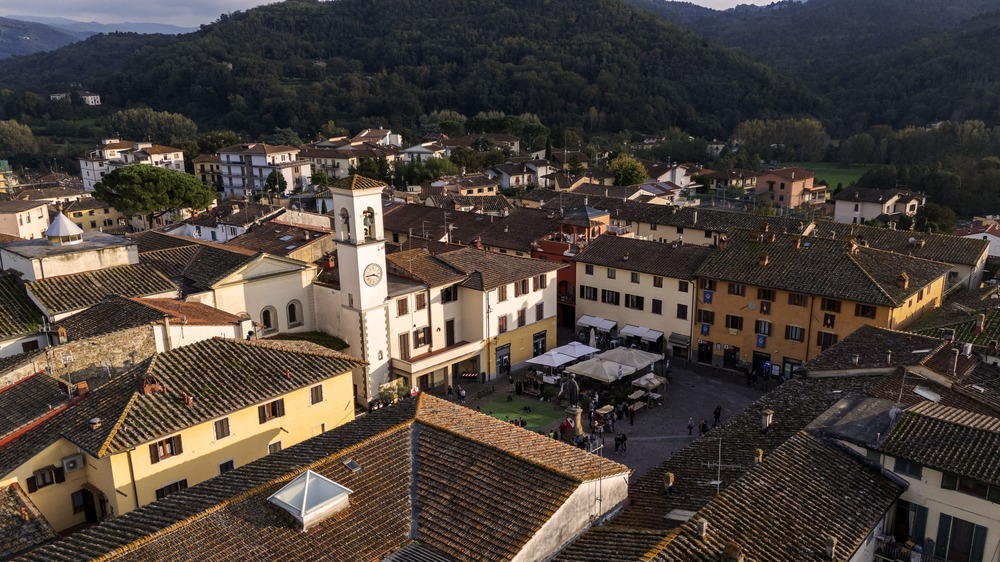
Vicchio is not the kind of place you rush through. It takes time.
Time to climb the trails of Monte Giovi on foot, to push the pedals along the panoramic roads cutting through the Mugello countryside, or to visit the places that gave birth to Giotto.
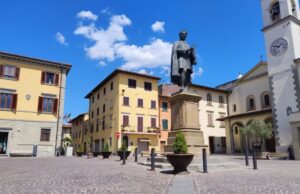
The climb worth making. The 25th Barbiana March — Saturday, May 23
Some journeys are not made only with your feet. They are made with your mind, with the questions you carry with you, with what you know and what you still do not.
On Saturday, May 23, for the twenty-fifth time, the road from Vicchio rises toward Barbiana: clinging to the slopes of Monte Giovi, about ten kilometres from the town, far from the speed of the rest of the world. A church, a small cemetery, a few scattered houses in the woods. And that school. That story.
Don Lorenzo Milani arrived here in December 1954. He remained for nearly thirteen yearsand taught the children of farmers that language is not a privilege, that knowledge is not a luxury, and that those who cannot read the world cannot change it. An uncomfortable voice, out of step with its time. And perhaps that is exactly why, seventy years later, it still echoes.
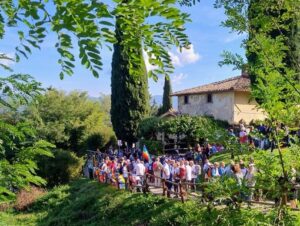
The March began in 2002. Since then, every year, people have retraced that climb not out of nostalgia, but out of necessity: because the questions Don Milani raised a public school open to all, inclusive, capable of forming citizens rather than subjects are not settled questions. Ifanything, they feel more urgent than ever.
The route is steep and quiet. Just as it should be. Reaching the top changes something, not in a dramatic way, but slowly. The landscape, the air, the pace that begins to soften. It is the kind of place where thinking comes naturally, where questions rise easily, where listeningfeels possible.
This year marks the twenty-fifth anniversary. A quarter of a century of shared steps, of civiccommitment renewed again and again.
Vicchio by bike: the countryside is yours
If the Barbiana March asks you to climb vertically, Vicchio by bike invites you to movehorizontally. To discover that same countryside you see from above while walking, this time from within.
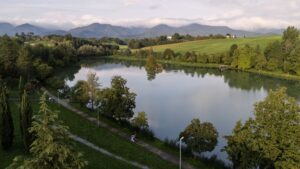
You set off from the town centre. The route runs along Lake Montelleri toward Gattaia, a small hamlet from which you take the panoramic road to Ronta, with a short gravel stretch that feels less like an obstacle and more like a rite of passage. Then you turn toward La Tomba and descend along the scenic road to Santa Maria a Vezzano. Here the landscapeopens into a countryside that holds every Tuscan cliché cypress trees, olive groves, hills thatroll gently into the distance.
Then comes Vespignano. And here it is worth stopping.
On this hill, Giotto was born the painter who changed the way Europe learned to see. Giotto’sHouse is not an ordinary museum: it is a place of experience, of artistic production, a spacethat does not simply preserve, but continues. On the other side of town, the Museum of Sacred Art and Popular Religiousness of Beato Angelico holds works of rare quality, in memory of the second great painter born here in Vicchio.
The full route is around 15 kilometres, with 450 metres of elevation gain: demanding enoughto feel real, never impossible. Those who want to go further can cross the SP551, reach the ancient Ponte di Cimabue, continue to Sagginale, and return to Vicchio following the Sieve River along the cycle path. A flat, slow ending that helps you take in everything you haveseen.
Vicchio works like this. It gives you something to do climb, ride, explore and in doing so, ittells you something about itself. And about you.
Info: Ufficio Informazioni Turistiche, Piazza della Vittoria n. 17 / Tel. 324 9070857 / prolocovicchio2016@gmail.com / www.comune.vicchio.fi.it