By Claudia Cencini
A journey to discover Truffleland, Urbani Tartufi’s mega-nursery for the production and sale of truffle seedlings, where truffle cultivation meets experimentation and technology.
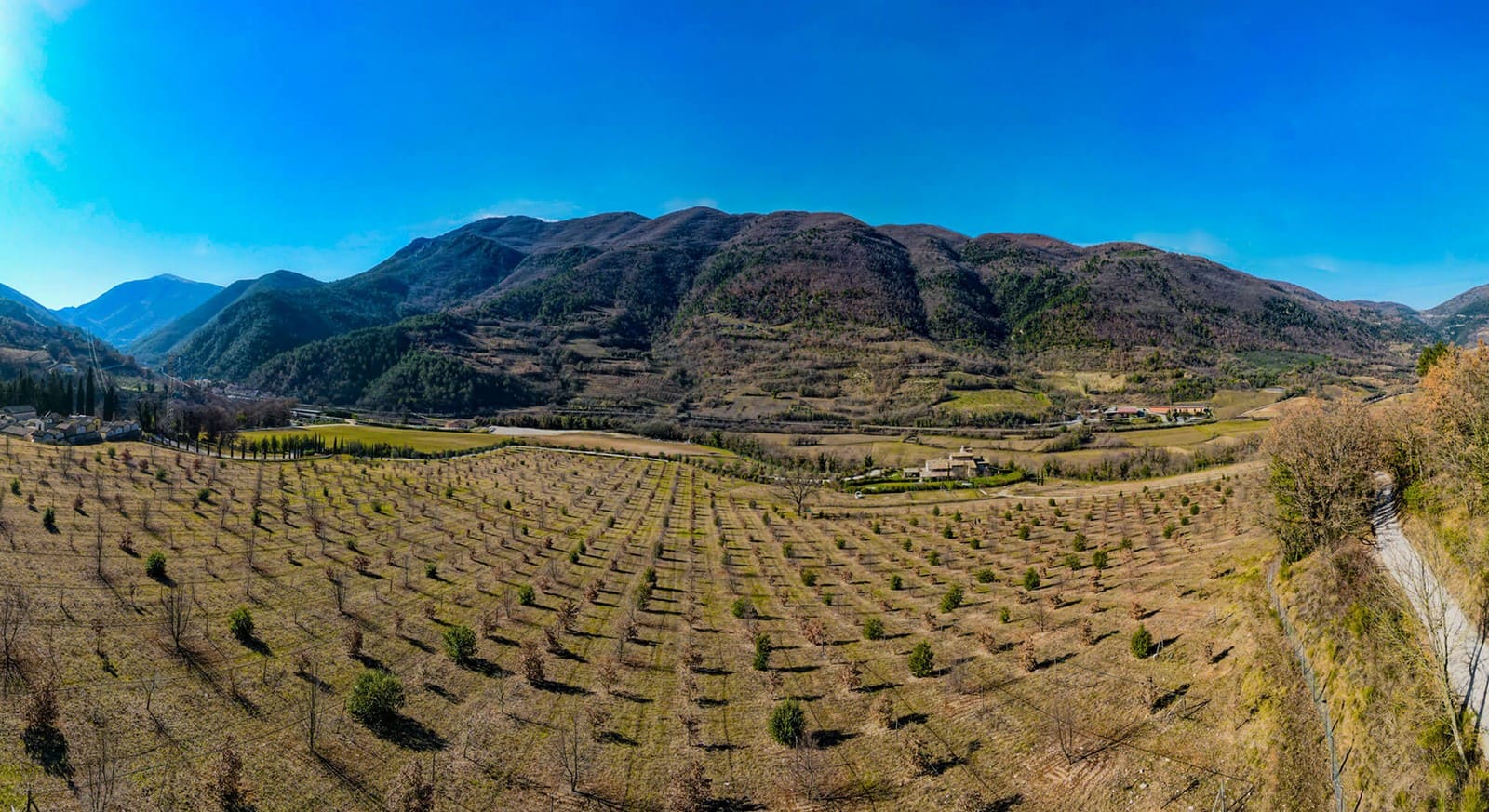
The truffle, long considered the “black gold” of Umbria, is not only harvested but can also be cultivated. To do so, however, one cannot simply wing it; instead, one must rely on the expertise and professionalism of experts with a proven and globally recognized track record. And who better than Urbani—a pioneer and leading brand for six generations in the global truffle market—to support those venturing into truffle cultivation for the first time? It was precisely with this goal in mind that, in 2017, Truffleland was born, a journey from seed to plant that begins in the soil and takes the form of a high-tech nursery based in Sant’Anatolia di Narco, just outside Scheggino, where not only are mycorrhizal seedlings cultivated to produce the truffles of the future, but research is conducted to develop, stay current, and achieve unparalleled leadership powered by cutting-edge technologies.
A young project, for young people
That’s how Francesco Loreti Urbani, co-founder of Truffleland, describes it: “This project was born out of the demand for Italian truffles. At a certain point, we realized it made no sense to import truffles when we have suitable land in Umbria and a climate naturally suited to their cultivation. Truffleland is the the right choice for anyone who wants to try their hand at this activity.
Fortunately, many young people are rediscovering agriculture today, thanks in part to incentives; with us, they can find hands-on guidance and assistance, starting with soil analysis. Not all soils, in fact, have the right composition for this type of cultivation; you need calcareous, aerated, and well-drained soils. Some are suited for the prized black truffle, others for the scorzone.
To give an example, our task is to study the soil composition to best advise those who want to embark on this path, which more often than not turns into a rewarding and profitable career.”
In Francesco’s words, one can sense not only his heartfelt commitment but also his enthusiasm and passion for carrying out a project that aims to revitalize Umbria and beyond, as Truffleland is present from north to south, both in terms of operations and landscape: “We’re breathing new life into abandoned land, this also helps reshape the landscape reclaiming plots that have sat idle for years; thanks to truffle plantations, they regain their luster and vitality. It would be wonderful to to rebuild on these foundations to create a habitat capable of attracting tourism and making Umbria—already a region beloved worldwide—a unique and evocative destination in this regard as well.” A winning idea that combines the pleasure of fine dining—where the truffle reigns supreme—with a full immersion in truffle plantations capable of offering unique and evocative natural scenery.

A “turnkey” business
What might prompt an aspiring truffle farmer to knock on Truffleland’s door? The answer lies in the history of a brand founded in 1852—a family-owned business that has remained true to its roots while climbing to the top of the world as an unrivaled network. Today, the Urbani supply chain holds a 67% market share, with sales soaring even overseas. The Truffleland team consists of professionals and technicians capable of providing the best advice to those who turn to them, offering sustainable business models that utilize consultants for the design of the truffle farm all the way through to the actual harvest, thanks to a copyrighted protocol of cultivation methods and specific techniques tailored to every type of truffle bed. In between lie phases of soil preparation, maintenance, and monitoring, during which the client is not left to fend for themselves but is guided in the selection and planting of seedlings, as well as supported through the subsequent steps up to the harvest. Keep in mind that it will take approximately five to six years for the plant to grow and bear fruit, but Truffleland’s role does not end there. This is where the Urbani supply chain comes into play, ready to purchase the cultivated truffles, with no binding commitments for the truffle grower, who, for their part, will have the privilege of selling the product directly to the brand that brought it to life.
Strength in Unity
Beyond its highly competitive commercial offer and the entrepreneurial expertise it has built up over nine years of operation, Truffleland is not a soulless shell but a “family” made up of people and essential values, which are conveyed to clients through the hospitality and expertise that have always defined the members of the supply chain.
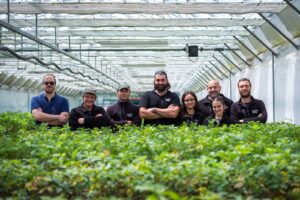
Over time, the core team has expanded to include individuals with specific roles, starting with the long-standing coordinator and project manager Riccardo Cesari, agronomist Riccardo Piantoni, and, on the operational side, Pietro Manna, a true jack-of-all-trades, supported by a close-knit group of young professionals comprising, first and foremost, Giada and Melissa, who manage the nursery, and operators Jaser and Giovanni, father and son, whose contributions are indispensable to the company’s success.
“Changing your life at 48 isn’t for everyone,” Pietro tells us, “but I did it and I don’t regret it. I’ve always had a passion for truffles, and now that I work at Truffleland, I’ve fulfilled my dream—I’m doing what I love and what brings me satisfaction. Of course, there’s work to be done, because farming doesn’t follow a calendar, but I don’t see it as a chore because it’s what I chose, and I feel fulfilled.”
 Mycorrhization: ever heard of it?
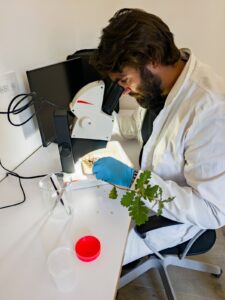
Mycorrhization is an overused term when discussing truffles, but not everyone knows its meaning, which lies at the heart of truffle terminology. To understand its meaning, it’s important to remember that the truffle is a fungus that develops spontaneously underground in contact with the roots of forest plants, such as holm oaks, oaks, hornbeams, and hazelnuts. To recreate the humus that nourishes their growth, the seedlings must be “mycorrhized” in nurseries and greenhouses before being transplanted into the soil that will host the future plantations.
As a rule, the seedlings treated by Truffleland leave the nursery fully mycorrhized. What does “mycorrhized” mean? Pietro Manna, a key figure who helped bring Truffleland’s vision to life, explains: “Bringing the spores into contact with the roots so that the spore germinates and creates the mycelium.” In some cases, certain seedlings may require a “drip feed” to recover from attacks by natural killers such as hypogeal fungi present in the soil, which can be aggressive during the initial planting phase. At this point, an innovative technique developed by Truffleland is employed, as explained by Luca Loreti Urbani, CEO of the agricultural company Srl: “To strengthen them, we perform spore inoculation, a highly effective treatment that involves introducing new spores using pre-sterilized limestone sand instead of sterile water, specifically to promote mycelium development.”
One of the advantages offered by Truffleland lies precisely in the guaranteed success of the truffle plantation, evidenced by the highest percentage of mycorrhization of seedlings on the European market in terms of fruiting spore concentration. Furthermore, those who walk through Truffleland’s doors do not find a mere supplier, but enter into a relationship with a solid and well-structured business: a wealth of expertise and experience that becomes concrete and reliable support for those who choose to embark on this exciting journey.
The Challenge of the White Truffle
So far, truffle cultivation has been limited to the prized black truffle, the bianchetto, and the summer truffle. The white truffle is missing from the list, but only for now, because Truffleland is already experimenting in the lab with the cultivation of Tuber Magnatum Pico. Although it is not yet possible to market seedlings for its cultivation, the company is confident it will soon be able once the seedlings’ productivity rates have been tested.
Truffleland’s laboratories are not stopping at this challenge; they are conducting a comprehensive study of the complex and fascinating world of truffles to optimize production. For example, they are working to understand why one plant produces truffles while another does not, and they are focusing on many other aspects that still need clarification to continually improve. The goal is to increasingly leverage the technology and digital innovation already extensively used in plant monitoring and in managing the microclimate best suited to their growth.
How much can it yield?
Growing truffles is no walk in the park, but over time it can prove to be a winning investment because the returns won’t be an illusion if you’re willing to learn the ropes and put yourself in the right hands. Once production begins, you can earn up to 30,000 euros per hectare annually for over twenty years, with minimal maintenance required for the land—less than what is needed for a simple wheat field.
As can be seen, those who choose the land—and, specifically, truffle cultivation—can count on more than satisfactory long-term returns, a trend that has not gone unnoticed given the growing interest shown especially by young people intent on hanging up their office or factory badges to rediscover themselves as aspiring truffle farmers. In this shift, Truffleland leads the way, establishing itself as a model of sustainable and responsible agriculture that yields results without harming or polluting the environment. It is no coincidence that its staff willingly assists newcomers seeking to change their lives or careers, as well as those truffle farmers who are already in the business but feel the need to take their work to the next level.
At Truffle School
Truffleland looks to young people with genuine confidence and tangible commitment, having formed a partnership with the Sant’Anatolia di Narco Agricultural Technical Institute, with which it organizes on-site internships for students who want to explore the world of truffles. And this is where the difference really shows. Let’s dispel the myth that young people can’t find work: if you have passion and a desire to learn, you can carve out a future for yourself. This is demonstrated by some of the young people who now work at Truffleland and who, after a school internship, decided to stay. Today they hold key positions and work under permanent contracts, proving that meritocracy, fortunately, isn’t always just an empty phrase. At least not at Truffleland.
Info: Truffleland, Loc. Fontegiana 1, S. Anatolia di Narco (Pg) / www.truffleland.com